

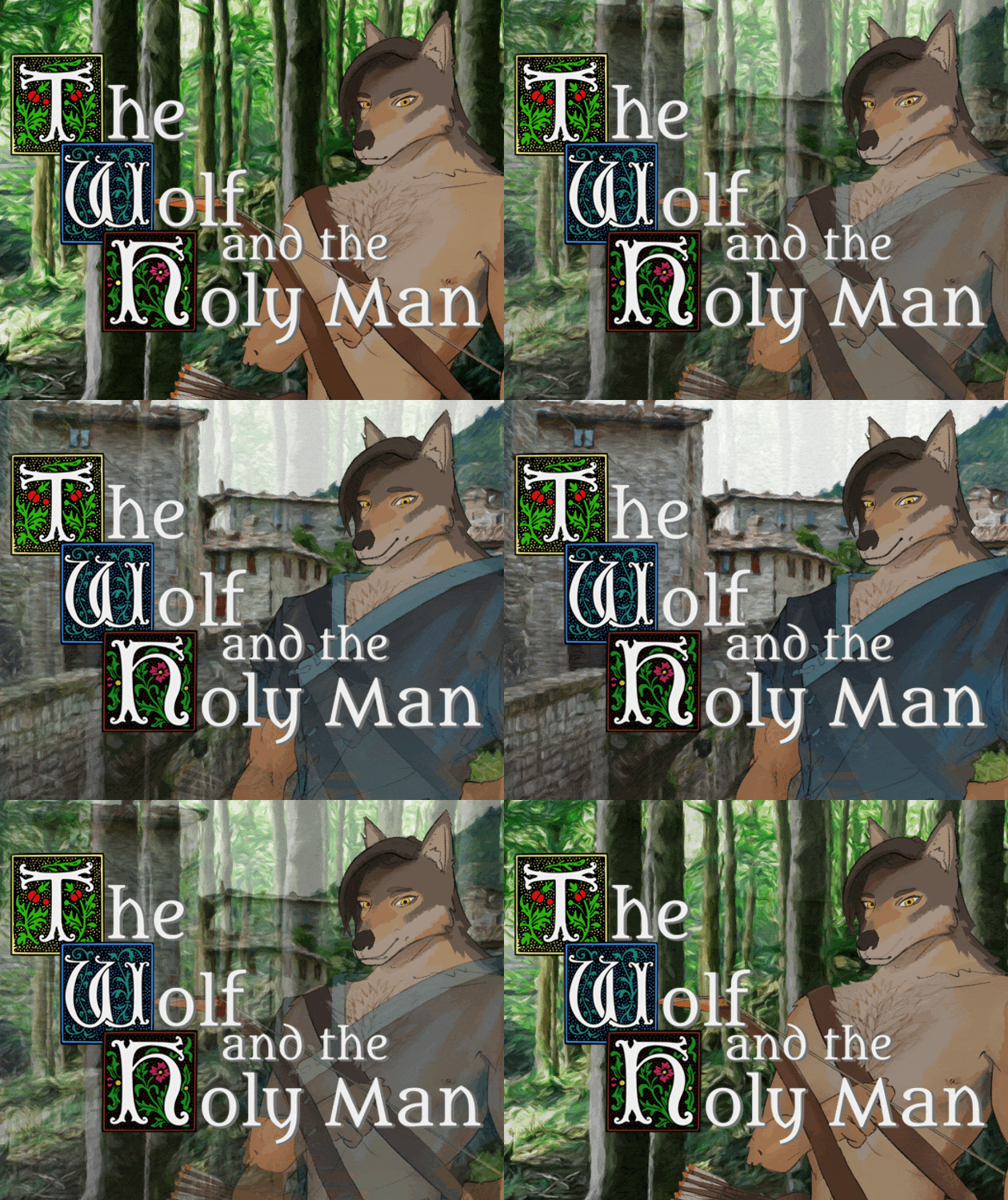
Play game
The Wolf and the Holy Man's itch.io pageResults
| Criteria | Rank | Score* | Raw Score |
| Implementation of Theme | #15 | 3.575 | 3.821 |
| Writing | #24 | 3.307 | 3.536 |
| Presentation | #31 | 3.140 | 3.357 |
| Story | #32 | 2.973 | 3.179 |
| Creativity | #35 | 2.873 | 3.071 |
Ranked from 28 ratings. Score is adjusted from raw score by the median number of ratings per game in the jam.
What is the name of your wolf/wolfess/wolves?
The Wolf (Nameless)
Leave a comment
Log in with itch.io to leave a comment.
Comments
Good use of the colored dialogue, the NVL mode, and the liberal use of music is much appreciated. The framing, the blurriness in the beginning, doesn't feel so far from our world. It says it is a fantasy story, but... the wolf feels really human. And the actual humans are bad, and hate change, oh, I wish the wolf made more friends while he could be friendly. He's a bit of a loner, isn't he? Actually, everyone hated him. No one went to bat for him, as soon as the priest left... see, that dreadful feeling...
The dread at the end is very real and very important. I understand others saying that it is dragging on by that point, but it's something that sticks to your skin or even your second skin.
Overall, it was a very pleasant read.
This really manages to read a lot like old christian stories. On the other hand, it reads a lot like old christian stories. I think it succeeds in doing what it set out to do, but I didn’t really vibe with the writing and subject matter. The folklore theme is quite apparent, first because the inspirations are mentionned in the credits, and second because the VN looks like folklore itself.
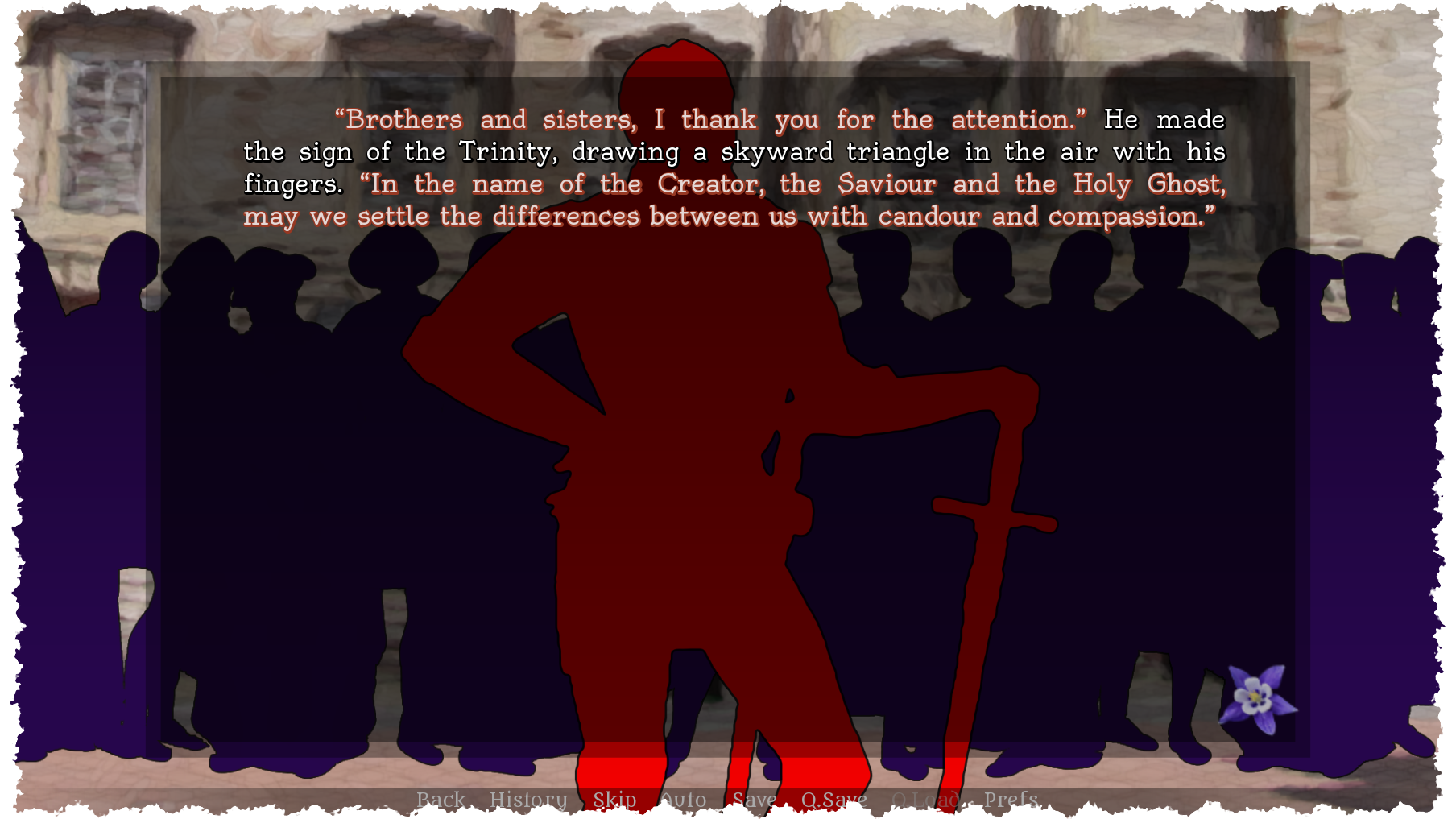
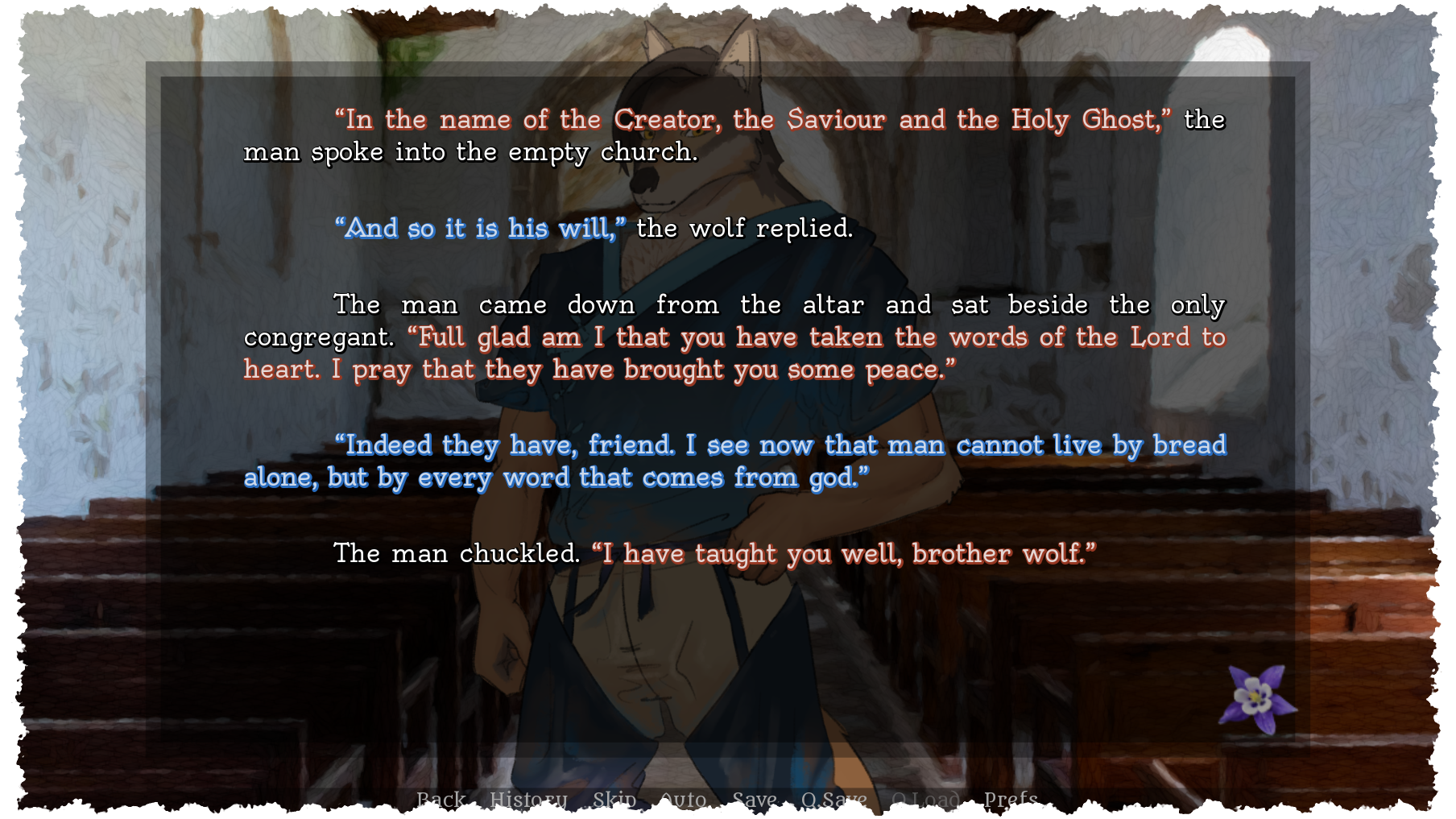
The NVL mode quite fit the story and was well implemented. I really liked the colored dialogue. The click-to-continue icon was maybe a bit too big and distracting. I liked how the present scenes are blurry to represent the MC’s declining vision. However, I fail to think of a reason for the guard in the past to only be a silhouette, oh well. The music and the background fit well.
Overall, it’s really well made and the problems I have with it are mostly very subjective. Great job!
This VN is incredibly unique, and I’ll have to agree with everyone else in that it’s very well-made technically - I think NVL mode is used well here, the UI and “filled in” sprites look great, and the music is incredibly pleasant to listen to. In general, this is quite a fun read.
I’ll also have to commend the VN on introducing me to Los Motivos del Lobo - I’m not christian, and I don’t have particularly fond feelings regarding Christianity, but it’s a pretty damn good poem, and I wouldn’t have learned of it without reading this.
In practice, the VN functions as an extended version of the poem, swapping out verses for the structure of a traditional novel, and with a new framing device to tie it all together - but I feel as though the VN’s additions wind up making the impact of it all dimish somewhat, without adding enough to bolster it in place of what the poem had to offer.
The main element that stands out to me is with the decision to turn the wolf into a more humanlike figure - within the poem, the wolf is pure - untainted by humanity - and Francis’ taming of the wolf and its integration into society is its first exposure to humanity and the village’s sins. The wolf functions as a foil to the humans of the village - its natural instincts to hunt, devour, and terrorize the village (which is something that is absent from this work - the wolf in the poem killed a whole lot of people) are shown to be no more evil than the sins of humanity - which is why it eventually chooses to abandon them and return to nature.
Within the VN, however, the wolf is, effectively, human as well. Someone from a different, mysterious culture - and someone who is perhaps even more of an outsider than a wolf would be, given how an ordinary wolf could just be considered a dog - but a human nonetheless. The story becomes one about a queer foreigner converting to Christianity and eventually being ostracized from the village due to his stricter adhesion to its rules than the rest of the villagers.
Of course, this criticism operates under the (presumably incorrect) assumption that the VN wants to just adapt the poem - but, at least in my eyes, it also doesn’t vary things up enough to make its changes and additions work well. It feels as though, in spite of expanding on the original, the story mostly adheres to it in tone - and its additions don’t flesh it out, as much as they just change the format of the narrative.
This forms a sort of dissonance - where the narrative of the original and the narrative formed by the changes to the story clash, neither really reaching their full potential due to both ‘opposing’ one another - after all, the wolf in this VN can’t exactly represent the ambivalent violence inherent to nature when he’s so humanized and his sins are ‘sanded down’, just as the wolf in the original poem can’t be seen as representative of foreigners without it coming off as incredibly offensive.
I’ll also mention that, in spite of me focusing so much on the ‘twist’ at the end - the VN actually puts far less of an emphasis on the ending than Los Motivos del Lobo does. In the poem, the narrative of the wolf abandoning the village takes up almost a third of the work - whereas here it feels more like an after-credits scene - one final twist for us to keep in mind after the pair’s emotional farewell. I feel as though this could have certainly benefited from putting more focus on that scene, or on changing how it happened… but at the end of the day, that’s just my opinion, and I can also see how that might not align with the creator’s intentions.
Ultimately though, like I said… this is just my opinion, and I certainly don’t want to downplay the incredible work that went into actually putting this all together. This VN is incredibly well put together technically, and is still an enjoyable read - I’d definitely recommend people read it, even if just to see a new unique take on how to present a visual novel. It’s just that it I ultimately didn’t really connect with it all that much as a result of the changes made to the original work (and, no doubt, due to some of my own personal feelings regarding Christianity. At the end of the day, I find the parts inspired by Los Motivos del Lobo far more interesting than the more straightforward tale of St. Francis and the Wolf of Gubbio - which is why I focused more on it and why I was disappointed to see how little focus was placed on it comparatively).
It's kinda nuts how much of an antithesis this is to A Werewolf in Charleston.
Anyway, I liked this VN. One thing this jam made me realize is that I like slow-paced fantasy stories with intricate prose. I'm a bit weird like that. The setting is a little interesting, being set in a post-schism (fun fact: I learned what that means from other people reading this VN) Italy. It's more unique compared to the usual medieval fantasy setting you'd see. Though I use the word "fantasy" lightly, as the story is extremely low-fantasy. The only thing that's fantastical is the wolfman, of course. I will say, for some reason, the game avoids referencing the cross in any way, even though it's based on a Christian story and makes Christian references anyway. That's certainly a questionable writing decision. The beginning is kinda slow and boring, but it does pick up once the wolf appears. I like the style of prose being used. It's very Biblical, which makes it feel a lot more like a folklore story. Something about seeing fancy words like "verily" makes the neurons in my head light up. It's a delight to read. That being said, I'm not a fan of how dialogue tags are used. I like NVL mode, I'm a big fan of Umineko after all, but when a VN is written exactly the same as a paper novel, you start to wonder why you aren't reading a regular novel. It is a minor gripe overall, though. I also think the pacing at the end drags on for just a little bit, but nothing too major. This is definitely a unique VN that I enjoyed quite a bit. I would recommend it to anyone who enjoys a well-written folklore tale.
Finally, a jam entry where I can put all those years of Catholic school to good use. I know the Prayer of Saint Francis when I see it lol.
While I think the high concept is interesting and the effort was admirable, this one didn't really land for me though. Let's get into it:
Implementation of Theme:
Yeah, requirement met for sure, and this is probably the most interesting part of the project for me. I think there's an instinct to link "folklore" to high fantasy, cryptids, or pre-Christian cultural traditions, as seen through many other entries, but hagiography is just as much folklore as those other subjects, and choosing such a unique angle was inspired (
divinely? maybe not). I don't really have any other notes for this section. Well done here.Presentation/Writing:
Alright, let's start with the good: I thought the music was pretty spot on throughout, the UI was fitting, the expressions on the stock sprite assets were used effectively, and the text was very well proofread, with only a couple noticeable errors in the script.
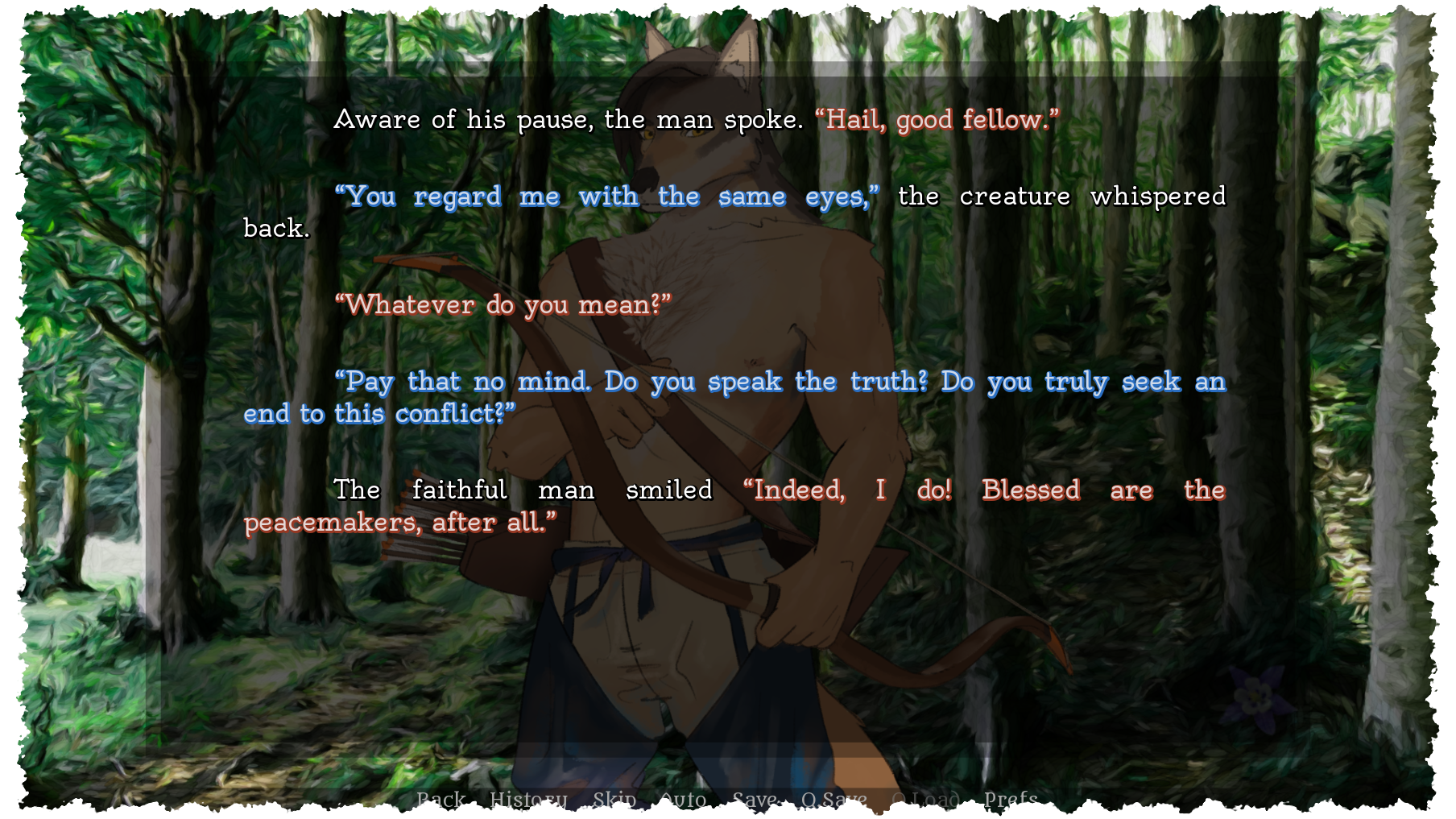
You definitely went outside the "typical" VN box with the formatting here, but I'm not sure this worked for me, personally. While framing the whole VN in NVL mode is distinct, I also think it disrupts the "visual" component ot the visual novel, with the sprites, as few as they are, often obscured by walls of text. The breaks in the text to show the wolf's shifting emotions were welcome, but in a more "traditional" style, you wouldn't need the breaks since those transitions could happen in "real time" and the reader could keep seeing the current emotion without having to hide the interface. With the number of direct quotes in the game taken from the source material, part of me wonders whether the decision to put the whole game in NVL was entirely aesthetic or was more of a necessity to display such long blocks of text.
I agree with some of the points below about relying on text colors to differentiate speakers - aside from some colors being too similar, like the orange for the guard and red for the Holy Man, the lack of actual names for any of the characters can make who's speaking hard to distinguish as well. Since basically every character is referred to as "he", if you get your wires crossed on which color refers to whom, it's easy to get lost.
While I understand that the writing style was deliberately crafted to reflect the source material, I think there are still places where you could have made edits to favor readability over strict imitation, as the verbose, winding language can get a bit tedious. I'm not saying you have to drop the bit and put the whole thing in 21st century vernacular, but I don't think you'd be breaking the immersion if you edited phrases like "He let out a soft chuckle" to "He softly chuckled." Also, not sure if this is a regional punctuation thing or something, but it's generally helpful to have spaces between words and dashes to make sure the reader knows that's supposed to be a pause and not a hyphenated word, and there were no such spaces in the text here.
Last note on presentation - I'm not entirely sure what the point of including the Italian audio at the end was, other than just because you could. Especially with how short that sequence is, I don't know what we're getting out of the voiceover that the text couldn't already communicate.
Story/Creativity:
While the high concept is interesting, as noted above, I find it a bit hard to give full points for creativity when the best lines in the VN are ripped straight from existing media. While there are some superficial changes tacked on, and I'll get to how these are probably underutilized in a second, as others have pointed out, the plot more or less follows the story of the Wolf of Gubbio exactly, and even the vision of the town's betrayal of the wolf and the wolf's subsequent disillusionment is lifted straight from "Los Motivos del Lobo". If anything, this VN feels like a piano recital to me - there's an emphasis on imitating an existing style that's very technically proficient, but at the end of the day, this is basically just playing a cover.
To be clear, there's nothing wrong with adaptation, but the best adaptations focus on taking the concept in a different direction, or at least adding a different spin on the original. We get traces of this throughout the VN, but none of these ideas are ever developed or expanded in meaningful directions. We get a line from the wolf mentioning aspects of his culture, but the Holy Man doesn't follow up on this at all. Like, we know he's surprised by the existence of an anthro wolf from their first interaction, and now he's hearing that there's an entire culture of these beings and that has no impact whatsoever? What if the wolves are a threat? What if they could be allies? What if that's a whole other group he could be evangelizing?
Same thing with the gay temptation subplot that's hinted at a couple times and then pretty much summarily dealt with over about a paragraph. What if Francis really was tempted? What if he succumbed? How does that affect him, and how does it affect the wolf, especially after the town that Francis convinced him to join turned its back on him?
There are some interesting ways you could incorporate this, too. Right now, the frame story doesn't add much, and as is, could probably be cut entirely with a few other edits, but what if we see glimpses from Francis' perspective that he's not telling the whole truth? Like maybe he's telling the younger monks about how he resisted the wolf's desires, but we get other hints from the story itself, like inconsistencies that the monks wouldn't question but the reader would, that he did not?
Again, what's here isn't bad, I just really would have liked to see this concept pushed further than it was.
Final score of 12 instruments of peace out of 4 stigmata.
I did find this a pleasant read on the whole (having previously seen just a little slice that I gave some playtesting feedback on), but I feel like there are a couple of significant conceptual missteps. Some positives first: the use of NVL mode is pretty smooth. My biggest nitpicks would probably be the that the decision to give the Holy Man a different text color in the past and present sections is puzzling, and the use of colors in general comes off as a bit visually busy and isn't colorblind-friendly. The backgrounds are all near-anonymous medieval & natural imagery, but the how the sprite is animated with shifting expressions is an insanely strong visual idea.
It's a bit difficult to gauge how exactly the story, the prose, and the presentation all contribute to the reading experience. While playing, I was haunted by a nagging feeling that there was something not working that I wasn't quite able put into words, or maybe that the VN was trying to do something very specific I couldn't get a handle on. Luckily, I think looking at the inspiration – which I was not familiar with – helped put things into focus. In summary, as fun and creative of an adaptation the game is, I feel like all the individual changes it makes in both form and content fail to cohere into something that fully makes sense as a visual novel.
Consider, for instance, just the level of line-to-line pacing, where the plot is generally delivered as you'd do in a short poem or a parable. How the eponymous characters meet is that the Holy Man walks into the forest and then, almost immediately, runs into the wolf. On paper, it's a tense scene that could get more detailed with its descriptions and build up to the meeting more patiently, but we don't worry about things like that – it just happens. But on the other hand, scenes of the characters talking are rendered in a more traditional novelistic style, coming off as hopelessly drawn out in comparison even though the VN isn't egregiously long on the whole. There's a sharp collision between the beats taken as-is from the original texts and what's instead borrowed from how visual novels tend to work.
On the plot side, we get a lot of expansion in the form of complications to the wolf's side of the story and general situation, the little epilogues, and the framing device. Fundamentally, though, the conflict is still about the townspeople just defeating their prejudices and coming to a mutually beneficial agreement. If I recall correctly, the dead kids aren't even mentioned after we find out what happened to them, and my bad if I missed something, but I'm also not sure if the fact that the wolf is a part of a culture rather than just a random beast really alters anything about how the rest of the story plays out. Do we even find out why he's hanging out alone in the woods? There's all this scaffolding to make things more grounded and plausible with the change that the plot involves a wolf man instead of an animal, but I'm not sure how much the story really gets from it. The original tale's simplicity and blatant disregard for the laws of nature certainly didn't harm it, I think.
Then, on the other hand, there's the fact that the relationship between our main characters has more stuff going on. It's definitely a good thread to pull, and I did find the conclusion a little affecting regardless, but I think you can feel the source material not providing a lot to work with and even the lengthy dialogue scenes added here mostly consisting of the two discussing pragmatic plot matters. For the romance-that-wasn't to strike a home run, I wish we had learned just a bit more about the wolf. Intellectually, I get why someone living in the woods would become attached to the first friendly person they meet, but when that's all there is to bite into, the story ultimately feels a little shallow and lacking in specificity. (It would work the other way around because we can see that he's hot, but to an audience of furries, I guess you have to explain why someone would be attracted to a human...)
Another angle to consider is prose. As an exercise in stylistic imitation, the VN fares quite well; everything it quotes or paraphrases from its inspirations feels totally seamless. And yet, the writing is so focused on replicating the voice that I feel like it forgets to consider how it should adapt itself into the new medium, especially when it comes to variation. The characters all sound quite similar, with the single biggest missed opportunity being not giving the wolf a more distinct voice. Also, despite the frame story, it doesn't feel like the game does anything particularly interesting or useful with the conceit of being narrated by the Holy Man – I think it's something you could draw from, for example, to make the pacing feel more natural.
All in all, I don't think the final VN quite sticks the landing as it gets lost in the weeds of forcibly dragging the story towards a more novelistic take that nevertheless isn't radical enough of a reimagining. Still, it's a conceptually bold project, and we like to see that; I'll always be there for stuff that isn't afraid of taking external influences and reworking them into a furry context.
I think this was really style over substance. And the Style was really well executed! But it also ultimately left me wanting. At the end of the day this is just a short retelling of the wolf of gubbio, which wouldn't be inherently bad but the unique things it brings to table through this retelling are just unused. "The wolf is a bipedal sentient man with his own culture and problems" is a great concept but nothing is really that different from the original story itself, except that we add on a bonus "humans are naturally inclined to suck" statement at the end. The Wolf's feelings for the friar are rejected in a sentence or two, because they decide the wolf belongs with the city and the friar belongs journeying for god. There's not really anything that pays off about this, and though we find out the friar ends up being wrong, there's not really any recompense or time to think about that.
It's an impressive writing exercise, but ultimately feels lacking as a visual novel, and the concepts introduced that are unique to this format end up being irrelevant to the narrative as a whole.
The lack of visual is balanced by the story and the UI, I like how you used the color to make it clear who’s speaking. The medieval / formal language helped for the immersion in the story too!
Theme: 5/5
Story: 5/5
Presentation: 5/5
Writing: 4/5
Creativity: 5/5
Most of what I want to say has already been said by previous commenters, so I'm not going to go in-depth in my explanations as to why theme, story, presentation, and creativity are 5/5. However, I will explain why I gave 4/5 in writing.
To give the non-writing readers some context, in writing historical fiction (or historical fantasy) the author always has to balance carefully the tightrope battle between clarity, brevity, and being understandable to modern audiences versus congruence with the established setting. While for the most part the writing is successful in balancing this regard, it does err too far to the latter's side once in a while, especially in the beginning, where I had to reread a few sentences because of their odd structures.
It's rare that a work this steeped into religious context and themes is able to capture my interest and even make me empathize with the most devout. But in this case, I found myself even admiring the Holy Man and his general attitude. This story made for a good vessel for the Holy Man to demonstrate how his piety can lead to acceptance of the Other. His humility is also a welcome sight, as he made some mistaken assumptions and easily repented for them. The relationship between the characters is also altered by his role, as there was never any expectation of a romantic connection. Still, their acceptance of each other and eventual friendship is no less heartwarming. The ending might have been expected, but it is still quite sad. This work gives up plot twists and emotional moments in favor of a quiet sort of sincerity, making this a consistently entertaining read. The NVL nature of the work and the slightly elevated prose actually work well to make this story feel different from the usual FVN. Though, I do have to comment that there were several typos throughout the work, which I wish had been edited since this VN is excellent in other ways. And, I suppose it qualifies as folklore in that it's a retelling, though with a slightly gay and furry twist. But only slightly, the appropriate amount in fact.
'The Wolf and the Holy Man' is what I think I would call a classic parable written in modern times but as if it were from the olden times. Especially as it is a story of a story from the point of view of a old Christian monk on the twilight of his life. It features several of the mainstays of religious parables, like the faith in the divine being, preaching forgiveness and understanding, the tragedy of life and death, and the basal nature of humans. It shows the friendship (
and forbidden love) that the young monk has with a strange mythical creature, the anthropomorphic wolf, and how despite coming from two worlds, are able to come together and understand each other, only for them to part as it could never be.The first thing that stands out about this story is the antiquated prose that it uses, with all the surprisingly archaic and religious jargon that I'm sure even some of the more seasoned visual novel readers would need to look up the definitions of. I don't fault it for that, because it fits the tone that this is going for, and it never hurts to learn some new words. That being said, the parable itself is quite simple, classic fear of the unknown and prejudice against those who are different, leading to tragedy, and that then festers into resentment and hostility. But there is also the aspect of the story that is of regret and longing. The monk is someone who has had a lifetime of good deeds and is considered a saint, and yet, even he has regrets over a love he denied for his own notions of sanctity, and it brings into question, whether or not such convictions would inevitably lead to this outcome, or if he were to have indulged in those forbidden feelings, would he be the same person. Part of me wonders if having the final scene with the wolf confirming the visions the monk had takes away from what could have been an ambiguous ending, where the monk is left with these regrets because he never truly knows what happens to the wolf, and if his visions were his cynical viewpoint manifesting. Then again, I also don't hate having the final line be a confirmation that while the larger population of the town hadn't changed, at least the wolf was changed by meeting the monk. Ah, to be spoiled by artistic choice.
The presentation itself is quite well done as well. I think this is probably the first time I've seen that filter on backgrounds actually work in the context of the story it's going for. The blur painterly style works great with this sort of religious parable genre, and having it also be told primarily through the NVL-mode makes it feel more story book quality than your traditional visual novel text box. The use of colored text to indicate who was talking was really good, though I wonder if making the silhouette of the guard red confused me for a bit when the monk's text is red and the guard is orange. Like is it the guard or does the monk just have a sword? Same with how the crowd text is yellow, but the silhouettes are in dark blue. Just some stylistic observations. I thought the minimal usage of ambient forest and waterfall sounds was very well placed and the music fit the vibe you were going for. Even the bit at the end with the dream like distorted backgrounds was also a really nice touch. The surprise voicing monologue was unexpected and put a nice cap on the story. I think in terms of creativity, what stood out to me the most was the minimalist use of silhouettes and the commitment to the archaic vocabulary you used.
In terms of implementation of the folklore theme, this is basically a folklore tale in visual novel form, with the entire story being told from start to finish, which checks the box. The drawing from real life folk lore is also a really nice bonus point on top of that. It's surprising how much I was moved by this, but I guess that's just the nature of the dynamic of a doomed yaoi couple. This visual novel will have it's fans, but I feel like they're going to be the type who enjoy challenging reads and reading for readings' sake, rather than the subject matter of the story, but it seems like that was expected when writing this. Academic is a way I would describe this visual novel, the kind that is assigned via homework and enjoyed by literary enthusiasts rather than picked up for recreation by the layman. That said, I appreciate it's existence and feel like it brings a sense of dignity to this game jam.
Absolutely breathtaking. I adore every character involved, and the ending was so beautifully bittersweet.. I wish there was more on the visual side of things, but the story more than makes up for it in its rich story-telling. As someone unfamiliar with the tales this story retells, I still found the story to be coherent and fun to read. It wraps up quite well.