


Play game
dudo quantico's itch.io pageDescription of the game
Dudo Quántico is Perudo — liar's dice — played with dice that are made of qubits.
The rules are the ones an Inca emperor is said to have taught his captor. Three players, three dice each, hidden under the cup. Bid a quantity and a face, raise or call dudo, and whoever was wrong loses a die. Ones are wild. Last cup standing wins.
One thing is new. Before the shake, you secretly clip some of your dice to a hidden table die. Every clipped die on the table — yours and your opponents' — lands on the same face, while each individual die still reads one in six on its own. Clipped dice are threaded onto one another, so each round builds a single
braid of entangled dice running across the table. Nobody can catch you by looking at a die — the information is not in any die, it is in the braid — and by the time the totals give it away, everybody has already bid.
The dice are not simulated. Every combination of what the three players might clip was run ahead of time on an IBM quantum processor, and the game deals you the measured outcome of the gates you actually chose. The backend name and the job ID are printed in the header so you can check the run yourself.
Credits (names/nicks + roles)
Ioannis Theodonis — design, quantum circuits, vibe code
How is your game related to quantum physics?
Each die is three qubits holding a face from one to six, prepared as an equal superposition of exactly six of the eight basis states — honest d6 with no rejection sampling.
A clipped die is joined to a hidden table die by three CNOTs, producing a GHZ-type entangled state across every clipped die on the table.
The entanglement is what makes the bluff work. Every die's reduced state stays exactly uniform no matter how many are clipped, so a player cannot detect clipping from their own dice — that is no-signalling, not a design choice. What changes is the joint distribution: the average number of any face is untouched,
the variance is not, so a bid that classical Perudo arithmetic would call an obvious lie starts landing.
All 64 combinations of the three players' choices were compiled and batched into a single job on IBM hardware; the game replays those measured bitstrings, so the dice really were rolled by a quantum processor rather than a random number
generator.
How is your game related to the theme?
Braiding is about worldlines, not objects: particles that cannot pass one another without tracing a path, and a state that remembers the path.
Dudo Quántico is played with dice whose worldlines cross. The one non-classical move is clipping: your dice are not joined to the table from a single source, they are threaded onto the die clipped before them, so every round builds one chain of entangled worldlines running across the table and across the chip. What players bid on is not any die — it is the history of how the dice were joined.
That history cannot be read by looking at the objects. Every die in the braid is perfectly uniform on its own, no matter how many are threaded, so no measurement on any single die in any basis reveals the chain. This is the property that makes
braided information immune to local probing, and in this game it is the bluff: your lie cannot be caught by examining dice, only by cutting the whole braid open at once, which is exactly what calling dudo does.
The braid is also fragile, and we did not plan this. On real hardware decoherence severs the chain, and longer braids break first: emulated with a Heron device's calibration, a two-die braid survives 93% of rounds and a nine-die braid only 68%. The game reports it at the reveal — the braid held, or the braid
broke. Players feel the trade between a longer braid and a reliable one, which is the reason anyone wants topological protection in the first place.
Leave a comment
Log in with itch.io to leave a comment.
Comments
I thought I understood this, but then a couple of rounds ended like this:
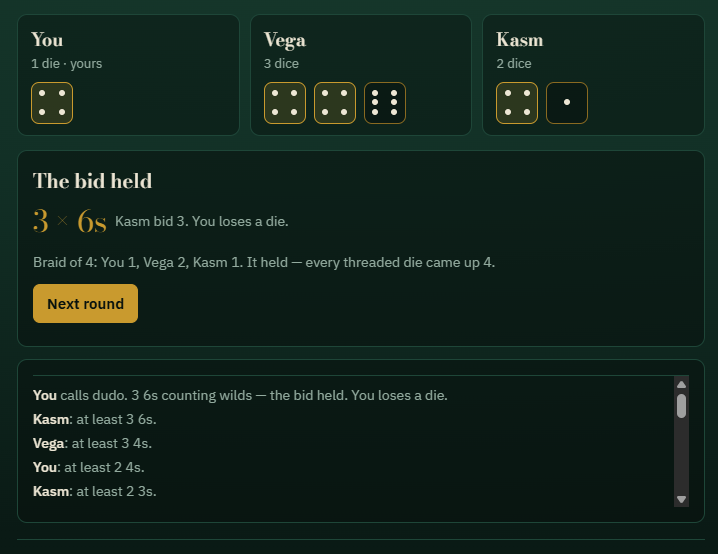
The opponent bid 3 sixes, I called "dudo" on that, there weren't 3 sixes, but I *lost*???
This could be "because of wilds" but I have no idea what "wilds" are or what it means in game terms when the braid breaks... does that just mean there are no answers and whoever called dudo automatically loses? Confused...