

Hey everyone!
Another AQUILA VII update is here!
Over the last few releases, I've spent a lot of time improving the graphics, rebuilding the terrain, adding voice acting, and redesigning the interface.
But this time, I wanted to focus on something a little different.
Making the game actually feel better to play.
There are already plenty of units, historical battles, formations, and strategic mechanics in AQUILA VII. Rather than adding even more content, I've been going through the existing systems and improving all those little details that make a difference during a battle.
And quite a few things have changed!
Combat Feels More Alive
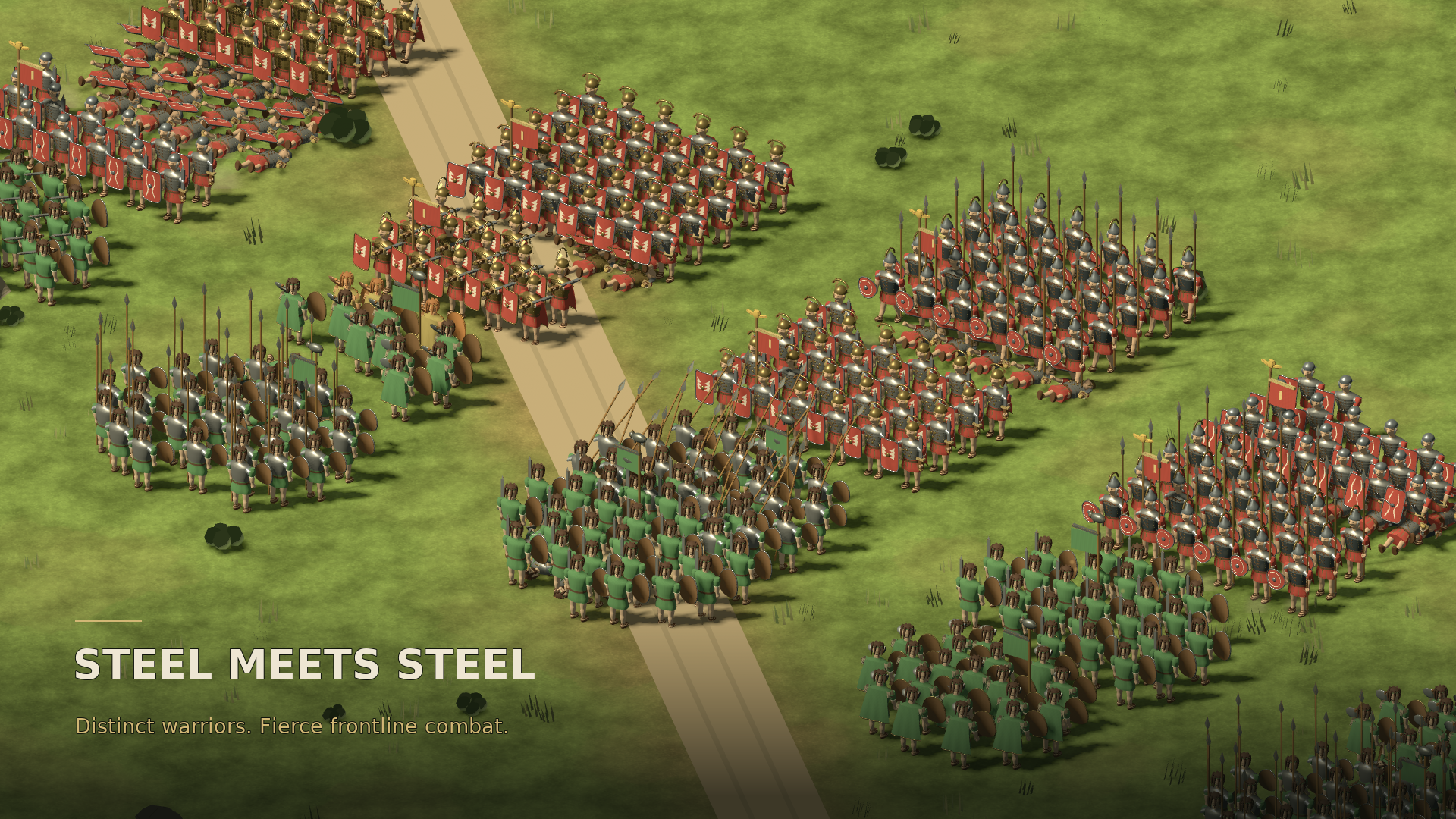
One thing I've always wanted to improve is how soldiers behave when they're fighting.
Previously, soldiers within the same formation could look a little too synchronized, especially during melee combat.
In version 0.39, I've introduced more variation to their combat animations.
Soldiers now have slightly different attack timings, additional weapon movements, and subtle shield and guard reactions.
Units in the rear ranks also behave more naturally, maintaining their reserve positions instead of looking like they're all participating in the same attack.
Spearmen retain their thrusting animations, while other melee units benefit from more varied strikes.
These are primarily visual improvements, so the underlying formation-based combat simulation remains intact.
The idea is to make a formation look like a group of individual soldiers, rather than thirty identical characters repeating the same animation.
Cavalry Charges Have More Impact
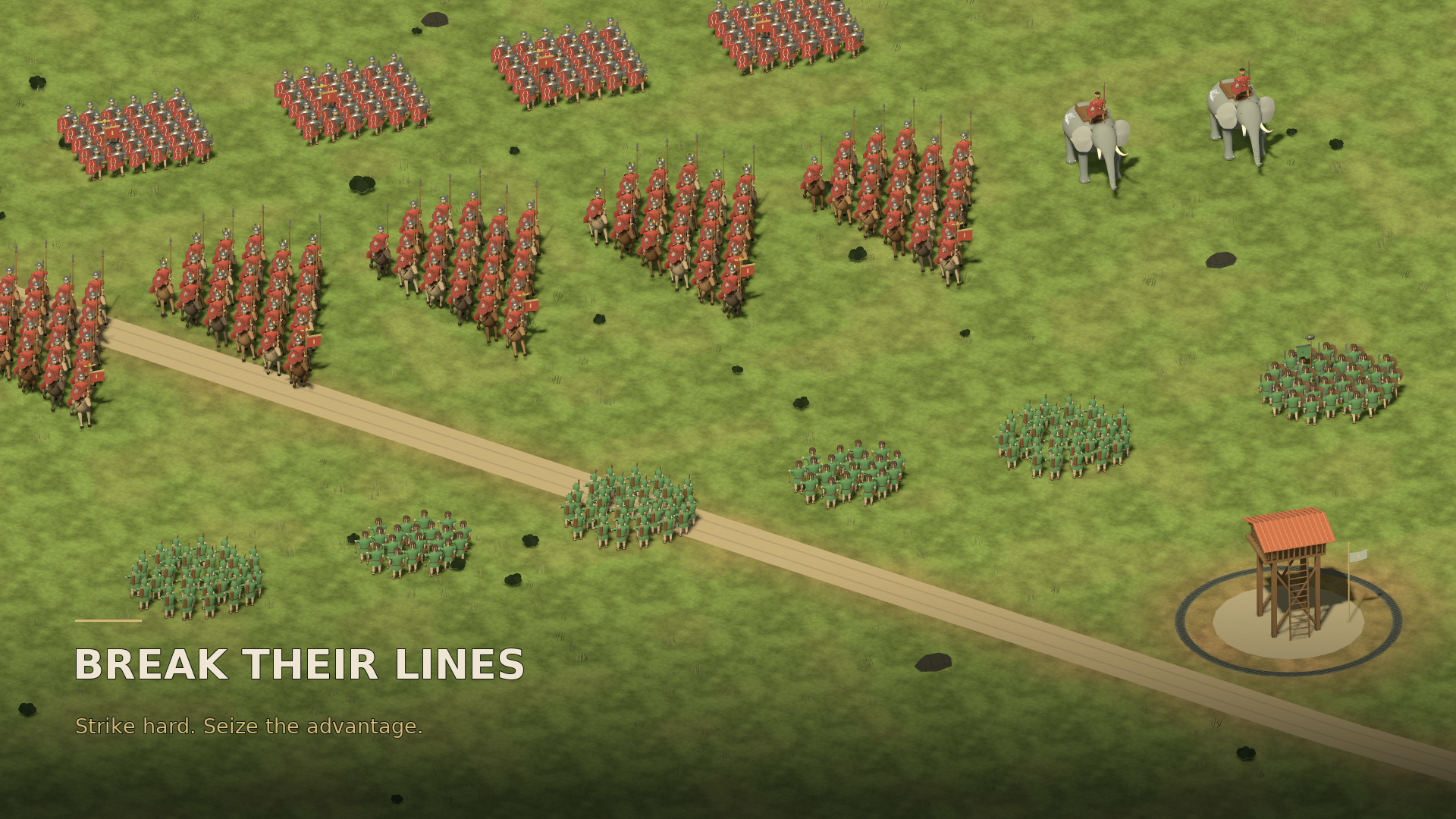
Cavalry charges are one of my favorite things to watch in an ancient warfare game.
So naturally, I wanted them to feel more powerful!
I've improved several aspects of the charge animations and visual effects:
- Dust builds up as cavalry accelerates toward its target.
- Weapons and arms lower as soldiers prepare for impact.
- Formations visually compress slightly during the charge.
- Impacts, knockdowns, and recovery animations have been refined.
- A subtle camera shake adds weight to the collision.
The camera effect is completely optional and can be disabled in the settings.
The result should make cavalry charges easier to follow and more satisfying to watch, especially when zooming in close to the action.
Clearer Orders and Smoother Camera Controls
I've also spent time improving how the game responds to your commands.
Movement, attack, and capture orders now have different visual indicators, making it easier to understand exactly what you've told your troops to do.
You can also see facing directions and queued orders more clearly.
If a command can't be executed, the game now provides contextual feedback instead of leaving you wondering what happened.
Invalid movement destinations are rejected before changing the unit's existing orders.
These indicators also remain visible during tactical pause, so you can plan your next move without rushing.
The camera has received some attention too!
Zooming is now smoother and follows the position beneath your cursor, even on elevated terrain. Rotations feel less abrupt, and recalling a control group transitions more naturally toward its location.
And for players who prefer the old, immediate camera behavior, the transitions can be disabled.
A More Natural Battlefield
The terrain received a major overhaul in previous versions, but I felt there was still room to make the environments more convincing.
I've now added more natural variation across the maps.
Forests have less uniform edges, additional ground vegetation, and improved woodland surfaces.
Fields have more convincing furrows, settlements include small environmental details, and roads blend more naturally into the surrounding ground.
I've also improved rocky slopes, damp areas, vegetation distribution, and the transitions between different terrain types.
Road edges have been refined across all 54 maps, and older field geometry that could appear suspended above the terrain has been replaced with details integrated into the current ground surface.
Lighting and materials have also been adjusted to better distinguish metal, fabric, and terrain, with softer contact shadows in close-up views.
The goal isn't just to make the maps prettier. I want the world to feel more believable when you're watching your armies march through it.
Hundreds of Soldiers, One Living Battlefield
Another change I'm particularly happy about is the new movement audio system.
Previously, footsteps and horse hooves were handled through a much simpler setup.
Now movement sounds are grouped spatially, taking into account the number of soldiers, their distance from the camera, and the current zoom level.
A small patrol shouldn't sound like an entire legion marching.
And a large army advancing together should have a much stronger presence.
The system uses the existing audio recordings, so there's no need for additional downloads or online services.
More Work on Performance
With all the visual improvements introduced recently, optimization has become increasingly important.
Version 0.39 includes several changes designed to reduce unnecessary processing during larger battles.
Some of the main improvements include:
- More formation movement and repositioning handled on the GPU in distant views.
- Soldier rendering data updated when relevant changes occur, rather than being rebuilt unnecessarily.
- Improved GPU handling of animated projectile volleys.
- Better caching for navigation and commonly used rendering paths.
- Asynchronous loading of tactical voice recordings.
- Heavy simulation tasks distributed more evenly across frames during extreme workloads.
These changes are intended to help larger battles run more consistently without sacrificing the detailed close-up experience.
Performance optimization is still an ongoing process, particularly on different hardware configurations.
A New 5-Minute Tactical Trial!
This is a new addition I'm especially interested in hearing your feedback about.
I've introduced a short guided exercise called Tactical Trial — 5 Minutes.
It's designed to help players get familiar with some of AQUILA VII's most important battlefield mechanics.
During the exercise, you'll practice selecting formations, using tactical pause, moving and orienting units, firing with archers, launching a flanking cavalry charge, and ordering a retreat.
The trial progresses based on the actions you actually perform, rather than simply waiting for a timer.
And despite the name, there's no automatic defeat when five minutes have passed. That's just the approximate duration.
You can also restart the exercise or continue from a saved stage.
I hope this makes the game a little easier to approach, especially for players who haven't spent much time with formation-based RTS games.
A Cleaner Battlefield Interface
The interface introduced in version 0.36 has also received some additional refinements.
Several panels are now more compact and adapt better to the available space.
Important unit warnings are easier to notice, even when the affected units aren't currently selected.
Tooltips provide additional explanations, while the existing voice notification system continues to prioritize important battlefield events.
It's all about reducing the amount of time spent fighting the interface and spending more time commanding your army.
Additional Improvements
Alongside the main changes, this update also includes refreshed text across all five supported languages, 54 regenerated map previews, and updated Windows packages for both the full game and the free demo.
The existing content remains unchanged:
5 playable civilizations, 71 unit types, and 54 scenarios in the full game, including the historical campaigns and skirmishes.
This update is focused on improving the experience rather than increasing the amount of content.