On Sale: GamesAssetsToolsTabletopComics
Indie game storeFree gamesFun gamesHorror games
Game developmentAssetsComics
SalesBundles
Jobs
TagsGame Engines

Browser MMORPG development

A topic by Wagrant created Jun 08, 2026 Views: 4,848 Replies: 39
Viewing posts 21 to 32 of 32 · Previous page · First page
(1 edit)

Benedict & the New NPC Economy

I’ve finished the first major NPC built around the new economy and relationship systems: Benedict, the merchant from the capital.

He visits the village only from the 1st to the 7th of each month, and he absolutely hates coming here. The shard is poor, dangerous, no longer pays tribute, and Benedict’s real job is partly to watch whether the settlement is becoming prosperous enough for the Crown to care again.

Benedict has four main roles:

  • Numismatist — buys rare cleaned coins, but only above 95% preservation.
  • Royal Intermediary — brings the King’s Orders and Grants.
  • Premium Reseller — sells expensive, high-quality capital goods that let players skip long crafting chains.
  • Exporter — buys valuable local goods that can be resold in the capital.

His shop uses only Royal Coins. His goods are intentionally expensive, but usually powerful and high quality. Most are still fragile.

Trust & Reputation

NPC relationships now have two resources:

Trust is accumulated through helping an NPC.
Reputation represents major relationship milestones.

Both can also be spent on favors: discounts, better sale prices, information, reserved goods, private stock, special imports, and other exceptions.

Reputation is no longer gained automatically at 100 Trust. Reaching 100 Trust unlocks a personal task from that NPC.

Benedict’s first Reputation task is simple but very specific:

Give him a copper coin with exactly 100% preservation.

He does not buy it. It is a gift.

Future Reputation levels will require progressively harder personal requests tied to each NPC’s interests.

Learning NPCs through dialogue

The Journal now contains detailed NPC dossiers.

The important part: it only shows what the player has actually learned.

At first, you know almost nothing about Benedict. Through dialogue, trades, discoveries and higher Reputation, new information gets recorded:

  • what goods interest him;
  • exact coin requirements;
  • his interest in gold, silver and gems;
  • export opportunities;
  • hidden services;
  • royal information;
  • available favors.

So dialogue is now part of the economy rather than just lore.

Export trading

Benedict sells each player one jar of milk per visit for 25 Royal Silver.

After drinking the milk, the jar remains. It can be filled with honey or one of five jams, labeled, and turned into an export product.

After unlocking Benedict’s Exporter role:

  • Honey Jar base value: 30 Royal Silver
  • Jam Jar base value: 35 Royal Silver

Final value scales through the existing rarity/quality system.

Royal Orders & Grants

These are two separate systems.

Royal Orders are the King’s ridiculous personal ideas.

The first one:

The Greatest Candle in the Kingdom
The King wants a gigantic candle.
Required: 10,000 kg of wax.

Future Orders will be handcrafted and get their own illustrations.

Royal Grants are practical large-scale purchases: fish, mushrooms, meat, plants, and other resource categories. Their value depends on the actual rarity, quality and properties of what players deliver.

Benedict can also sell capital rumors for Trust, giving hints about future demand without directly revealing next month’s requirements.

This entire system is designed as a template for other NPCs: each one will have their own interests, relationship progression, personal requests, economy, knowledge, favors and reasons to keep interacting with them long-term.
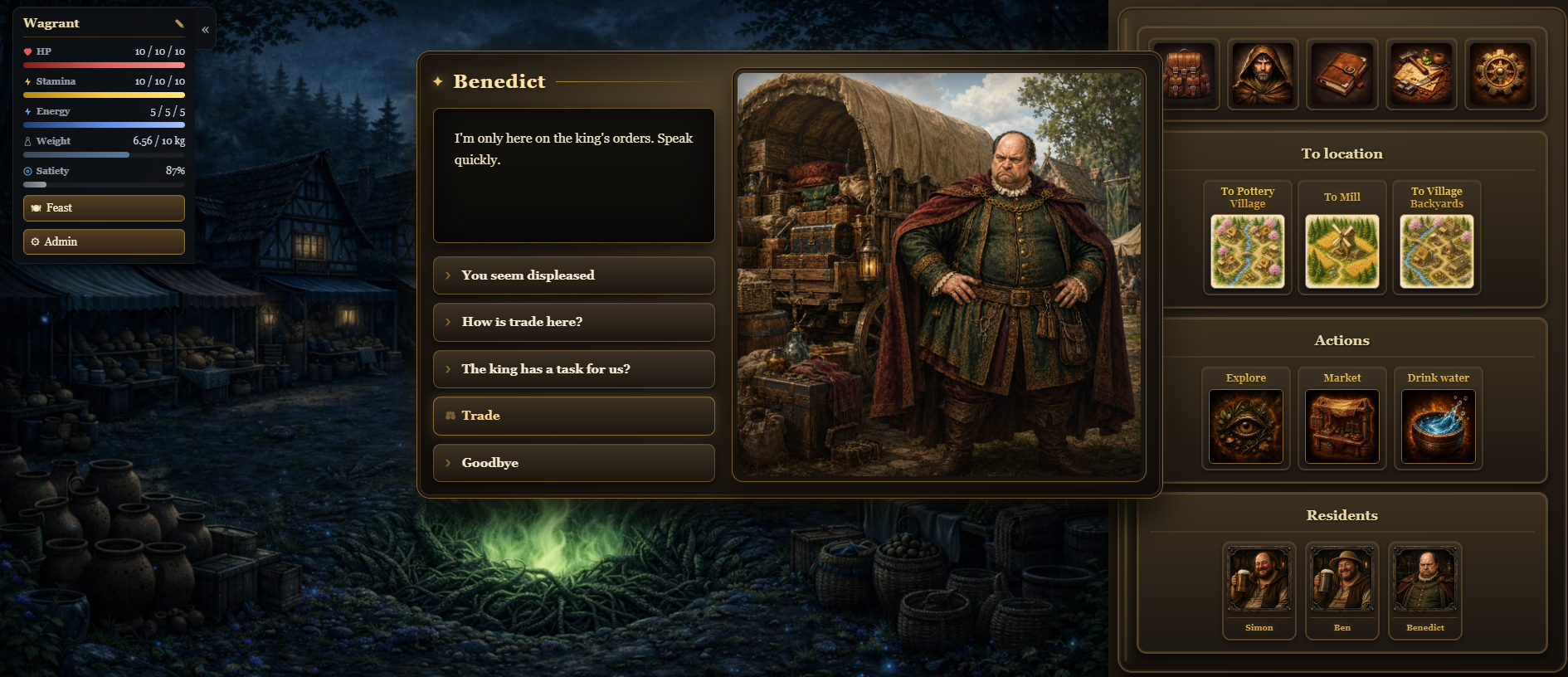

By the way, the season has changed (a new month has started) and the rare Eshamoor season has arrived, changing the usual approach to the game. Interesting, since the chance is about 5%. Of course, it is absolutely not done, not even started, but all locations have a different appearance.

See you in Runelight.
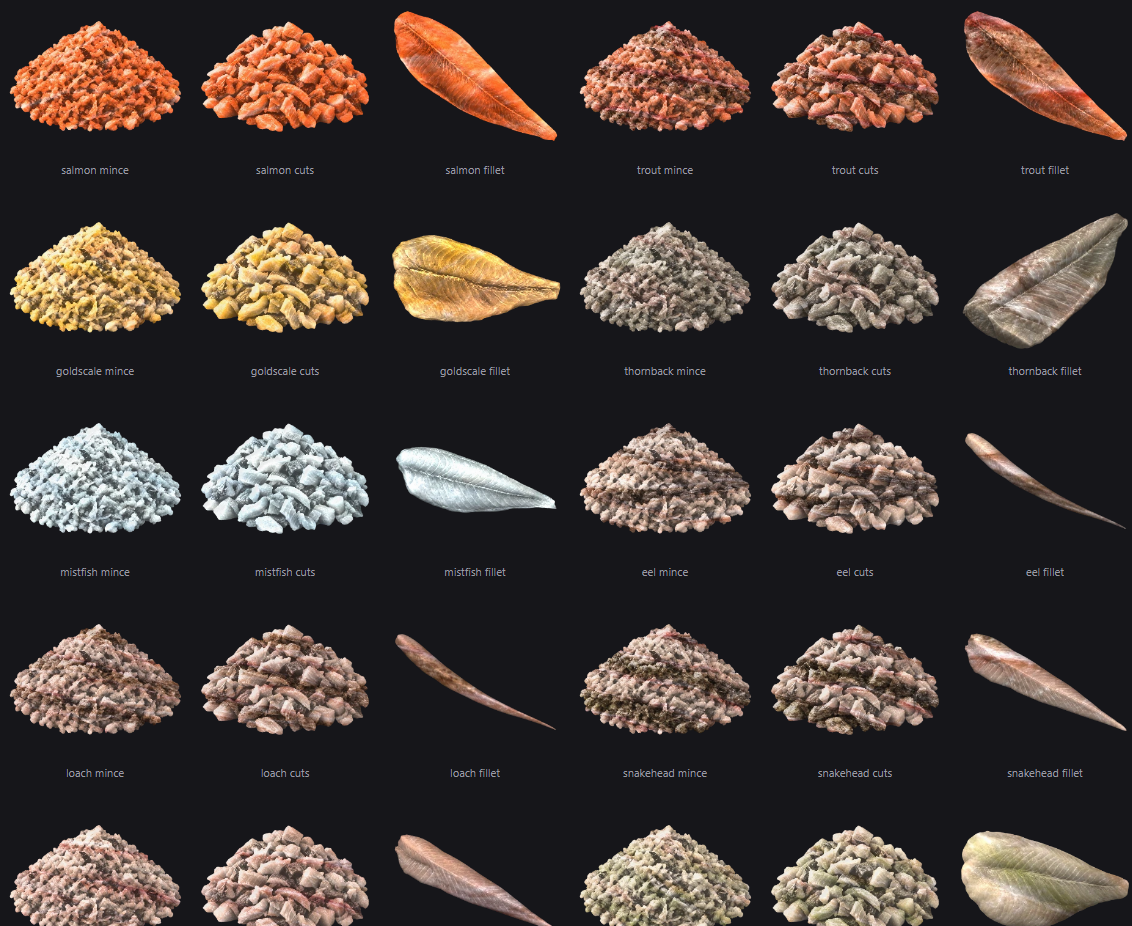
The fish cooking branch is finally complete.

After a ridiculous amount of reworks, fixes, and art generation, all 40 fish recipes and their blueprints are finished. There’s still plenty of testing ahead, but the full system is now in place.

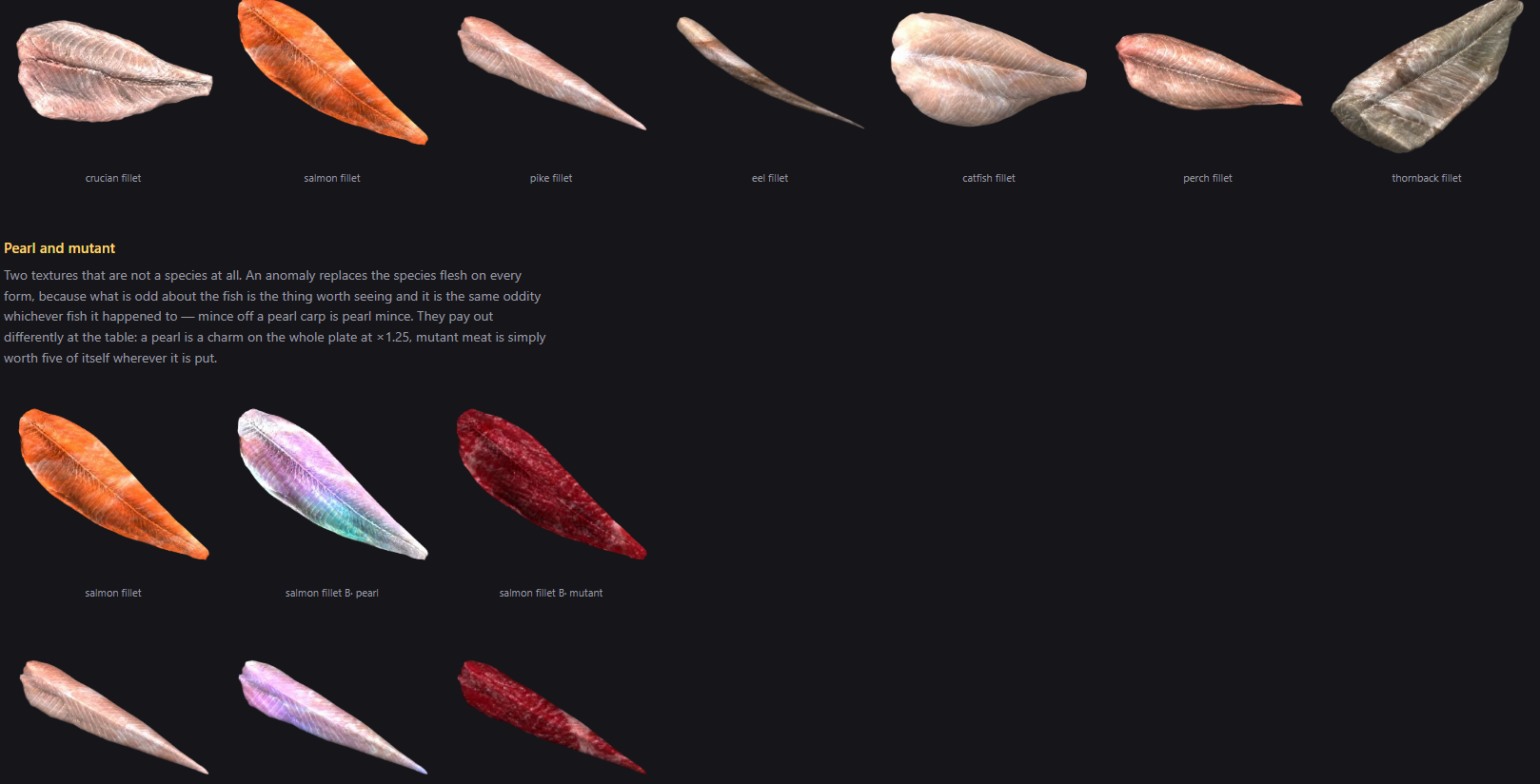
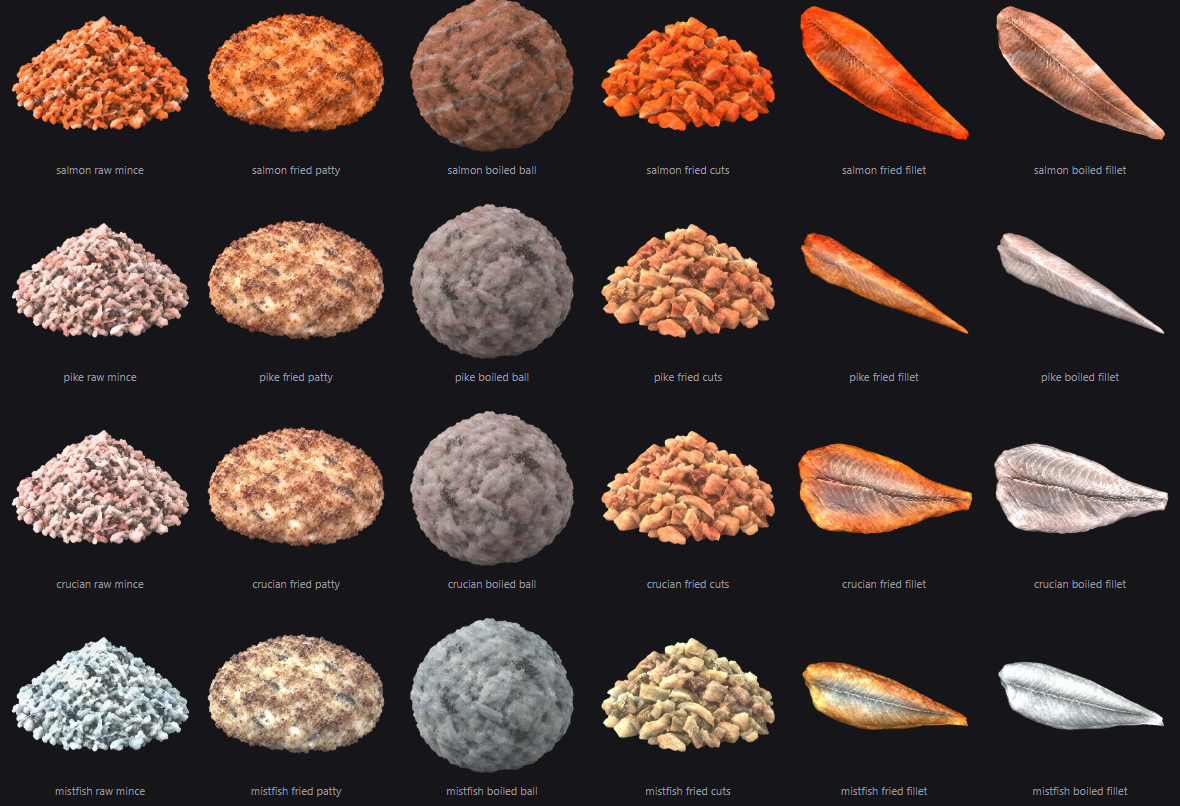
Fish can be butchered into mince, chunks, and fillets, with the available cuts improving as your butchering skill grows. Each species keeps its own attributes and flavour profile, while the form determines which recipes you can make. The meat also uses shared art masks tinted to match the fish species, so we don’t need a separate drawing for every cut of every fish.

Cooking is built around actual weight, preparation methods, ingredient combinations, and seasoning. A recipe can accept different fish species and valid preparation methods, while the ingredients determine the final flavour and attribute distribution. There are also separate rules for Pearl and Mutant fish, giving rare catches a real purpose in the kitchen.

The important part is that we now have a complete reference for future cooking branches. Meat is next, using the same foundation with mince, steaks, and large cuts.


Also 

Giving Runelight’s People a Past

Most of my recent work has been on the people of Runelight. I've been going through their backgrounds, personalities, relationships, professions, and the things they actually want from the world.

I wanted to get beyond “this is the cook” or “this is the fisherman.” Who were they before Runelight? Why did they end up here? Who do they trust, who do they avoid, and what are they hiding? What would they do if the player never showed up?

I've also been working out their specializations and progression, so getting to know someone can gradually reveal more than just another shop or a new dialogue option. Some characters have a lot to teach you. Others have plans of their own, and helping them doesn't necessarily mean you understand what you're helping with.

A big part of this has been connecting their stories to each other. Two people can remember the same event differently, know different parts of the truth, or have a relationship the player knows nothing about. I want those connections to matter, rather than having every NPC exist in their own little bubble.

There's still a lot to implement and test, but the background work is giving me a much clearer picture of who these people are and how their stories fit together. It's been one of the more interesting parts of development lately.

I also see people starting to show up - rarely, but they do drop into the game, which is great. It’s only now that I’ve realized just how far from ready it is to show to anyone. But despite that, I’ve made it mobile-friendly (landscape mode) of course, it’s still very rough, but the world is taking shape.

If the game or its world has piqued your interest, feel free to ask anything on Discord. It’s hard for me to gauge the difficulty level since I’m the one creating it, and things look different from a player's perspective.

See you in Runelight.


A lot of work has gone into the game lately: beekeeping is now fully implemented, the Scurren equipment set is complete, the new alchemy system is finished, and I’ve fixed hundreds of bugs along the way.
Beekeeping

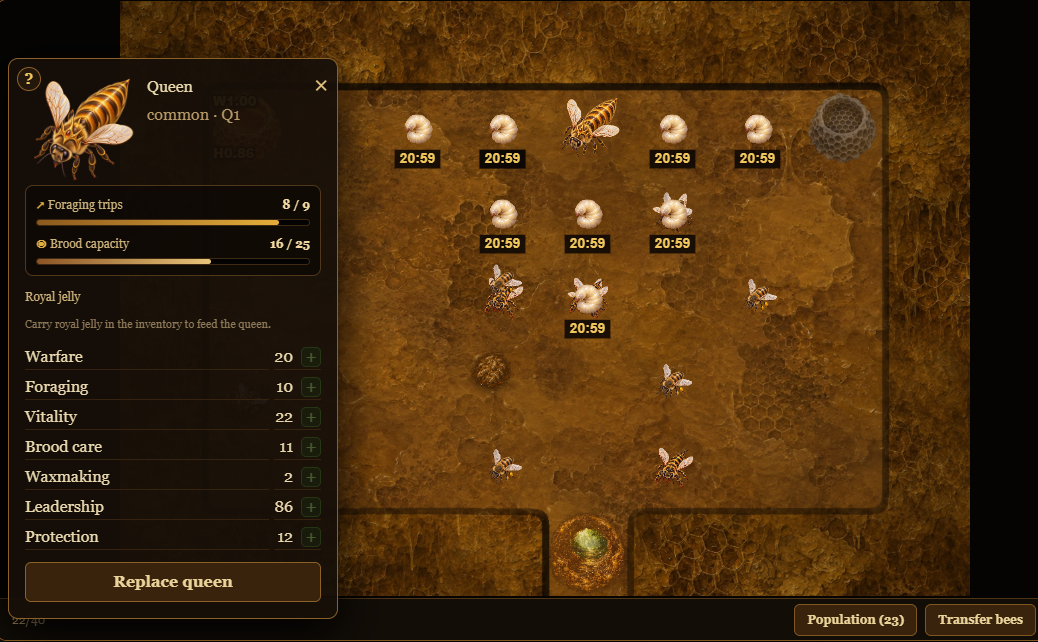
While exploring forests and meadows, you can now find wild beehives.

Destroying one is not exactly safe — you’ll have to survive the angry swarm — but you can recover honeycombs and capture some of the bees living inside. These can be gatherers, builders, defenders, larvae, or, if you’re lucky, even the Queen.

Once you have a Queen, you can build a primitive clay hive and start your own colony around her. Place the hive on the meadows and the family will begin gathering resources and producing honey.

But your colony is not alone.

Other wild bee families live on the same meadows, and they may attack your hive to steal the Queen, larvae and honeycombs.

Of course, you can do exactly the same to them if you think your colony is strong enough.

Alchemy

The entire alchemy system is now finished.

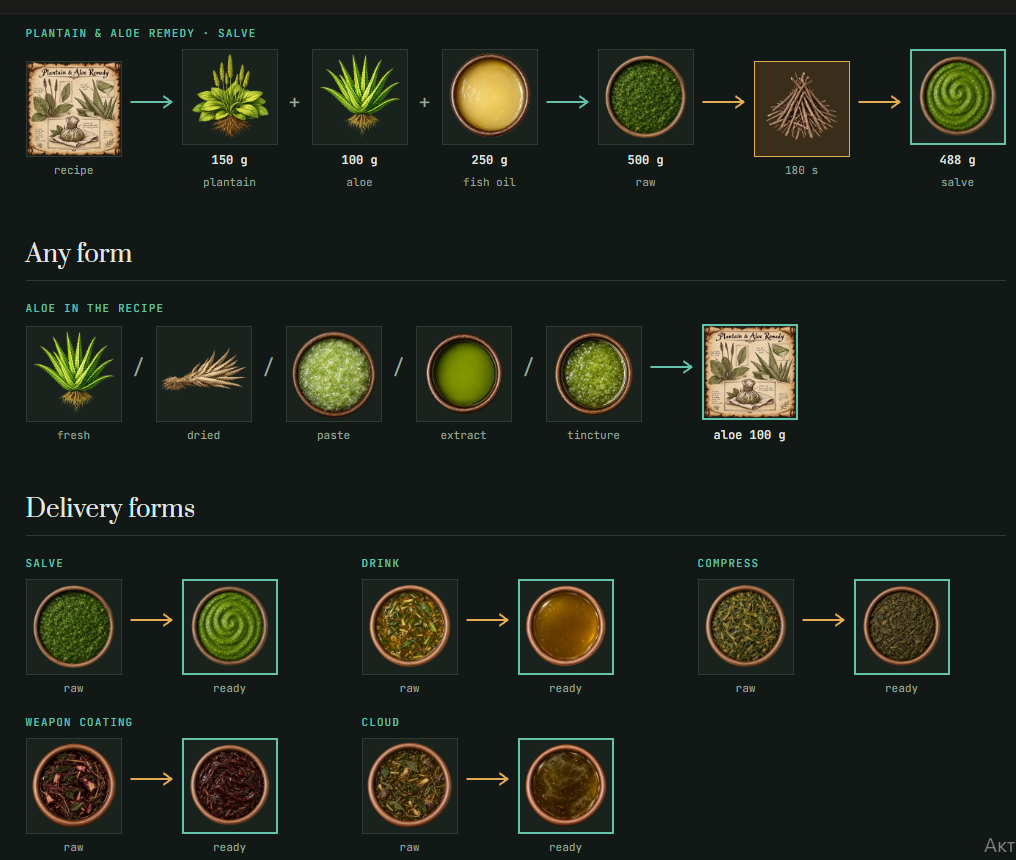
Recipes still define what you’re making, but they no longer define the final effects. Those now come from the actual ingredients you prepare and use.

Plants can be dried, ground, infused, extracted, filtered, concentrated, heated, diluted and mixed. Every step changes the material itself — its mass, concentration, available compounds and side effects. Nothing simply gets a hidden “better/worse” multiplier.

Carriers matter too. Water, honey, fish oil, wax, blood and worm juice extract different compounds and behave differently depending on whether you turn the final mixture into a drink, salve, compress, weapon coating or even an aerosol cloud.

The same recipe can therefore produce very different results depending on how you prepare it.

A simple Aloe + Plantain remedy could become a basic healing salve, a concentrated medicine with much stronger healing, or a badly prepared mixture that barely helps and causes severe nausea.

There is no purity score and no random final crafting roll.

The game simply simulates what you made and shows you the result.

The goal is simple: easy to use if you just follow a recipe, but with plenty of depth for players who want to experiment with the chemistry behind it.

Scurren / Windmill Equipment

The equipment branch connected to the Scurren Windmill instance is now complete as well.

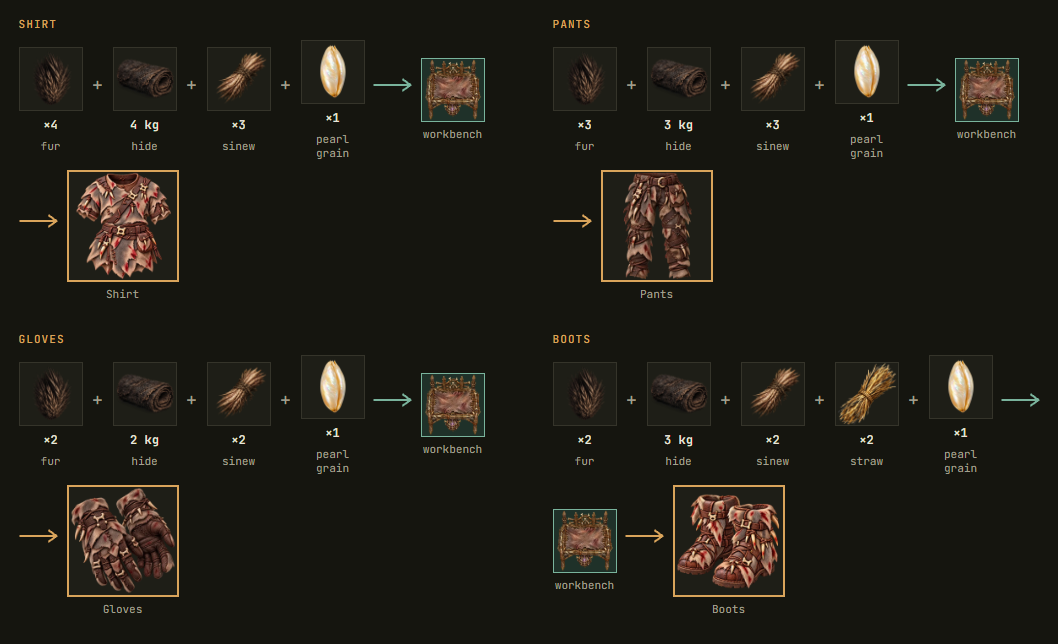
All recipes have been reworked, and the full equipment set can now be crafted from actual resources.

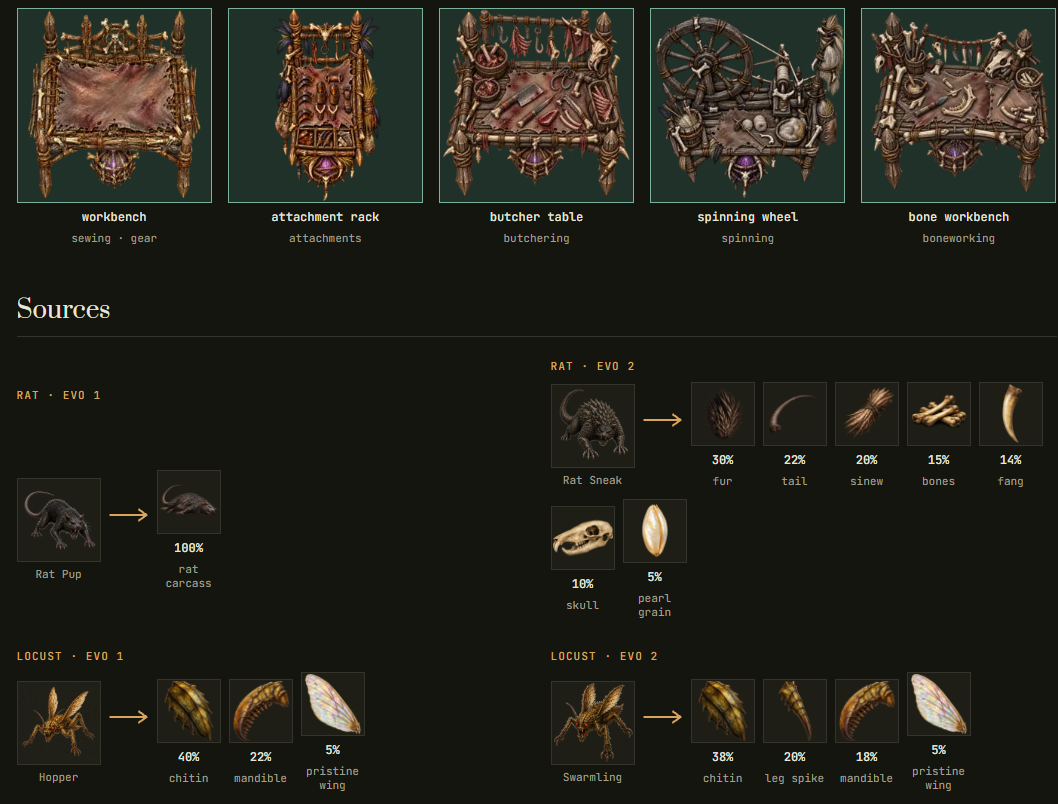
To begin crafting it, you first need to find the workbench blueprint inside the Windmill instance. Once the workbench is built, the equipment recipes become available.

The craftable set currently includes 12 pieces of clothing and armor, a sword, a one-handed mace, a two-handed mace and a shield.

There are also 16 extremely rare Scurren equipment pieces that cannot simply be crafted. These can drop randomly from Scurren creatures.

Rare equipment can be repaired and upgraded, so finding a good piece is only the beginning.

If you manage to craft or obtain equipment of Quality 3 or higher, attachment slots start opening.

There are currently 7 equipment attachments and 4 weapon attachments, providing additional armor, defense and damage.

I also finished the core equipment system itself.

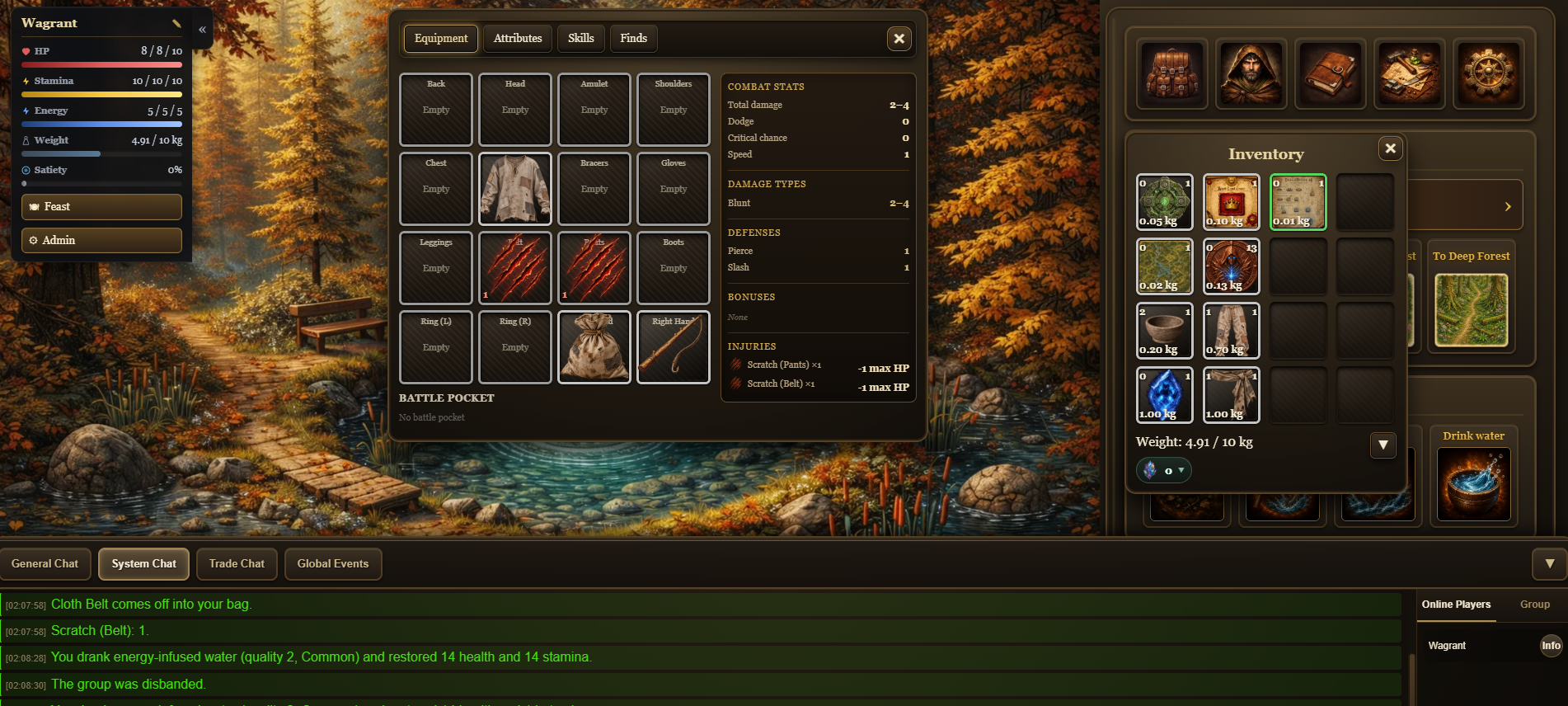
Every equipment piece now has two important defensive values:

Armor directly reduces incoming damage.

Defense is effectively the durability and health of the equipment itself — another layer of health standing between the player and serious injuries.

Injuries are still being worked on, and equipment will play a major role in protecting the player from them.

I’ve also reworked several lootboxes and fixed hundreds of bugs across the game.

Thanks for following the development.

See you in Runelight.


(1 edit)


Equipment rebalancing, injuries, completely rewritten code handling player action synchronization, throwable weapons, and groups, as well as an inordinate amount of testing and bug fixing.
Pretty hard and sad two weeks lol.

(1 edit)

Darkness, a lighthouse, a coastal village, silk, primitive weapons, food, some metallurgy, combat experience for each weapon type, an attribute tree, extensive balancing and testing, etc.


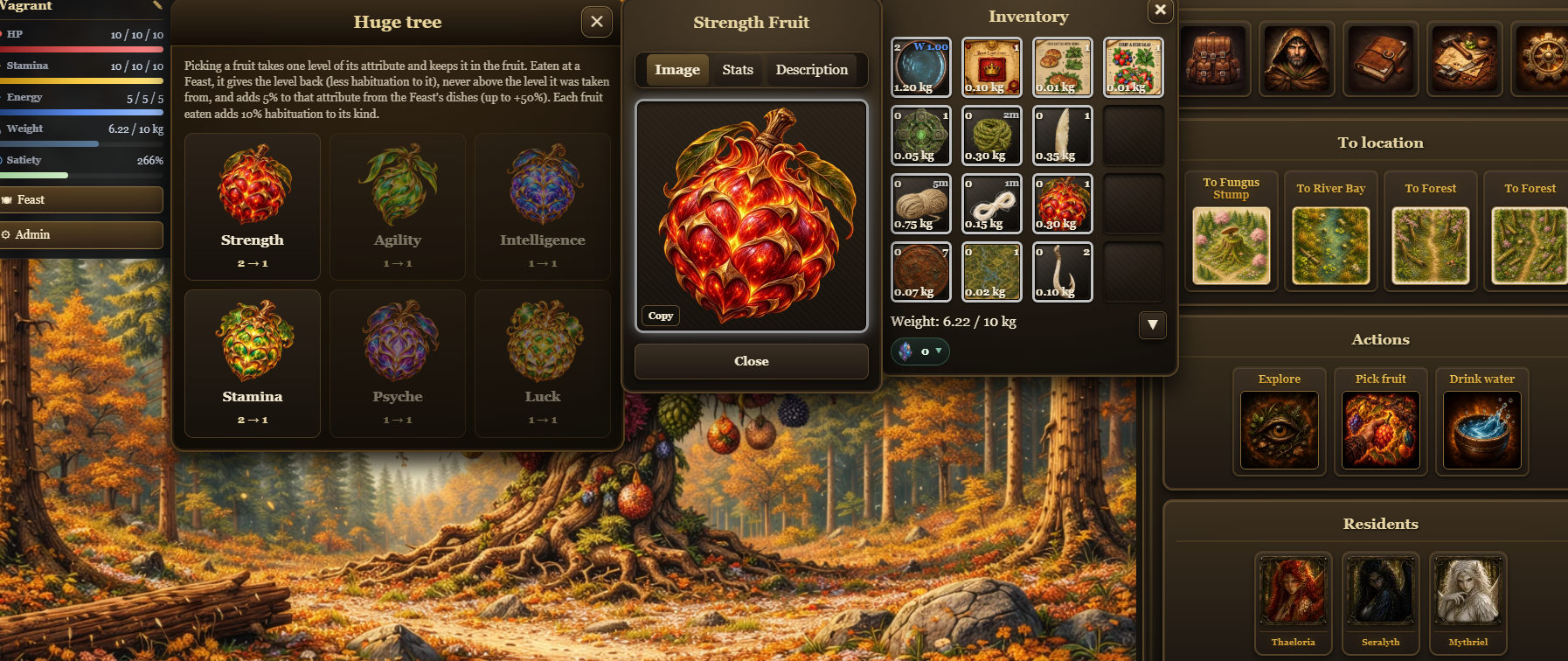
Fruit is a transfer of attributes between players, with a small bonus to the attributes given by the fruit when feasting.

Oh yea, and its 70% of version V0.1

(+1)

Pretty cool to see all the progress in this thread! Just wanted to say nice job. Always great to see people building new worlds!

(+1)

Thank you for the support! truly, that is what is missing the most.
As I’ve said more than once, if I had known how much work would be involved, I probably wouldn’t have started creating this world xD

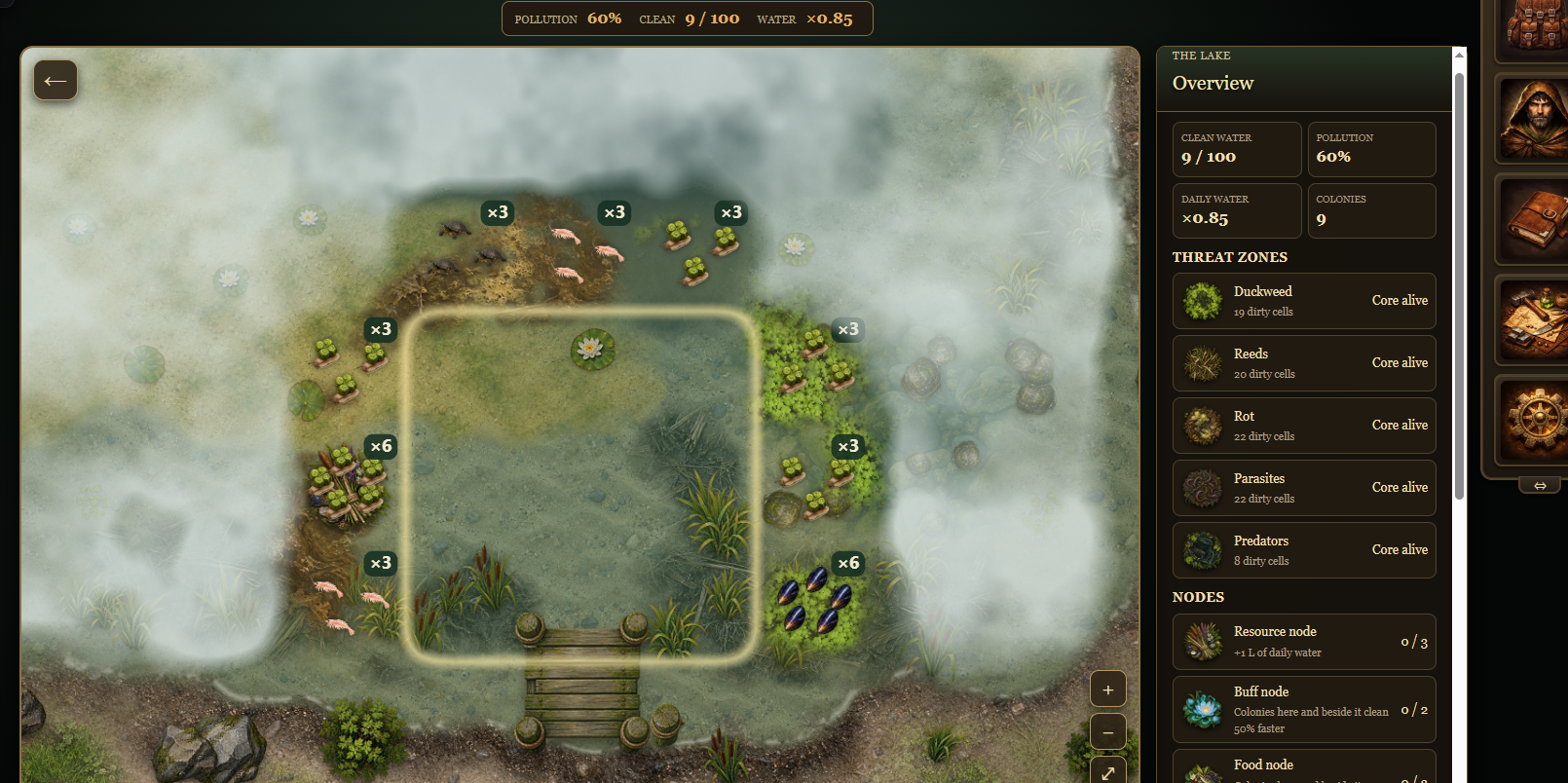
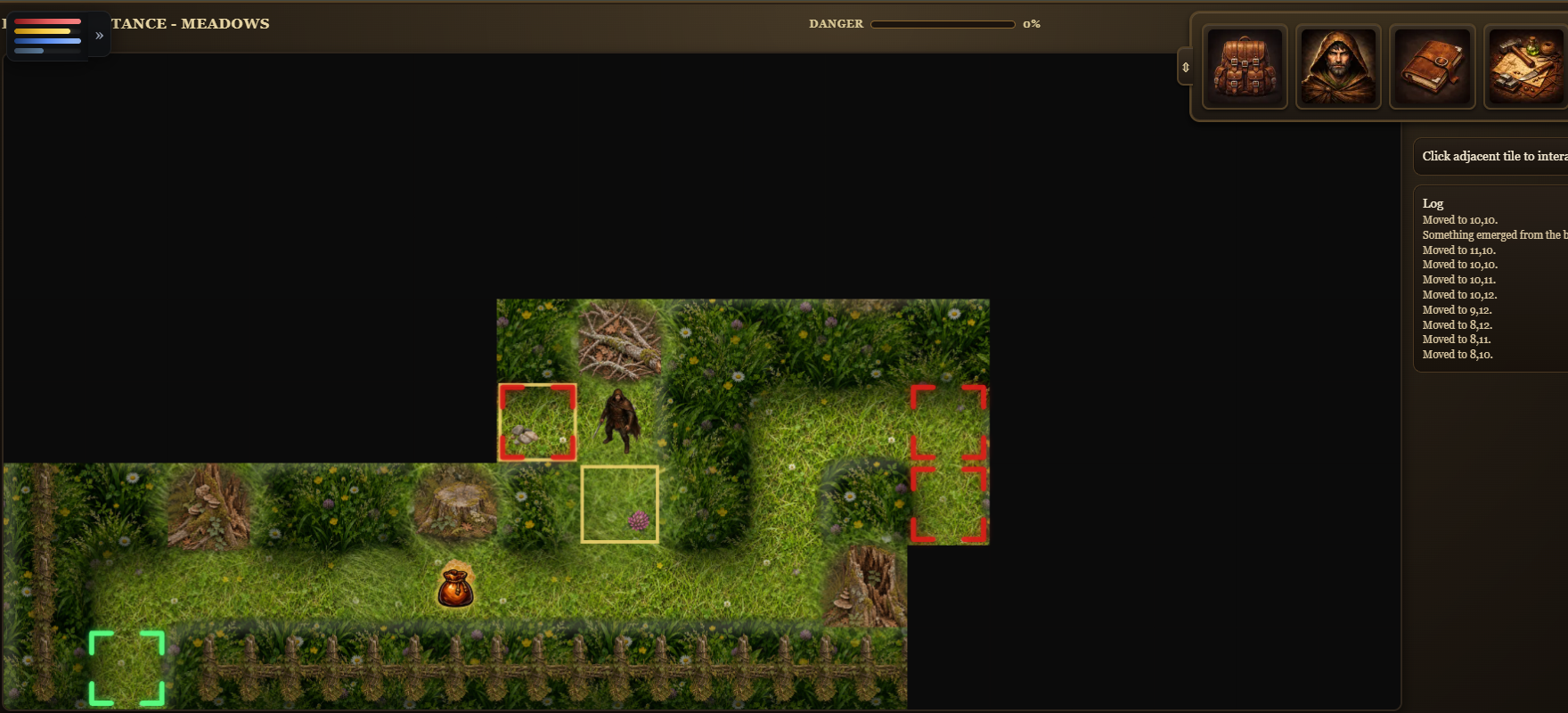
New visuals for the lake (an event on the player's land), bug fixes, new visuals for the forest (which I really don't like, but I don't know how to make it better - this is my 8th or 9th attempt), and a reworked meadows location.


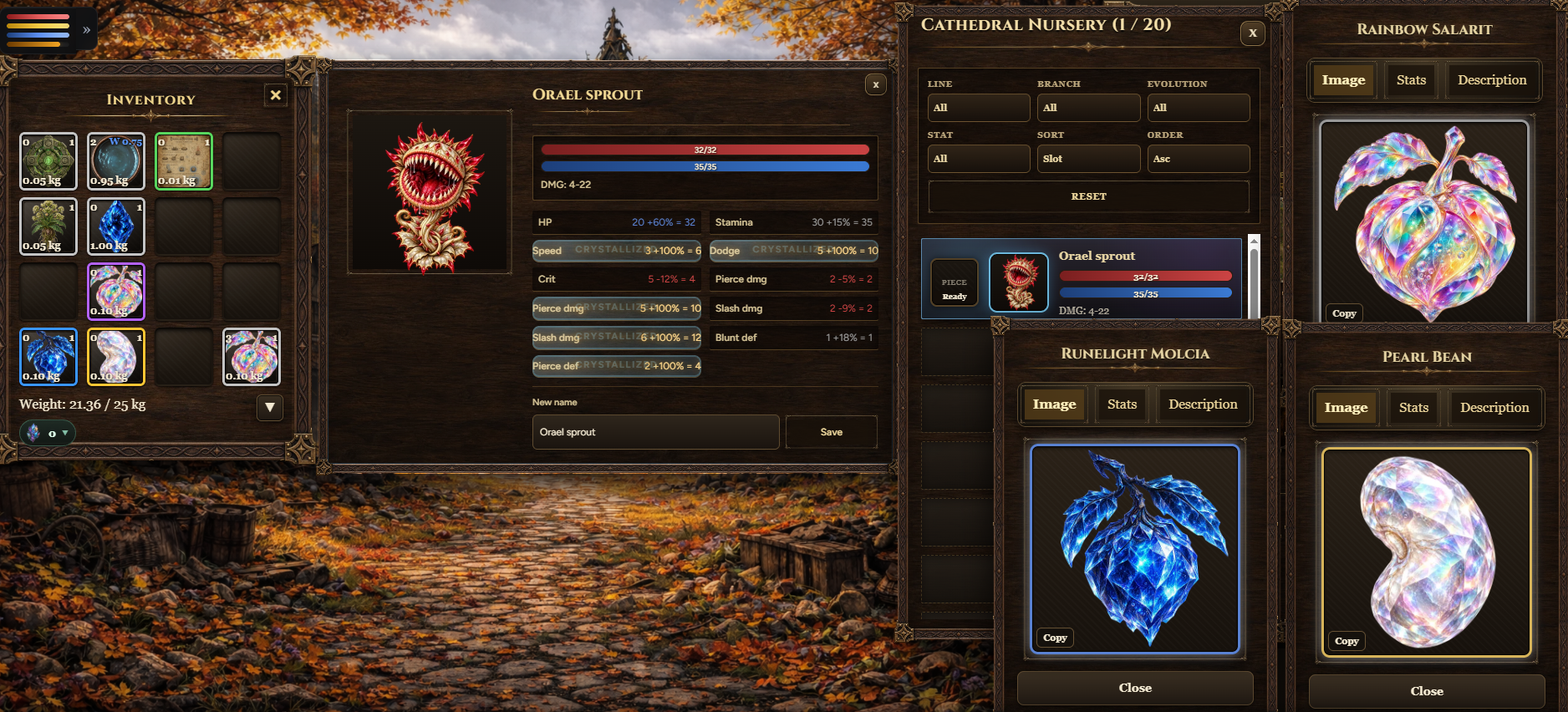
Crystal fruits (The method will increase the potential of creatures, crystallize characteristics or teach creatures new skills),  a new visual look for all monolith and enchanted monolith creatures, village map stand, teleportation with worlds key (fast travel between locations) Evo 1 - 3 creatures balance, and more.
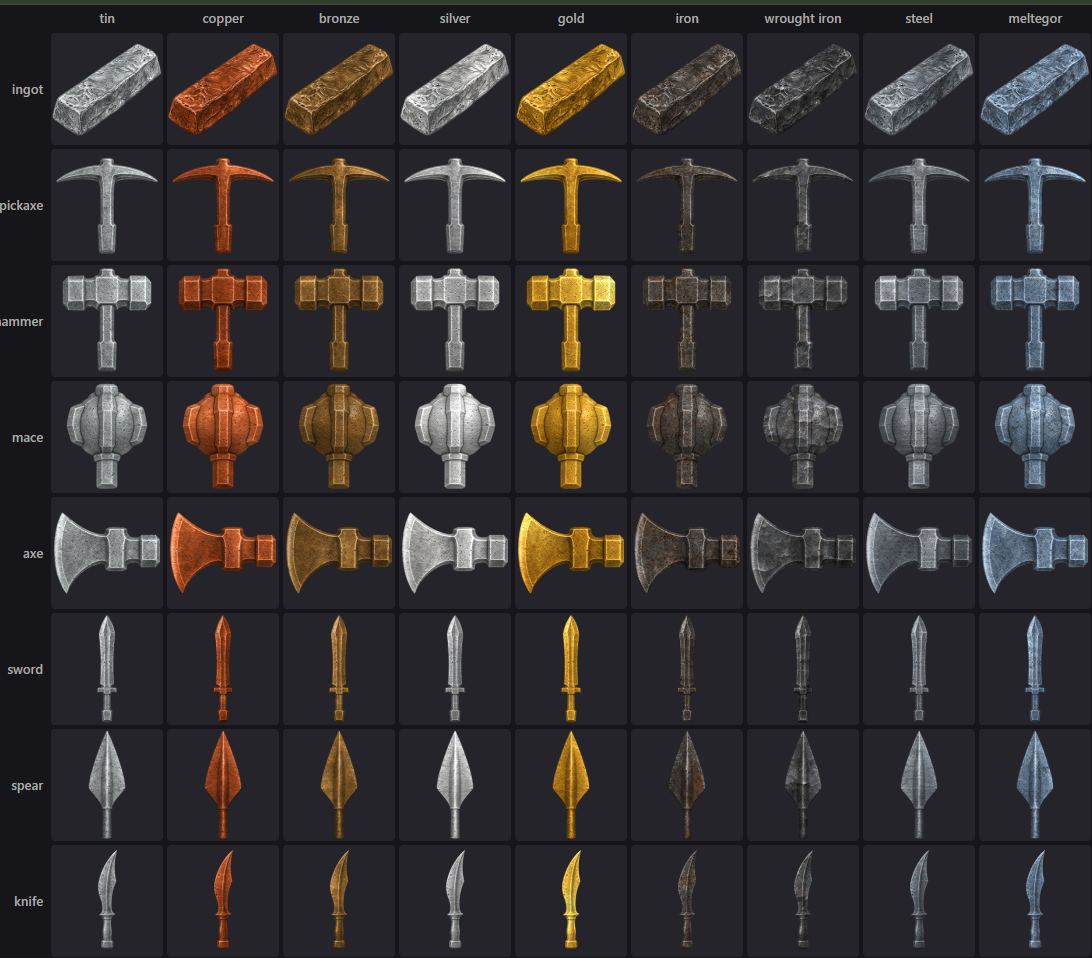
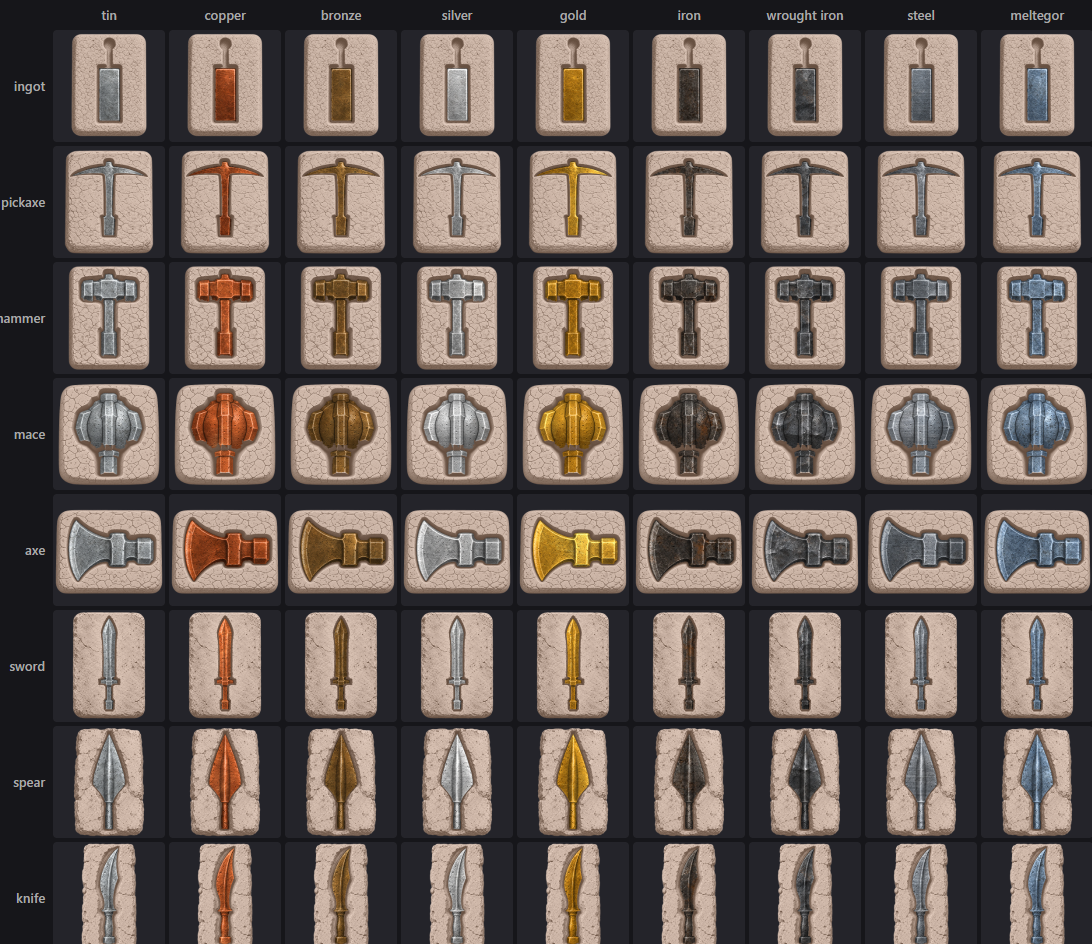
Next, I have plans to assemble metal tools (what I cast into molds will acquire handles and real characteristics), after which I will most likely deal with iron (the branch of iron is huge, there is not only casting, but also forging, and the creation of steel) But most likely iron will once again be postponed for the future, and I will deal with equipment sets, crafting and Chithex, Orael and Nerax machines.
See you in Runelight.

Combat Skills & The Military Camp

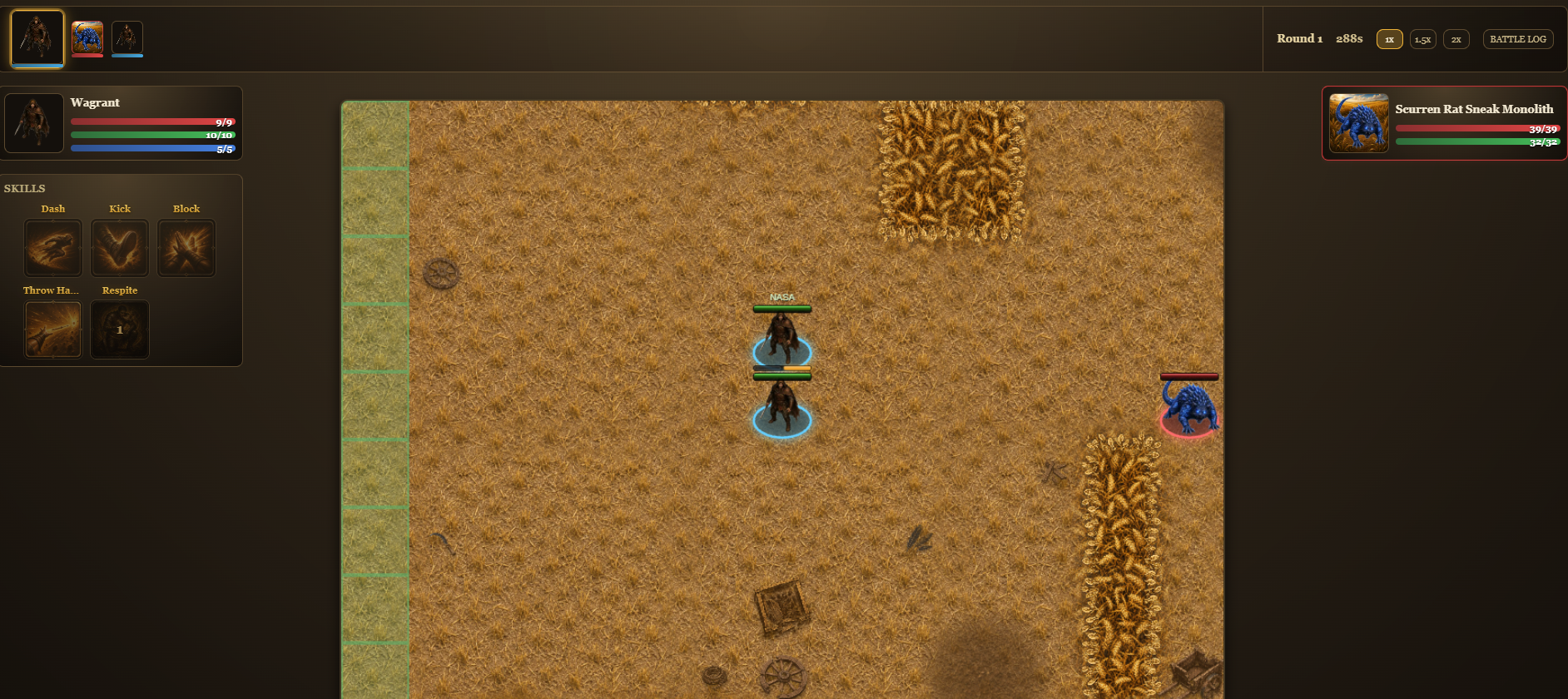
I'm planning a melee combat skill system for Runelight.

The Military Camp, one of the points of interest hidden in the Darkness, will introduce players to combat techniques. Through its quests, players will obtain a Book of Combat Knowledge and gradually unlock more slots for skill pages.

The idea is simple at first: find skill pages, place them in your book, and use their abilities with swords, axes, spears, maces, daggers, or shields.

But things get much more interesting later.

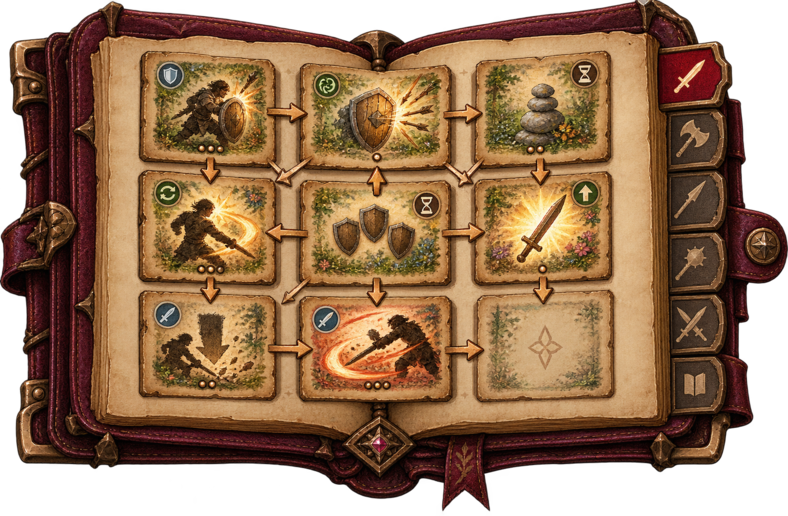
Each page can have directional connections to neighboring pages. Passive pages can modify active skills, react to combat events, accumulate effects, or automatically trigger other abilities.

For example:

  • Dash → Surrounded → Whirlwind: charge into a group and automatically strike surrounding enemies.
  • Block → Accumulate → Counterattack: build up successful blocks to unleash a powerful counterattack.
  • Crushing Blow → Weaken → Finisher: break an enemy's defenses before delivering a heavy strike.

The book starts with just 2 slots and can eventually expand into a 3×3 grid, allowing players to build their own combat combinations.

Pages will be physical, tradable items with different properties and connection directions. Each weapon type can have its own build.

The goal is to make combat easy to learn but offer enormous freedom for experimentation.

Instead of choosing a predefined class, you'll build your own fighting style.

(not ingame image, just example)

The main task of skills is to minimize costs (equipment wear) in battle, since powerful equipment does not give the player invulnerability even from weak creatures.

(+1)

dude is this Ai or you did the art yourself

(+1)

Unfortunately, all pictures are generated by AI, which is why they all differ in colors, visuals, and this is the reason why I regenerate many pictures once every 3 months.

The first book of Runelight is finally ready!

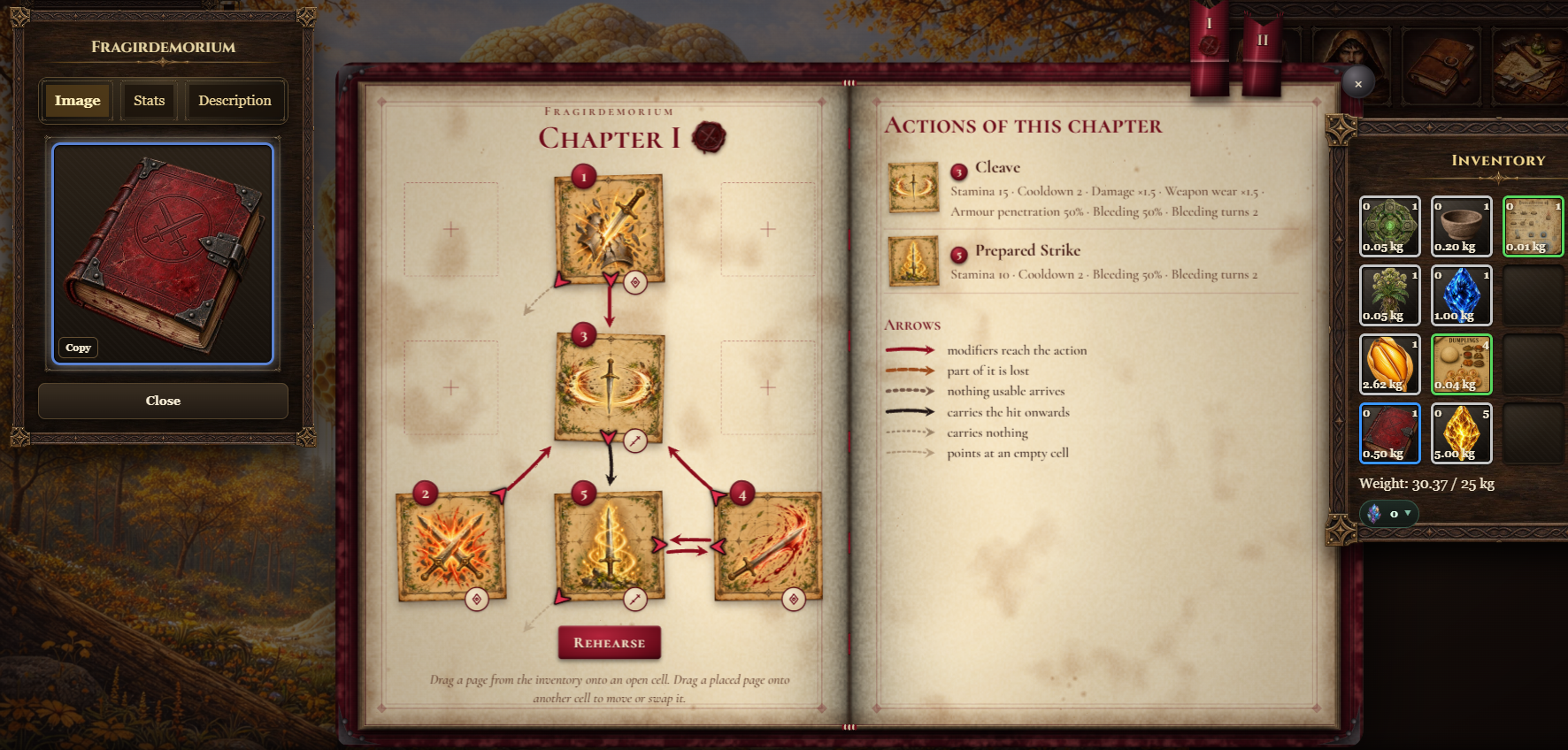
It's one of the four main books in the world, dedicated to the art of war: combat skills, combinations, and building chains of abilities for each weapon type.

The military camp itself is hidden deep in the darkness, and reaching it won't be easy. Players will have to fight their way through dozens of creatures of the dark just to get there.

The first version will include:

  • 10 passive pages that can affect weapon skills and even interact with each other.
  • 5 combat maneuvers.
  • 5 modifier pages (more experience from attacks, reduced weapon durability loss, and so on).
  • 5 active skills for each weapon type (5 for one-handed swords, 5 for two-handed swords, etc.).

The first tests were a complete disaster.

The sheer number of possible combinations in the skill builder was way beyond anything I had prepared for.

What started as a simple idea to make combat less resource-intensive through the book has turned into something much bigger, deeper, and more interesting than I expected.

Each page has its own set of arrows that determine where its effect flows within the book. This creates some really interesting possibilities when putting together different builds, even with a limited number of available pages.

I also realized that clearing a dungeon doesn't actually take that long, at least when we're talking about the first floor of any dungeon.

Tactical decisions have become much more interesting and unpredictable. But there's a funny side effect: now that I want to do everything at once during combat, I'm really starting to feel how limited my character's stamina is.

And, to be honest, I'm too lazy to cook food just to increase it.

Still, even with those limitations, combat feels much more active, dynamic, and alive than before.

What was supposed to be a relatively small improvement to combat has somehow turned into an entire system of its own. And I'm really enjoying where it's going!

Rituals of Scurren

I've been working on a new system of side events for Scurren's Mill — five rotating rituals, each focused on a different creature type: rats, scarecrows, wheat golems, locusts, and ravens.

These won't be ordinary farming areas. Rituals will feature large-scale battles, where dozens of creatures can fight together, form swarms, and overwhelm players through numerical superiority. A new Morale system, influenced by PSY, will make being surrounded genuinely dangerous.

Players will also discover ritual altars, sacrifice candles to trigger increasingly difficult encounters, hunt marked creatures, collect unusual materials, and document supernatural phenomena.

These discoveries can be sold to Torik, the dungeon researcher, for coins or used to investigate the true nature of the rituals.

The biggest addition is 15 unique ritual symbols that players will gradually discover, research, and learn to inscribe onto Scurren equipment using rare materials. This introduces another layer of long-term equipment progression, especially for repairable gear.

Each ritual will also feature a shared world boss, whose health is affected by battles across all participating players.

And there's a darker twist: every creature killed during these rituals actually contributes to the growing power of Scurren.

What looks like a profitable hunting ground may be something very different.

These sub-events are part of the first story arc, which reveals the backstory: they detail the brothers' goals and motivations, as well as their past and present. At this stage, the first level of the first dungeon will be considered complete in terms of game mechanics. I will implement the second level only visually (without sub-events or branching paths), as it would be too complex for the player. The third level is currently just a plan.
In addition, it remains to create three new god-themed locations, add six gear sets (each with its own specific objectives and effects), define the loot (resources) obtainable from creatures, develop an additional event for each new god location, and create structures based on these dungeons that the player can place on their own lands.
Once, when I was writing a post about rituals, it seemed that there wasn't much left...
But all this will add another 10% - which is desirable—toward the V0.1 goal.

By the way, the current drop rate for a skill page is 25%, for a piece of set gear it’s 1%, and the chance of encountering an "enchanted" creature is also 1%. If anyone is interested in seeing what the "on steroids" mode plays like, let me know—I’ll provide a book and some basic gear so you can see for yourself how the first of the four books works, as well as how the combat system currently functions.

See you in Runelight.

(+1)

Hey, ive been reading some of your post and wondering if you need help in animal related things. I offer animal content review to make animal related things in the game grounded, believable or accurate. My portfolio is in my profile if youre interested

Hello! Thanks for the suggestion, but there are no real animals in the game, everything in the world is filled with mythical creatures with their own rules of life and behavior, anomalies and interests, but thanks for showing interest in the project!

Viewing posts 21 to 32 of 32 · Previous page · First page