


Play game
Space Launch's itch.io pageResults
| Criteria | Rank | Score* | Raw Score |
| Innovation | #4 | 3.240 | 3.240 |
| Theme | #6 | 3.160 | 3.160 |
| Overall | #6 | 3.016 | 3.016 |
| Art Style/Visuals | #9 | 3.000 | 3.000 |
| Audio/Sound Design | #10 | 2.960 | 2.960 |
| Gameplay/Fun | #12 | 2.720 | 2.720 |
Ranked from 25 ratings. Score is adjusted from raw score by the median number of ratings per game in the jam.
Game Engine / Tools
Unity
How does your game fit the theme?
The game presents the planets' gravitational pull as the loop that needs to be broken. The player is challenged to carefully propel a rocket around an orbital loop in order to break the rocket free from its gravitational influence and be able to explore further planets. Instead of travelling a straight line, rockets naturally fall into orbit.
Self-made & used stuff
Graphics / Art (e.g. models or textures)
Audio (e.g. music or sound effects)
Assets (e.g. free or owned)
Leave a comment
Log in with itch.io to leave a comment.
Comments
It's an interesting concept. But it is really difficult to maneuver the ship on landing. Often times you return, sometimes drifted out.
And when you managed to ge close the planet, I don't feel the air resistance that slows the ship. I tried to slow down, but it still crash. I am probably doing it wrong. There is also risk of going out of the planet you are trying to land, until you ran out of fuel. Then restart back to 0.
If only we have more fuel capacity, then players can have more time to get familiar with landing mechanism and eventually get it right.
Nevertheless, I think this entry is great and original. Good work.
This is such a unique take on orbital mechanics! The way gravity acts as the loop to be broken is a clever interpretation of the theme. The physics feel well thought out, and it's satisfying to successfully navigate between planets. However, I do agree with others that the initial learning curve is quite steep, perhaps a small tutorial or visual hints would help players get the hang of it faster.
I also noticed that the particle effects on the rocket don’t always align perfectly when tilting, which could be a nice polish improvement. The zooming effect on the planets is really impressive; it gives a great sense of depth while keeping everything in 2D. Overall, a fantastic and immersive experience! great job! 🚀🔥
Nice game jam on launch I like the graphics.
What an interesting game concept! It truly feels unique and innovative, especially in how you approach the idea of breaking the loop through rocket launches to land successfully.
At first, I honestly thought it was impossible to land on a planet safely since I kept exploding every time I tried haha. So, my initial attempts were a bit frustrating.
A small tutorial would be really helpful to better understand how everything works. Maybe placing a nearby planet with detailed instructions on how to land would be a great way to help players grasp the mechanics and absorb the necessary skills, as it’s quite a complex system to master.
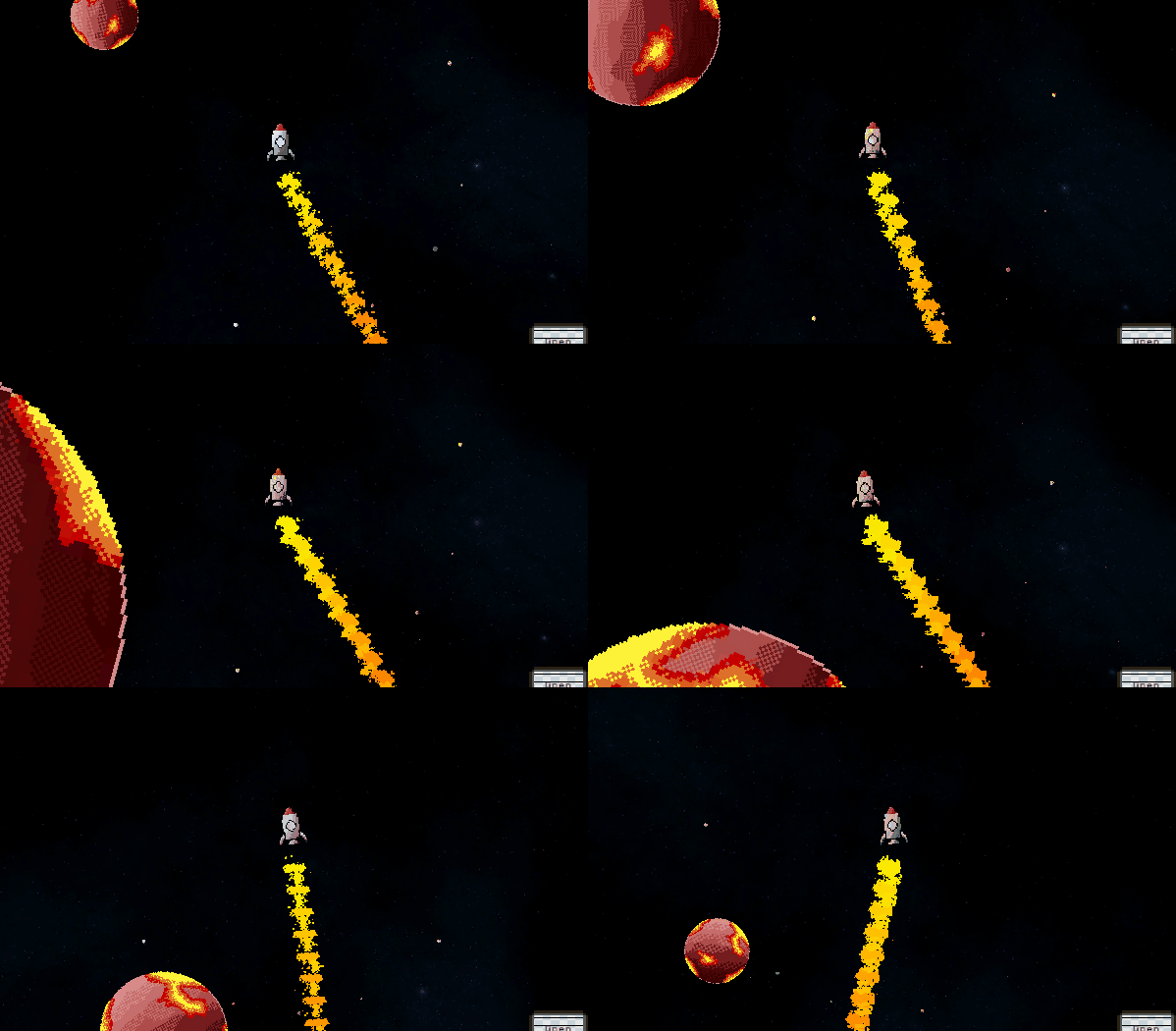
The sound effects and graphics are fantastic, adding great immersion to the game’s atmosphere. However, I did notice something about the rocket’s particles—they don’t seem to follow its direction when it’s tilted at an angle that isn’t straight. Tweaking this could make the combustion at the rocket’s tip feel more natural.
Speaking of particles, I have a suggestion for the intro. I found it fun and engaging, but I noticed that when the rocket takes off, it leaves the letters incomplete. Maybe if the letters had a fire-like texture similar to the rocket’s particles, it would enhance the visual impact, even though it doesn’t significantly affect the gameplay experience.
I’m genuinely curious about how you created the zooming effect on the planetary orbits. Could you share a bit about your thought process and implementation? I’d love to learn more about the techniques you used!
Congrats on the game, and best of luck with the jam!
Hey, thanks for playing!
Damn, I would have written a devlog if I had known that anyone would be genuinely interested in the utilized techniques.
So, each planet consists of a collider that is statically positioned somewhere in the world space (where I want the planet to be) and a sprite renderer that is - by default - positioned at the same position. The collider and the renderer have the same shape and size.
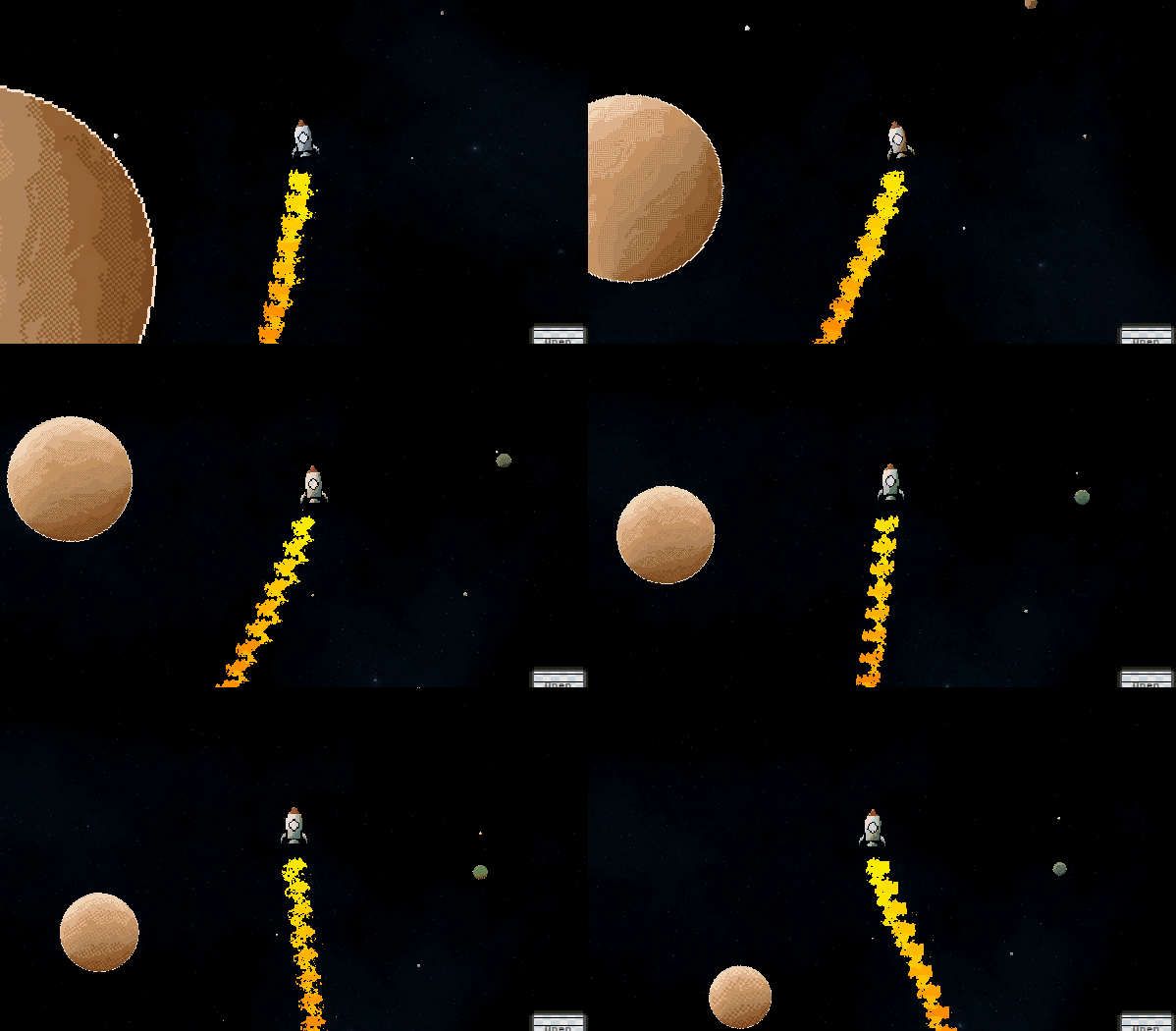
The collider remains at its original position and scale always, the sprite renderer's position and size on the other hand are computed based on the rocket's distance and direction to the planet's original position. If the distance is smaller than a certain threshold, then this indicates that the rocket is on the planet or at least very close to it - in which case the sprite renderer should be at its original position and size (and exactly match the collider's).
Once the rocket's distance to the planet increases, the sprite renderer's scale will be reduced by a fixed rate, until a limit has been reached (this is why planets never really disappear). Also, I am computing the direction from the rocket towards the original planet's position to determine the position of the "projection" (i.e. the sprite renderer). So if the original planet's position would be somewhere in the top left direction, the projection is rendered on the top left - just as an example.
With this approach, we can distinctly compute a size and position for each planet's projection based on the rocket's position and rotation.
Interestingly, even the background is a projection that simply moves with the rocket.
I think it will become clearer with a short video:
You can see the "regular" game view on the right hand side, and on the left side you can see what is really happening behind the scenes. You can see the planet's size and position changing as well as the background and everything moving with respect to the rocket, except for the collider (the green outline). That one stays in its position always.
I hope this information is useful for you. Glad that you are interested!
This felt like a mini-game version of Kerbal Space Program! :-)
A fun and well-thought-out concept, and the execution was impressive—especially considering how tricky the physics must have been, combined with the mix of 2D and 3D space.
Playing it wasn’t easy either! 😄 It took some practice to successfully travel from one planet to another, and landing wasn’t the simplest task I’ve ever faced in a game. But that added a fun challenge to the experience.
Making travel easier would have been nice to get to all planets quickly, but it was also good this way.
The pixel art gave the game a cute look, and the music and SFX fit the style perfectly.
The theme was incorporated in a unique way—check!
I really enjoyed hopping between planets and figuring out the mechanics.
All in all, a very creative and solid jam entry! 🚀🪐✨
Very hard to master but fun enough to keep trying. A bit more handholding in at the start in the form of a tutorial would be welcome but i understand in a game jam there is not always time for that. I also like the unique take on breaking the loop.
The game mechanic is quite difficult and can feel a bit frustrating without a tutorial. I struggled to land since I kept running out of fuel, but I can see that with some practice, it could become really engaging. The mechanic itself is very interesting and has a lot of potential. The theme fits well, and I really appreciate your unique interpretation of it. The overall art style is simple yet charming, and the music and sound effects complement the game nicely.
With a bit more guidance for new players, this could be a really fun and rewarding experience. Great work!
38 Crashes, 4,916,224 Units of Fuel used, 28 minutes, 54 seconds
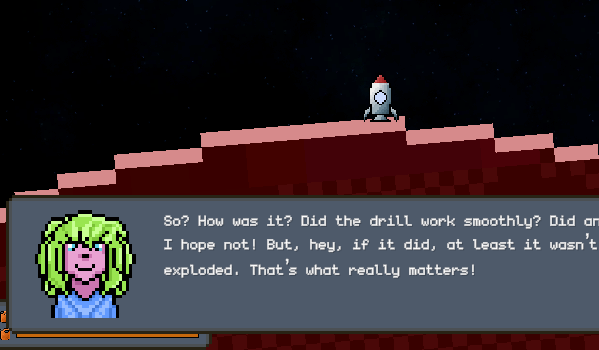
This game is a real treat. I really thought landing was impossible, but I eventually figured out how to do it. It made more sense once I understood how to get from planet to planet and how much distance the planets were from one to the other. I will admit I did not land on the pad. I landed the ship sideways on the final planet and skirted my way to the pad. Maybe put another base on the other side of pad if you want to prevent it. I was blown away with the way planets moved away and got closer as you came in and out of orbit. I am very curious if this was 2D assets in a 3D space or if you did this all in 2D. I much enjoyed the banter from the guide from the start and every time they contacted you after that. The manual was well done, and really liked it, although I would have preferred if traveling from planet to planet was in there. It took a while to realize I just needed to point the rocket at the planet I wanted to go to. Programming out edge cases was a nice touch like making the rocket explode on restart instead of teleporting the player back to the planet with no feedback. You even planned for the scenario of a player flying too far away from all the planets and suggesting a respawn. Great Work! I did eventually mute the music, which thank you for leaving an option to do so with a mouse click. I just was playing for so long the looped music got a little old. Lastly, I think it would be better if at the time of a crash, the camera would stop moving instead of bouncing around like crazy.
Thank you for the game. I really enjoyed playing it.
The gameplay was fun and engaging, and the gravity concept was great! I’m also really curious about the technical side of the game. The manual was well done and helpful.
Two things that I think could use some improvement:
Overall, it was a very enjoyable experience with simple visuals and fitting sound effects!
Wow, the physics were fun to play with in this game! Very cool and original idea. I played this game for quite some time—it was so satisfying to launch the rocket around the planets and then slow down enough to land on the different planets.
Nice soundtrack.
The engine exploding is kind of funny.
I liked the control of the rocket and the way gravity is overcome, although it requires quite a bit of practice.
The graphics and sound are at a good level.
It seems like a pretty innovative concept, but difficult.
It doesn't quite fit the theme of the jam, but it's good.