

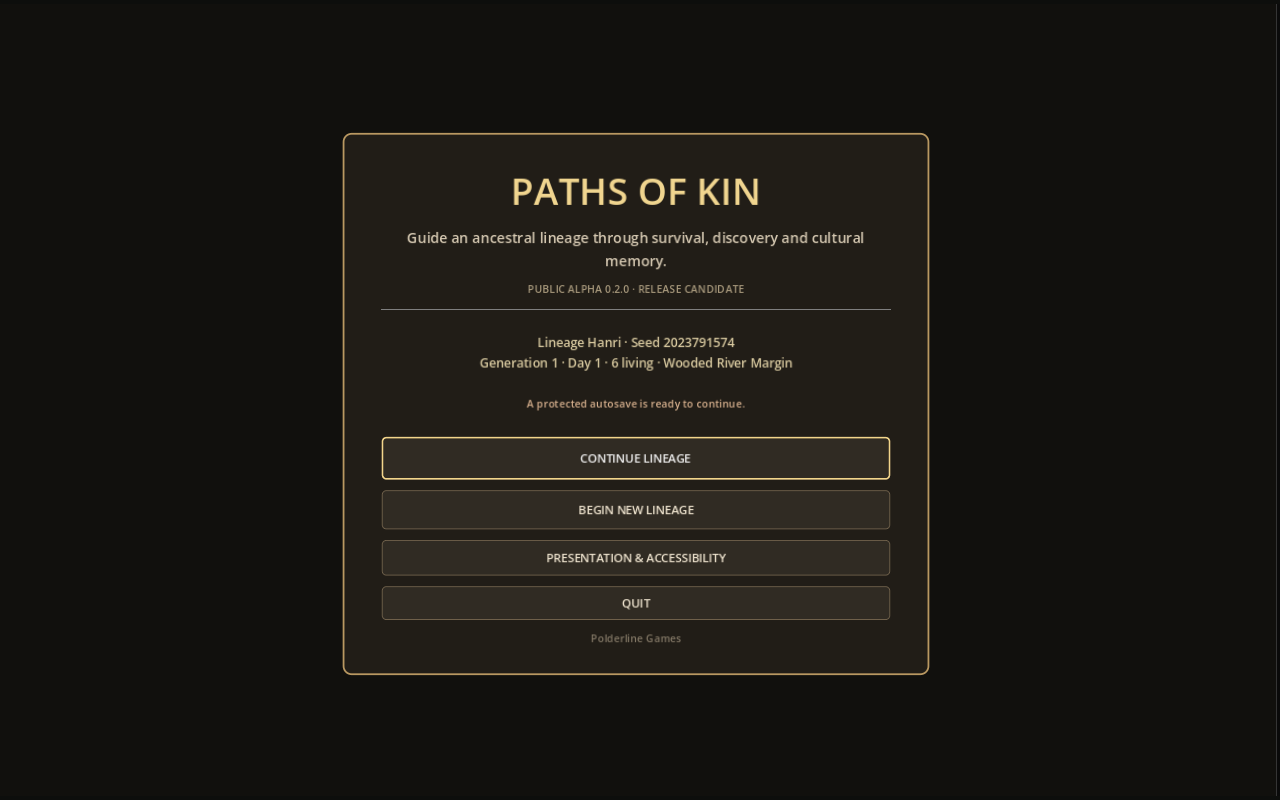
Hello! We are Polderline Games, a small independent game studio from the Netherlands. This is the first development log for Paths of Kin, our turn-based survival, ecology and cultural-discovery game.
Paths of Kin is about guiding a small ancestral lineage through a changing prehistoric world. It is not primarily about conquering territory or racing through a conventional technology tree. The focus is on survival, observation, experimentation and the knowledge that people pass between generations.
What do you do?
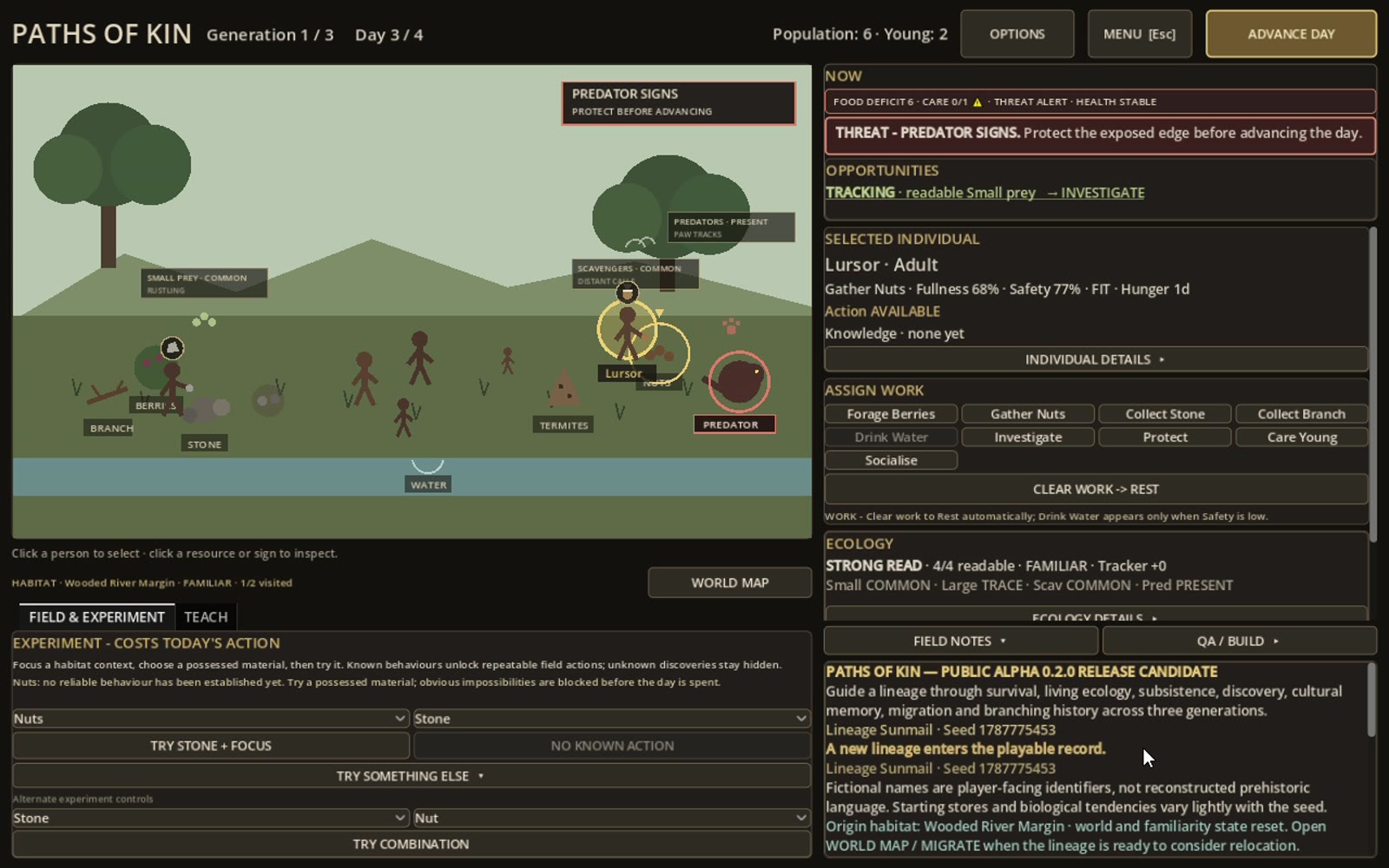
Each day, you decide how the members of your lineage spend their limited time. They might gather food, recover, investigate the environment, experiment with available materials or respond to threats and opportunities.
Individuals have different abilities, conditions and cultural knowledge. Sending the right person can improve an outcome, but concentrating important knowledge in only one person also creates risk. Injuries, illness, ageing and death can change what the group is capable of doing.
The world does not remain neutral. Animal activity, carcasses, resource pressure and environmental conditions change over time. A successful decision today can affect what remains available tomorrow.
Learning rather than unlocking
One of the central ideas behind Paths of Kin is that knowledge should feel discovered and carried—not simply purchased from a technology menu.
Experiments can reveal useful practices. People can teach what they know to others, and the history of that knowledge remains connected to the individuals who discovered or carried it. If knowledge is not shared, the lineage may eventually lose it.
We want players to think about questions such as:
- Who should take a risk?
- Who needs time to recover?
- Which environmental signs can be trusted?
- Should scarce knowledge be used immediately or taught to someone else?
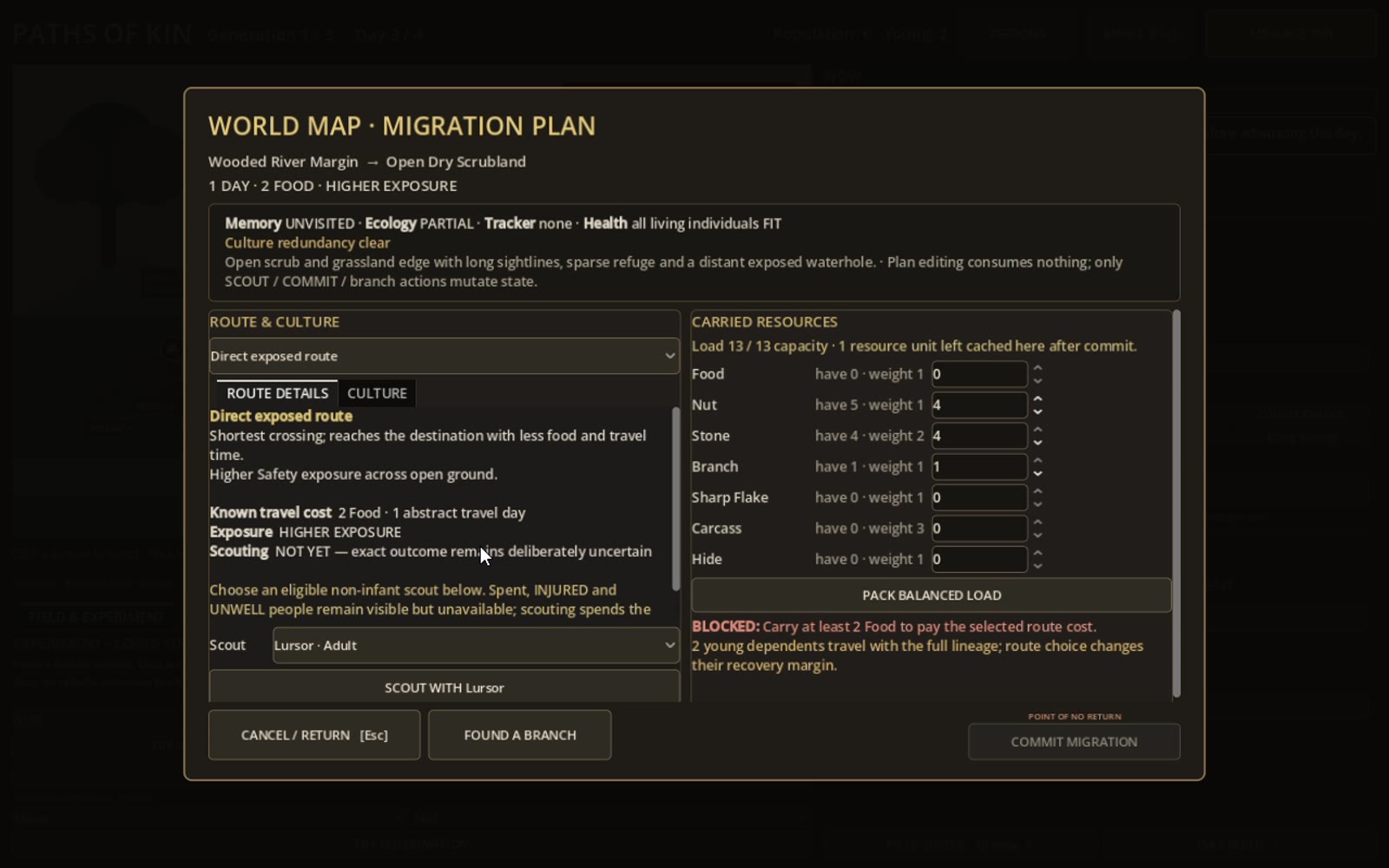
- Is it safer to remain in a familiar habitat or migrate into uncertainty?
A world that remembers
Paths of Kin records the consequences of the player’s decisions. The lineage develops its own history through discoveries, migrations, injuries, relationships and losses.
Seeded worlds provide reproducible starting conditions, while player choices create different histories from the same beginning. Save and branch features are designed to let players preserve a lineage or explore a different decision without erasing what happened before.
Our goal is for the end of a playthrough to feel like the history of a particular group of people—not merely a collection of upgraded statistics.
Current development stage
Paths of Kin is currently undergoing a restricted Windows alpha test. The build is not yet publicly downloadable or indexed on itch.io.
The present release candidate has passed external testing on two independent Windows computers, including download, launch, gameplay, save, quit, restart and continued-lineage restoration. We are now preparing a small cohort of first-time players to test something that is much harder for us to judge ourselves: whether the game communicates its systems clearly without requiring guidance from its creators.
We are particularly interested in:
- Whether players understand what deserves attention each day.
- Whether ecological information supports decisions without becoming overwhelming.
- Whether the effects of work, recovery and experimentation are sufficiently clear.
- Whether migration feels like a meaningful commitment.
- Which interfaces first-time players find difficult to read.
This thread will follow the project’s development, lessons from testing and the changes that result from them. We will keep private builds and tester information out of the public posts.
A design question
When a survival-management game involves uncertain outcomes, which presentation do you prefer?
- Exact probabilities, such as a 43% chance of success.
- Qualitative forecasts, such as Low, Uncertain or Favourable.
- Limited information that becomes clearer through observation and experience.
- A combination of these approaches.
Paths of Kin currently uses a mixture, but we are still examining where uncertainty feels meaningful and where it only makes decisions harder to understand.
Thank you for reading. Constructive thoughts about this question—or about the project’s central idea—are very welcome.