Indie game storeFree gamesFun gamesHorror games
Game developmentAssetsComics
SalesBundles
Jobs
TagsGame Engines

Polderline Games

5
Posts
2
Topics
A member registered 74 days ago · View creator page →

Recent community posts

Thanks for the detailed reply! It sounds like you already have a pretty clear idea of where you want to take it.

I especially like the idea of giving player size and attributes more meaningful strengths and weaknesses rather than simply making bigger/taller players “better.” If the events and match situations eventually make you think about speed, agility, heading, positioning, etc., I can see that adding quite a bit of personality to squad building.

Focusing on getting the gameplay logic where you want it before calling it beta makes sense too. Good luck with the next update — I’ll be interested to see how it develops!
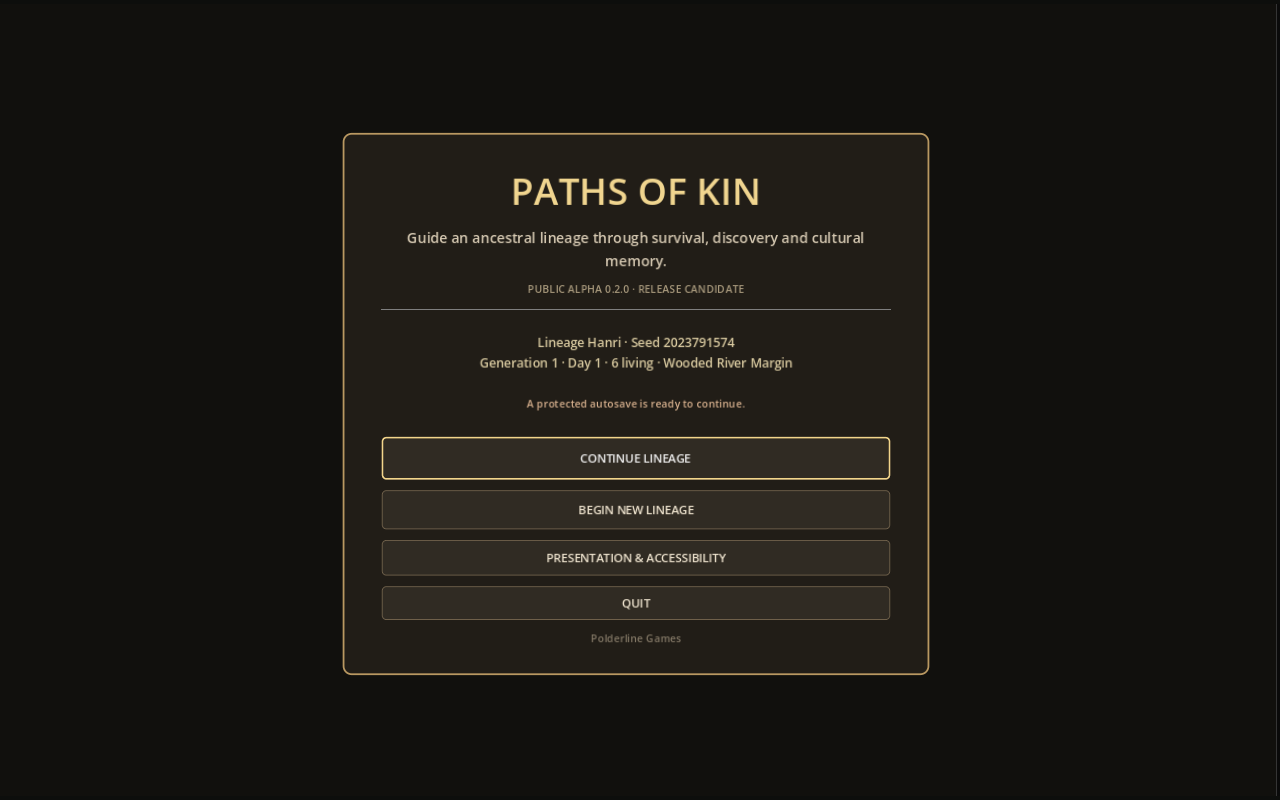
Hello! We are Polderline Games, a small independent game studio from the Netherlands. This is the first development log for Paths of Kin, our turn-based survival, ecology and cultural-discovery game.

Paths of Kin is about guiding a small ancestral lineage through a changing prehistoric world. It is not primarily about conquering territory or racing through a conventional technology tree. The focus is on survival, observation, experimentation and the knowledge that people pass between generations.

What do you do?

Each day, you decide how the members of your lineage spend their limited time. They might gather food, recover, investigate the environment, experiment with available materials or respond to threats and opportunities.

Individuals have different abilities, conditions and cultural knowledge. Sending the right person can improve an outcome, but concentrating important knowledge in only one person also creates risk. Injuries, illness, ageing and death can change what the group is capable of doing.

The world does not remain neutral. Animal activity, carcasses, resource pressure and environmental conditions change over time. A successful decision today can affect what remains available tomorrow.

Learning rather than unlocking

One of the central ideas behind Paths of Kin is that knowledge should feel discovered and carried—not simply purchased from a technology menu.

Experiments can reveal useful practices. People can teach what they know to others, and the history of that knowledge remains connected to the individuals who discovered or carried it. If knowledge is not shared, the lineage may eventually lose it.

We want players to think about questions such as:

  • Who should take a risk?
  • Who needs time to recover?
  • Which environmental signs can be trusted?
  • Should scarce knowledge be used immediately or taught to someone else?
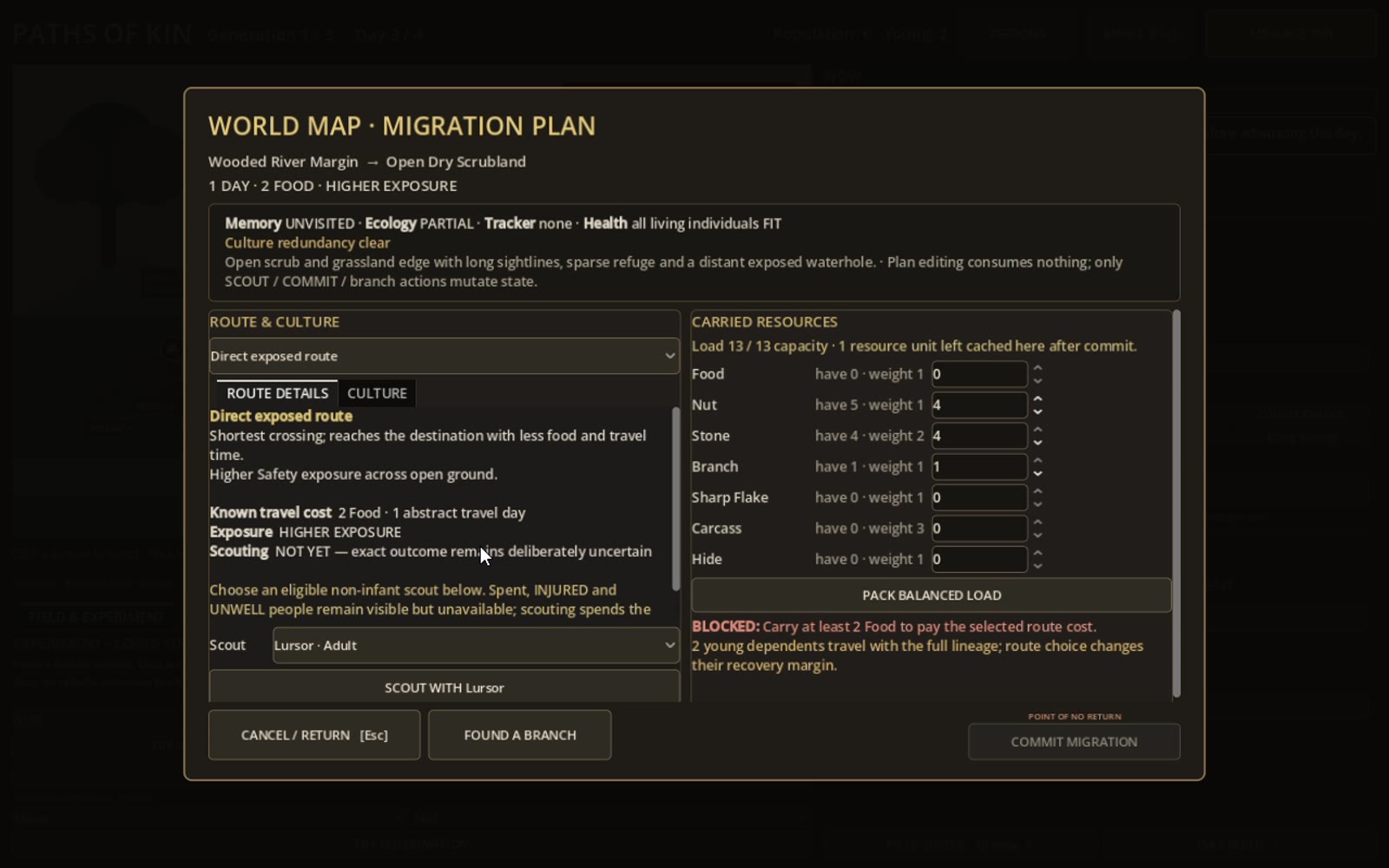
  • Is it safer to remain in a familiar habitat or migrate into uncertainty?

A world that remembers

Paths of Kin records the consequences of the player’s decisions. The lineage develops its own history through discoveries, migrations, injuries, relationships and losses.

Seeded worlds provide reproducible starting conditions, while player choices create different histories from the same beginning. Save and branch features are designed to let players preserve a lineage or explore a different decision without erasing what happened before.

Our goal is for the end of a playthrough to feel like the history of a particular group of people—not merely a collection of upgraded statistics.

Current development stage

Paths of Kin is currently undergoing a restricted Windows alpha test. The build is not yet publicly downloadable or indexed on itch.io.

The present release candidate has passed external testing on two independent Windows computers, including download, launch, gameplay, save, quit, restart and continued-lineage restoration. We are now preparing a small cohort of first-time players to test something that is much harder for us to judge ourselves: whether the game communicates its systems clearly without requiring guidance from its creators.

We are particularly interested in:

  • Whether players understand what deserves attention each day.
  • Whether ecological information supports decisions without becoming overwhelming.
  • Whether the effects of work, recovery and experimentation are sufficiently clear.
  • Whether migration feels like a meaningful commitment.
  • Which interfaces first-time players find difficult to read.

This thread will follow the project’s development, lessons from testing and the changes that result from them. We will keep private builds and tester information out of the public posts.

A design question

When a survival-management game involves uncertain outcomes, which presentation do you prefer?

  1. Exact probabilities, such as a 43% chance of success.
  2. Qualitative forecasts, such as Low, Uncertain or Favourable.
  3. Limited information that becomes clearer through observation and experience.
  4. A combination of these approaches.

Paths of Kin currently uses a mixture, but we are still examining where uncertainty feels meaningful and where it only makes decisions harder to understand.

Thank you for reading. Constructive thoughts about this question—or about the project’s central idea—are very welcome.

Hi! I tried version 0.08 in the browser and explored the club setup, Home screen, squad, tactics, players, contracts, training and part of the first match.

The initial objective was reasonably clear. The Home screen shows the next match and a useful “Needs Attention” list. However, once the career begins, many systems are presented with roughly equal importance. I could find the different pages, but I was not immediately sure which actions were essential before playing the first match. A short first-week checklist—such as confirm your lineup, choose training, review tactics and play the match—could help new players.

The individual tactics and training descriptions mostly made sense, but there was a lot of information to absorb immediately. On my first visit, I was not confident how much the tactical sliders would affect the match or how they related to the manager instincts selected during setup. A small summary of the expected benefits and risks of the current setup might make this easier to understand.

The match display was readable, and the humorous commentary fits the tone of the game. Players did frequently overlap or form tight clusters, especially around midfield, which made the action harder to follow and slightly less believable. I also noticed some of the goal-kick commentary repeating quite quickly.

My biggest point of friction was match resolution. I initially overlooked the Simulate button beside Play Match on the Home screen. After choosing Play Match, however, I could not find a way to simulate or instantly resolve the remainder of the match. I selected Top speed and checked the Tactics screen, but there was no obvious “Simulate remainder” or “Instant result” option. If one exists, it may need to be more visible; otherwise, I think it would be a useful addition. This was the point where I stopped playing.

I did not encounter a crash or broken control. I did not play long enough to judge season balance, finances or long-term player development fairly. I would be interested in continuing the career, particularly with clearer early priorities and the option to resolve the remainder of a live match.

I played through the opening in the browser on version 1.2.0 and reached the end-of-day objective.

The first few minutes were generally clear. The objective pointed me toward the shortwave radio, and I never felt that I was wandering around the room without knowing what to do. The persistent goal text and interaction prompts worked well.

While tuning toward the requested 88.7 MHz beacon, I found the 92.6 MHz practice station first and spent a couple of minutes decoding signals there. This felt more like an interesting optional discovery than a serious problem, but initially I wasn’t sure whether I was supposed to remain there or continue toward 88.7. Calling it an “optional practice station” might make that distinction clearer while preserving the discovery.

There also seems to be an important mismatch between this post and the current build. The post says to choose Advanced and use Space for the Morse key. In version 1.2.0, however, Intermediate is described as the mode where you tap the Morse key and the letter breaks are handled automatically. Advanced now says that nothing is recorded and that you decode directly from what you hear. I followed the post and chose Advanced, so I never received the pre-shaped Morse-key record and couldn’t evaluate that specific mechanic. Updating the instructions in this topic would probably help future testers reach the mode you want feedback on.

On the no-record Advanced mode, the assistance options worked well. Slowing the signal to 6 WPM, replaying it, using letter-by-letter playback, checking the character-count hint and receiving specific mismatch feedback allowed me to recover from several wrong answers and finish the objective.

One smaller usability observation: the Morse chart is readable and being able to drag it is helpful, but it covers a large portion of the radio and decoding interface. I moved it repeatedly to see the information underneath. A smaller docked version, adjustable size or more compact collapsed state might reduce that friction.

Overall, the opening was understandable, the radio interface communicated its state well, and the restrained room and sound-focused interaction established the atmosphere quickly.

Hello! I’m preparing a small restricted playtest for Paths of Kin, a turn-based survival, ecology and cultural-discovery game about guiding an ancestral lineage through a changing prehistoric world.

I’m looking for 3 independent first-time testers, and I will invite up to 5 volunteers to allow for scheduling or drop-off. This is an unpaid test of the Windows Public Alpha 0.2.0 release candidate and should take about 30–45 minutes.

I especially need feedback on:

- whether the first actions and daily work system make sense without coaching;

- whether food, water, care, health, ecology and threats are understandable;

- whether World Map, Field Notes, Options and the Lineage Menu are discoverable;

- readability at your normal Windows resolution/scaling;

- Save & Quit, relaunch and Continue Lineage behavior;

- crashes, freezes, blockers or confusing decisions.

Requirements: Windows 10 or 11 x64, Microsoft Defender enabled, and willingness to download/extract a ZIP and return a short structured feedback form. The build is not code-signed, so Windows may show an Unknown publisher SmartScreen notice on first launch. The ZIP has passed Defender scans on two separate Windows machines; testers should scan their own download and stop if they see a named detection or quarantine.

The itch.io page remains restricted. Suitable testers receive a unique private download key—no public key will be posted.

If interested, email playtest@polderlinegames.com with:

1. Windows 10 or 11;

2. approximate screen resolution/scaling if known;

3. confirmation that you have not previously played this build;

4. whether you can test within the next seven days.

If you are also an itch.io developer, I can optionally return a 20–30 minute playtest of one free Windows build after this cohort closes.


Itch.io creator profile: https://polderlinegames.itch.io/

Paths of Kin overview: https://polderlinegames.com/

Playtest access: Restricted itch.io build; selected testers receive individual private access by email.