
Indie game storeFree gamesFun gamesHorror games
Game developmentAssetsComics
SalesBundles
Jobs
TagsGame Engines

Hi, it's me again asking about the same thing as before. This is more of a feature request, though.

I would really like a built-in way to just punch out shapes/lights from the ambient color. 

I'd like to make a room that's entirely blue with a plain circle punched out of it, for example.
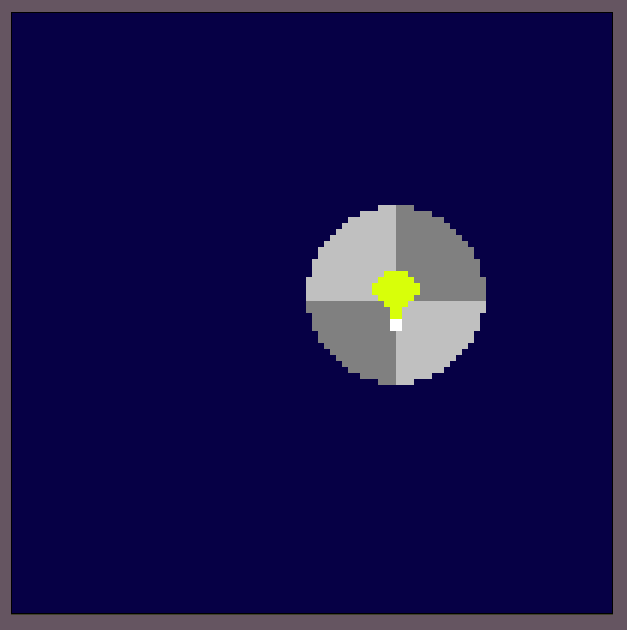
I don't want the light to appear colored at all. I just want it to be a punch-out from the ambient darkness.

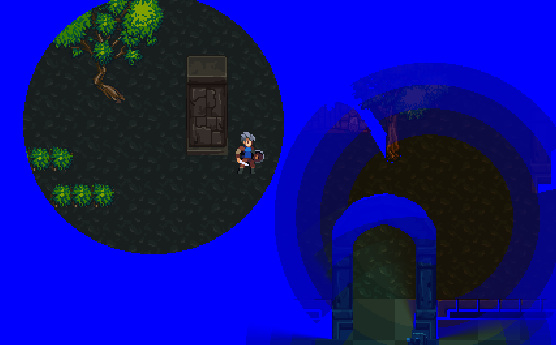
My last comments found a method for cutting out a hole in the ambient color, that is just hitting the ambient color with a light that's a perfect inverse of it. This only works if the ambient color is multiplicative, though. To make the ambient color fully opaque like the example above, I have to call .SetAmbientColorOverlayEnable(true);.

As far as I can tell, there isn't a way to cleanly cut a hole through fully-opaque lighting like this; every light in this environment has a blue tint to it, because the lights can basically only add color to the ambient lighting.

I feel like there are a lot of use cases for covering an area in complete darkness with lights acting as cut-outs like this, so I would really appreciate if there was an easy way to handle it. 
(1 edit)

Hello, Brittle Lizard

Okay, so basically this technique is the simplest one to make a lighting system in GameMaker, which essentially involves cutting the alpha channel of the surface based on what you draw. But Crystal needs to use a more complex blending process to work with shadows correctly. This approach of clipping the surface doesn't work correctly in Crystal because the alpha channel of the light texture is already being used for the shadows. Also, if I do it the way you suggested, the lights wouldn't work during the day, only if you have some ambient lighting.

However...

What can be done is to simulate this blending in a different way, but with the same result, in the combine pass shader itself.

I tried to do what you suggested, but it adds some edge cases that will take time to figure out, so I can't add it as a built-in feature for now, but you can use the code below as a workaround.

Open the shader: "__cle_shDeferredRender" (CTRL+T) and add this after the blending code in "Blend Lights" (or just replace it):

float lightMask = clamp(max(lightsCol.r, max(lightsCol.g, lightsCol.b)), 0.0, 1.0);
if (u_ambientColorIsOverlay > 0.5) {
    colFinal = mix(u_ambientColor, albedoTex.rgb * lightsCol.rgb, lightMask);
} else {
    vec3 lighting = u_ambientColor * (1.0 - lightMask) + lightsCol.rgb;
    colFinal = albedoTex.rgb * lighting;
}

This will cause the lights to act as a mask, like you want. The edge cases are precisely the LUT as ambient light; HDR lights may not work properly...

In any case, I hope this helps :)