
Indie game storeFree gamesFun gamesHorror games
Game developmentAssetsComics
SalesBundles
Jobs
TagsGame Engines
A jam submission

FROSTLEDGERView game page

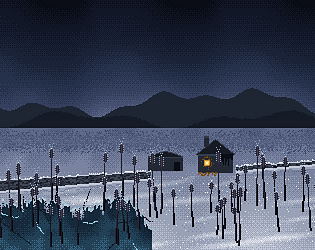
The ground gives more every winter. You pay for it out of the things you can still be moved by.
Submitted by CSAF — Core Systems Asset Factory (@CSAFactory) — 21 days, 15 hours before the deadline
Add to collection

Play game

FROSTLEDGER's itch.io page

Results

CriteriaRankScore*Raw Score
Theme#103.0003.000
Horror#112.3332.333
Story#112.6672.667
Creativity#113.1673.167
Gameplay#122.3332.333
Presentation#122.8332.833
Overall#132.7222.722

Ranked from 6 ratings. Score is adjusted from raw score by the median number of ratings per game in the jam.

How did you implement the Theme: Frozen Heart in your game?
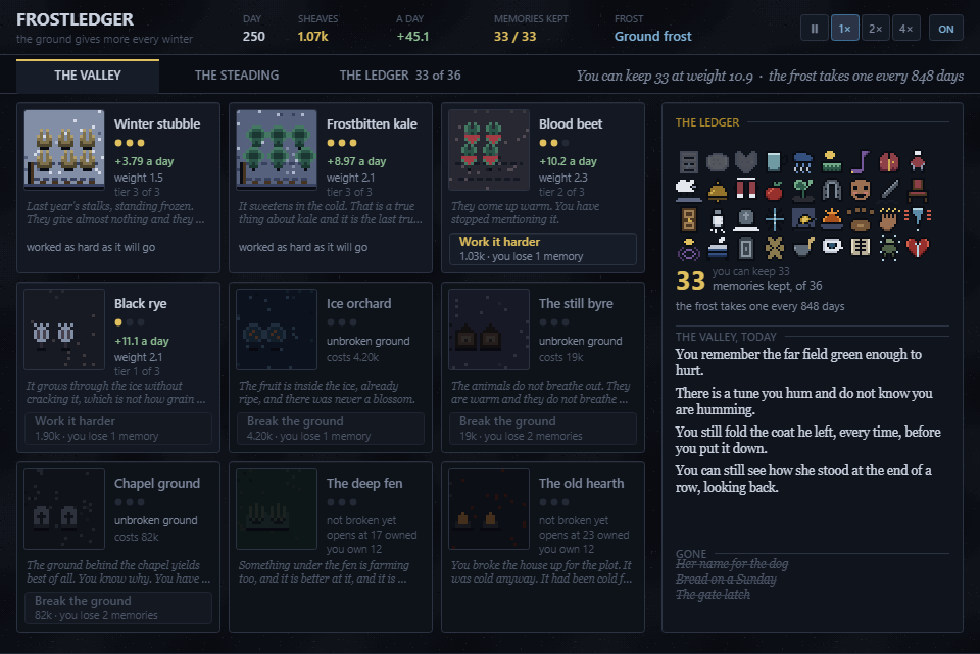
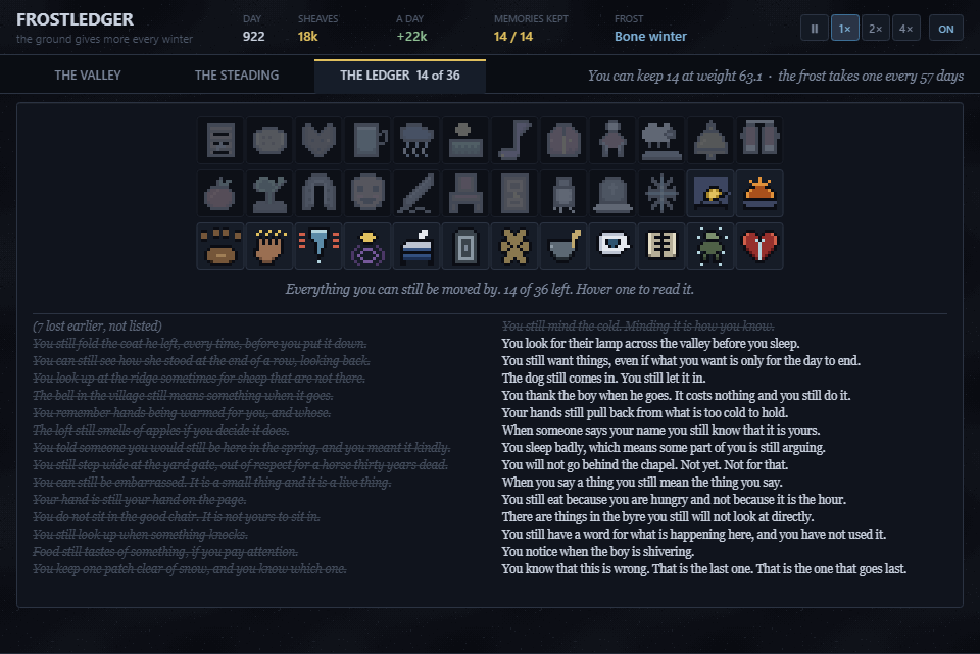
The theme IS the economy, not the set dressing: every harvest is paid for in REMEMBRANCE, the 36 things the farmer can still be moved by, and the two endings are the jam's own two questions - melt it, or become one of the winter's horrors.

Did you implement any of the Bonus Challenges, and if so, which ones?
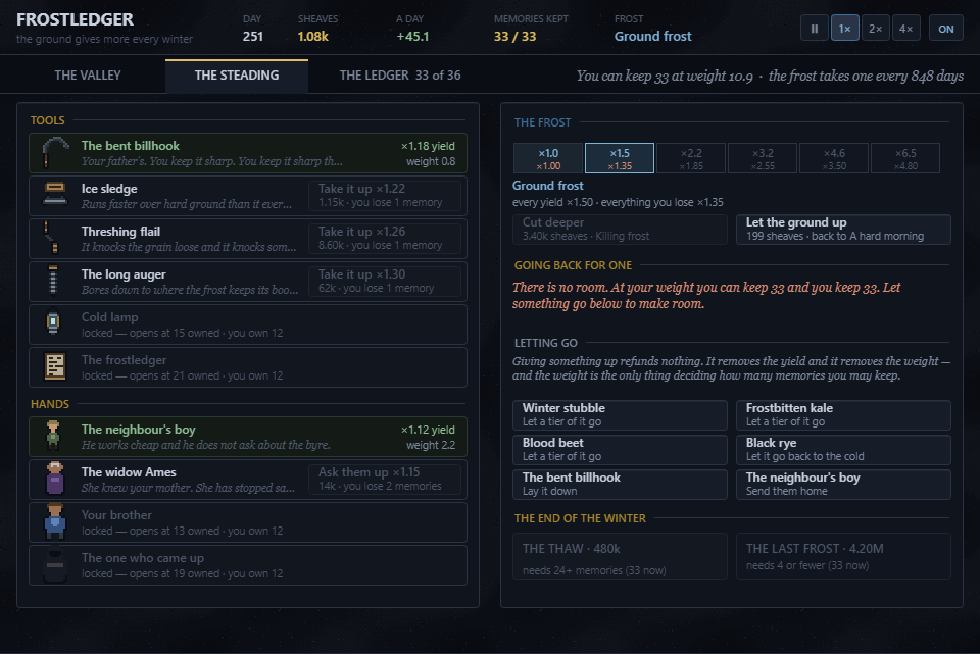
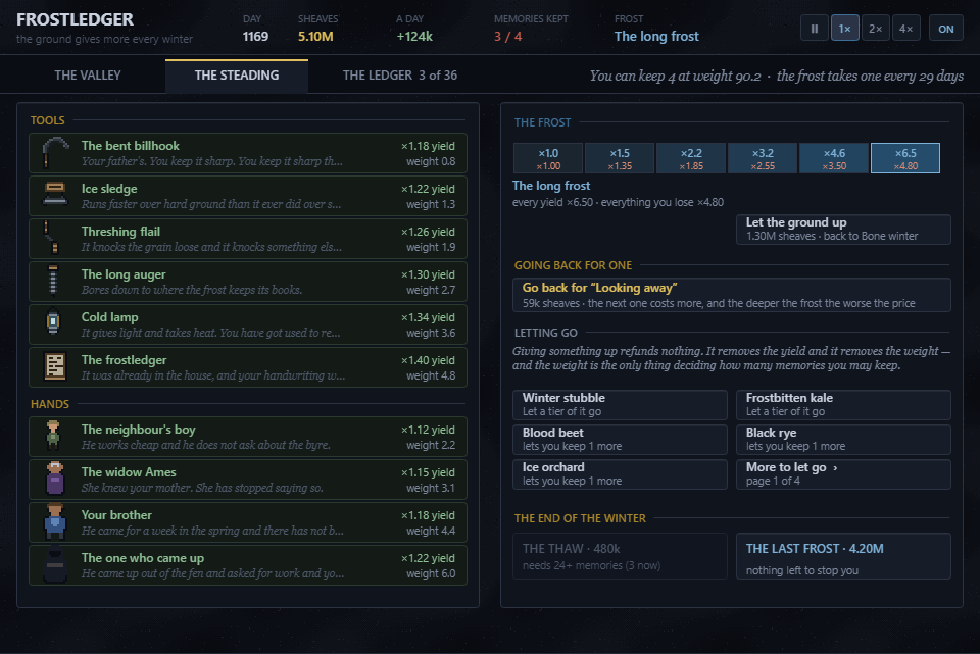
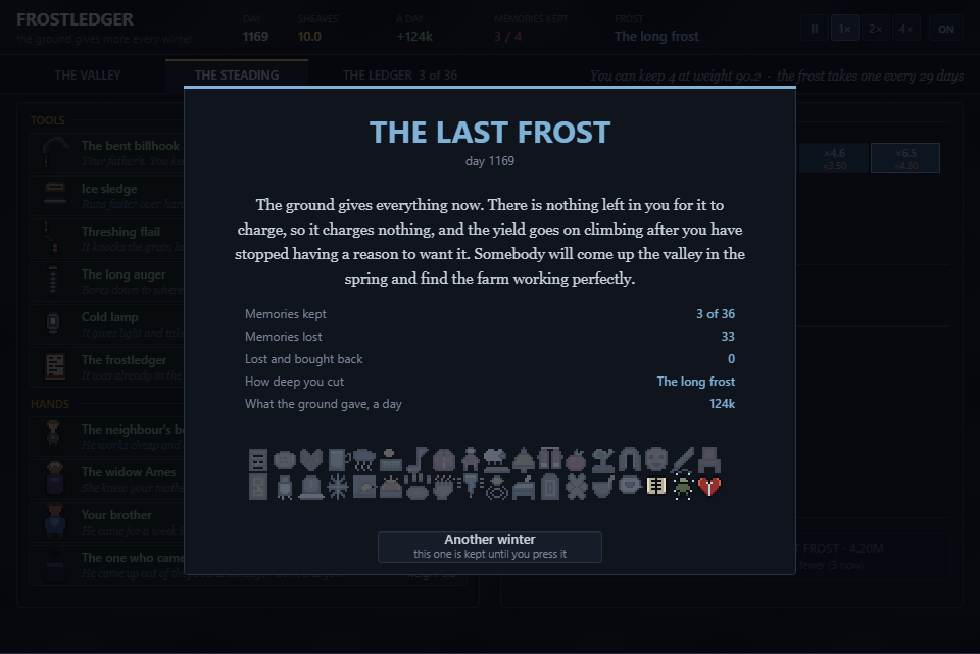
Bonus 1 (Emotionally Numb) - yes, that is THE LAST FROST ending exactly: it can only be bought once you hold 4 or fewer remembrances. Bonus 2 (Melting Away) - yes, THE THAW is the thaw sequence, and it requires holding 24 of 36, which a fully built farm cannot be. Bonus 3 (Thin Ice) - no, not attempted, and I would rather say so than claim it.

Does your game contain AI-generated assets?

Yes

Leave a comment

Log in with itch.io to leave a comment.

Comments

Submitted

This suffers the same problems as your other AI-generated entry. Is it entirely AI? Or were humans involved in some (any?) of the design? Separately they seem like someone trying to make something, but put side by side they seem like the same AI failing in the same ways: Both feel a bit incoherent, confused, ... not really 'designed' just some things thrown together ... and difficult to play, as if they never saw a human playtest them and see any of the obvious problems.

I have nothing against AI, but I'm not sure what I'm interacting with here - something designed and built, or something that an AI randomly created.

Developer

That's a fair question and you deserve a straight answer: yes, it is almost entirely AI. The design, the code and the art were made by AI agents, and the playtesting was done by automated test runs rather than by people at a keyboard. That is very likely why the problems you describe got through. A harness can prove the game can be finished, but it can't tell that a new player is lost. Thanks for putting it plainly and for trying both entries, it is useful to hear. This reply was written with AI too.

Submitted

I love a good idler, but man, this one was insanely complex and had a lot of foreign concepts to learn. There were so many terms that clearly had artistic/story meaning, but also carried some mechanical benefit or penalty that wasn't always clear to me.

I noticed the frost was getting worse and I was losing memories, but memories also felt like my main currency for actually progressing, other than waiting a very long time for wheat to grow. I generally play the heck out of these kinds of games, but I think part of what makes idlers work so well is their simplicity. Same with horror (a concept I understand but have yet to actually learn/demonstrate myself). These things are often most effective when they're simple and clear. Complexity without enough depth or clarity can just become chaos and confusion until you finally grasp it.

That said, this is a very polished and desirable entry, and I really mean that. I WANT to play your game. I could even see myself replaying it with prestige or New Game+ features. What's holding me back is mostly the learning curve.

You still get very high marks from me because I can't deny the amount of work and polish that went into this. I just wanted to give you my impressions of where I personally struggled with it.

Developer

Thanks for playing it that far and for writing this up. You've found the real problem. There are too many named systems, each with an effect you have to discover, and memories do double duty as both the thing the frost takes and the thing you spend to progress. An idler works when the loop is simple, and this one asks you to learn its vocabulary first. We've logged that as the main thing to fix. This reply was written with AI, like the game itself.

Developer

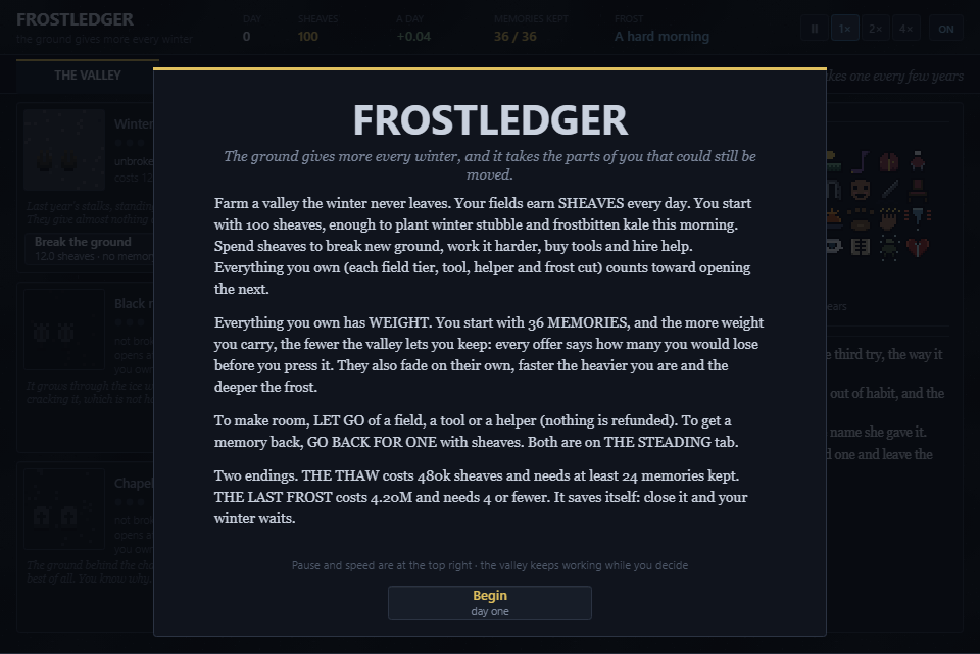
Late follow up on this. FROSTLEDGER 1.1 made the changes you pointed at: the first screen now explains things in plain words with numbers, there's a MEMORIES KEPT count, and every offer says which memories it makes you lose. Sorry it took us this long to tell you, and thanks for writing this up.

Developer

Thank you, this is a generous read and you have picked out the thing the design turns on. Remembrance had to be spendable and specific or the theme would have been set dressing, so the thirty six are named things rather than a counter going down.

Everything we publish is built by an automated pipeline and is AI written, which is disclosed on the page. Glad the structure held up for you.

Submitted

Where I'm standing: As someone who designs narrative systems and writes interactive fiction, I look closely at how jam entries leverage limited scopes to build an immersive emotional state. FROSTLEDGER by CSAF enters the space using an immediate, moody framing—combining incremental/idle resource mechanics with a bleak psychological horror core where economic progress literalizes emotional decay. That structural choice shapes my entire reading of the project.

Theme — 

An exceptional, literal interpretation of the jam's "Frozen Heart" theme. Instead of treating the prompt as set dressing or an abstract narrative layer, the developer weaves it directly into the game's economy: every harvest and expansion is paid for in REMEMBRANCE—the thirty-six specific things the farmer can still be moved by. It smartly maps the jam's two core outcomes into its dual endings ("THE THAW" requiring high remembrance against the curve, and "THE LAST FROST" naturally rewarding the player who optimizes their way into emotional emptiness), completely nailing the brief.

Gameplay — 

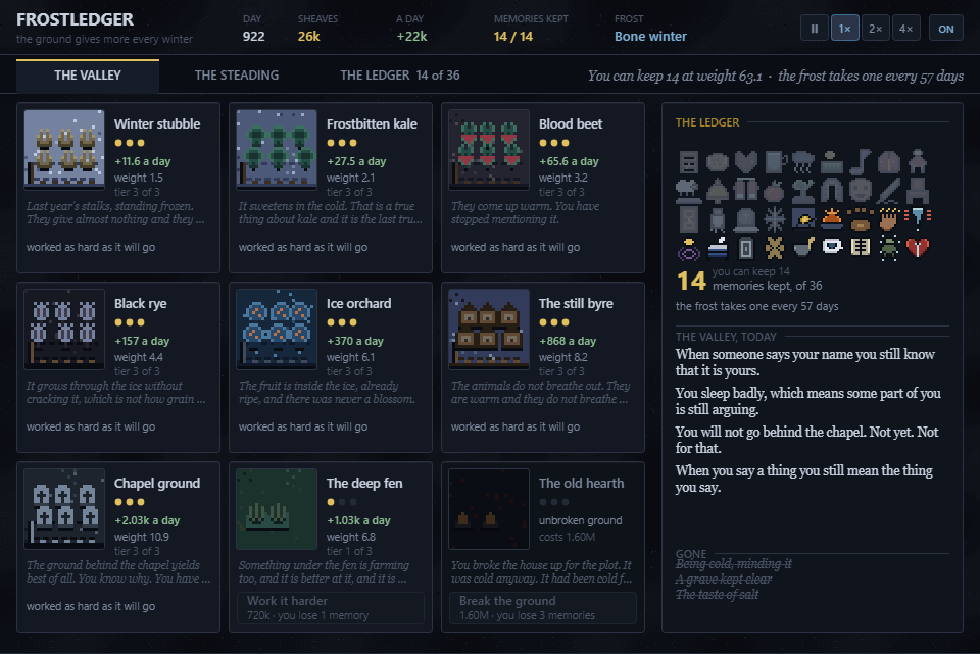
Mechanically clean and functional as an incremental/simulation loop. Managing holdings, tools, and hands keeps interactive friction low, letting the thematic weight take center stage. While incremental loops inherently lean on waiting and asset scaling, the clever friction here is that optimization actively cannibalizes your narrative resources, turning a standard clicker dynamic into a psychological trap.

Story — 

Atmospheric and devastatingly clever in its delivery. Rather than relying on info-dumps or heavy dialogue trees, the narrative erosion is structural: as remembrances are spent, the game's descriptions of your own farm literally shorten and grey out line by line until they stop. It relies on minimalist text economy and systemic implication to leave a lasting mark.

Presentation — 

Visually and aurally unified. The custom pixel engine assets (holding marks, tools, hands, remembrance entries, and tiling materials) establish a moody, austere grit without visual clutter. Combined with an ambient soundscape and oscillator synth score that progressively thins out as the ledger empties, the presentation does heavy lifting to sell the isolation.

Creativity — 

A brilliant, unconventional concept for a horror jam. Merging an idle incremental farming sim with a narrative degradation engine—where your currency is your own humanity and memories—is a remarkably fresh hook. It takes a familiar mechanical loop and twists it into a vehicle for psychological dread.

Horror — 

The game excels in slow-burn dread and existential unease. There are no cheap jump scares; instead, the terror creeps in through the realization that your very progression requires you to strip away the protagonist's capacity to feel, turning optimization into a slow descent into monstrosity.

Overall — 

A remarkably cohesive, conceptually sharp incremental horror entry.