

Play game
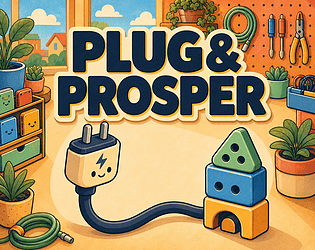
Plug & Prosper's itch.io pageResults
| Criteria | Rank | Score* | Raw Score |
| Sound/Music | #148 | 2.800 | 2.800 |
| Art / Graphics | #153 | 3.000 | 3.000 |
| Controls / UI | #168 | 2.600 | 2.600 |
| Overall Fun | #186 | 2.600 | 2.600 |
Ranked from 5 ratings. Score is adjusted from raw score by the median number of ratings per game in the jam.
Ai Usage
Mostly AI Generated
Genre
Strategy
Turn-based | Card Games | RTS | 4X
Puzzle
Mystery | Advenure
Rating
Family Friendly
Leave a comment
Log in with itch.io to leave a comment.
Comments
Hello! Welcome to Feedback Quest 9! I'm Hythrain, one of the hosts for this event! While I'm a bit behind with getting my VODs out, I played your game on stream and wanted to send you the VOD. I make the effort to express all of my thoughts for feedback in the VOD, so I hope it's useful to you! Here's the link: https://www.youtube.com/watch?v=5LCSGj1aiuQ
Thank you for playing and for sending the VOD! I watched my segment and took notes on how you played, along with your suggestions and impressions. I’d previously tuned the difficulty down, but watching your video helped me see where I’d lost the balance that made the game fun and tense. I need to improve the challenge, especially how the number of customers and the pressure build up.
And yes, the art was AI generated. I don’t see AI creation as inherently bad, though I’d also love to work with an artist on Plug & Prosper or another project. If you know someone interested in collaborating on an unpaid hobby project, send them my way!
I’ve been programming for over ten years, but most of the code in Plug & Prosper was AI generated too. I think it plays well because I understand the systems underneath and can steer the work toward the game I want to make. Maybe that’s the mythical 10× productivity boost without the usual AI slop :P
Thanks again for taking the time to play and share your thoughts!
I've certainly heard a lot of opinions regarding AI, and yours lines up with what I've heard from other programmers. That is, that programmers are more friendly to AI while creatives like artists and voice actors are wholly against it. I can see the arguments for both sides as well, which I think more folks from either side need to try and look at better.
Programmers are used to things like sharing code with others online, which using AI to do is incredibly similar to since a lot of the data that programming AI is built on is shared code online. Since the code is already shared freely, there's no strong sense of "ownership" over it. Permission to use isn't needed and you wouldn't worry about being compensated for it. On top of that, while AI programming could affect jobs for programmers (as we've seen many companies do in the past few years), it's becoming more and more recognized that that is a bad idea and keeping programmers to verify the work of AI is important. Even as AI get better, I suspect we'll see programmers being kept because AI can't be fully trusted.
By contrast, while creatives can and do share their work online it's always with the understanding that they own what they made and that others can't just use it for profit without their permission (though some do try to do this), which in turn means they can request compensation. When AI is trained to do creative work, it does so by taking the works of creatives without their permission and thus without compensating them. It then gains the ability to reproduce things that look like their artwork, which allows people to not have to hire creatives at all. While AI makes a lot of mistakes, it's getting better at it and eventually won't make those mistakes. This can then cost creatives a lot of paid work if not outright cause them to not be able to do paid creative work again.
I think that if both sides can come to understand these views, it would help properly shape the discourse over AI and make it easier for people to work together on a more unified view of AI that can hopefully influence the changes needed to make AI good for everyone.
I get both sides. Training practices vary too. Shutterstock licensed training data to OpenAI. That doesn’t answer every concern about consent or compensation, but it matters when talking about how these models are trained.
I see visual art similarly to programming. Generating an image or some code is one step. You still need direction, consistency, judgment, and the ability to put everything together into something that works. Artists and designers bring those skills, and their value goes beyond fixing AI mistakes.
Some paid work will disappear or change, and I understand why people are worried. But AI covers a lot of different tools, and there’s no single switch to turn it all off. To me, trying to stop it to preserve jobs is like banning cars to preserve work around horse-drawn transport. I’d rather protect people’s rights and help them adapt. The work changing doesn’t make their skills worthless.
I do agree that it's going to be hard, if not impossible, to turn the AI switch off. However, along with protecting people's rights I also believe that AI should be changed to be used ethically. For example, you can only use AI for something that you can already do yourself. This would mean that when it comes to AI making creative work, only a creative can use it and they can only get results that match their body of work. It then becomes that AI is a tool to assist people rather than something that some use to replace humans entirely.
My position is that AI should expand what people can create, not be reserved for those who can already do it manually. Direction, design, and integration are creative contributions too, just as a VTuber can contribute creatively without being able to draw or rig their avatar themselves. None of that means dismissing artists’ rights. Thanks for explaining your perspective, but I disagree with the restriction you’re proposing, and I’m leaving the discussion here.
Hi! Played this for the playtest exchange — fantastic UI and art direction, and the core concept is genuinely fun with a great mechanic behind it. Two things worth flagging: performance and visual clarity take a hit once you've got a lot of adapters placed around the room — it starts to feel a bit laggy and cluttered. Also, the music didn't quite feel like it matched the pace of the gameplay for me. Neither one took away from how fun the core loop is though — solid mechanic overall!
I played through to around DAY 23. Connecting the outlets and plugs kept me busy, but I found that surprisingly enjoyable! For me, the most fun part was working toward collecting two of each outlet with the various adapters plugged in. After that, though, I felt there wasn't much left to do and lost interest. Thank you for making such an enjoyable game!