


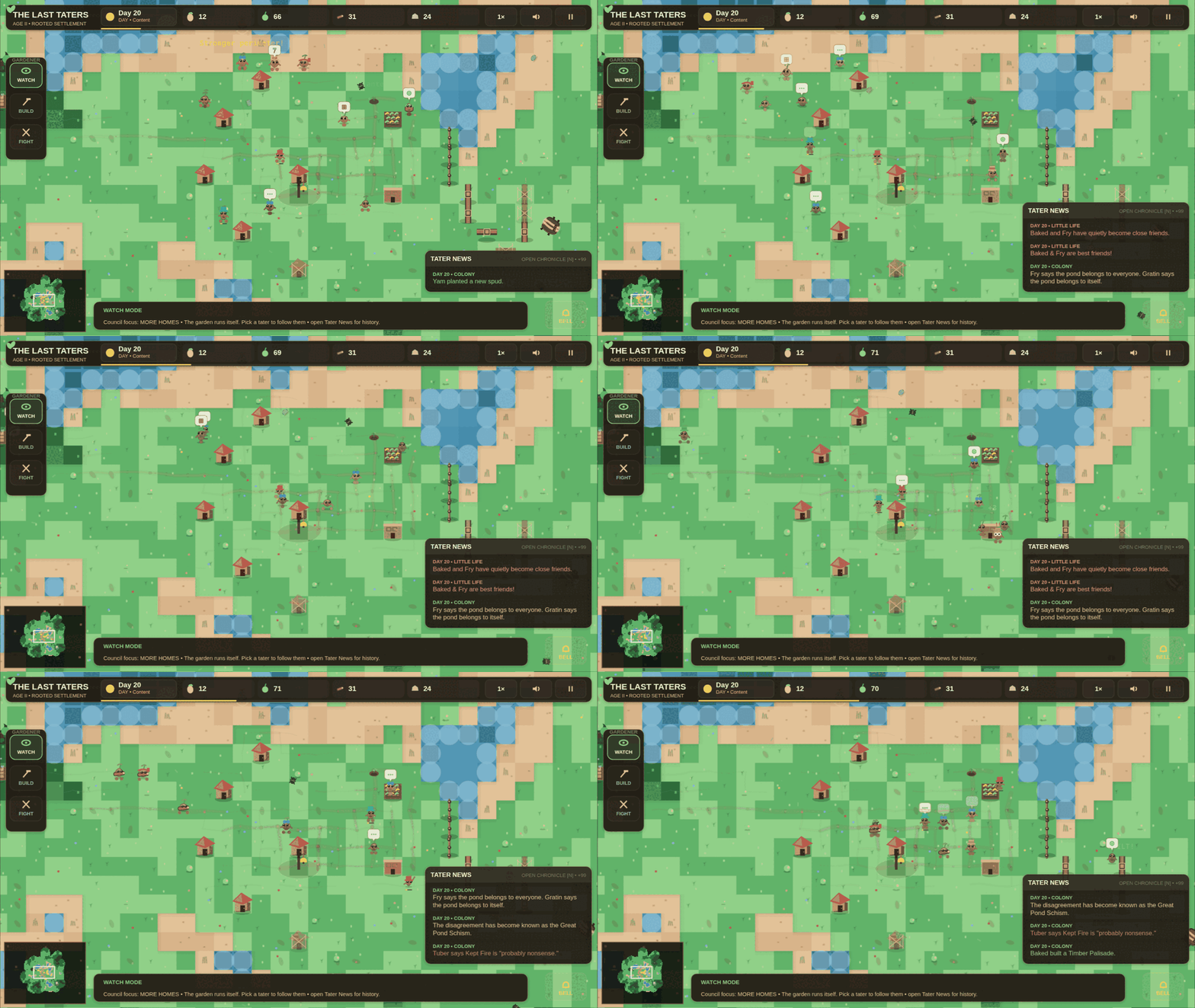
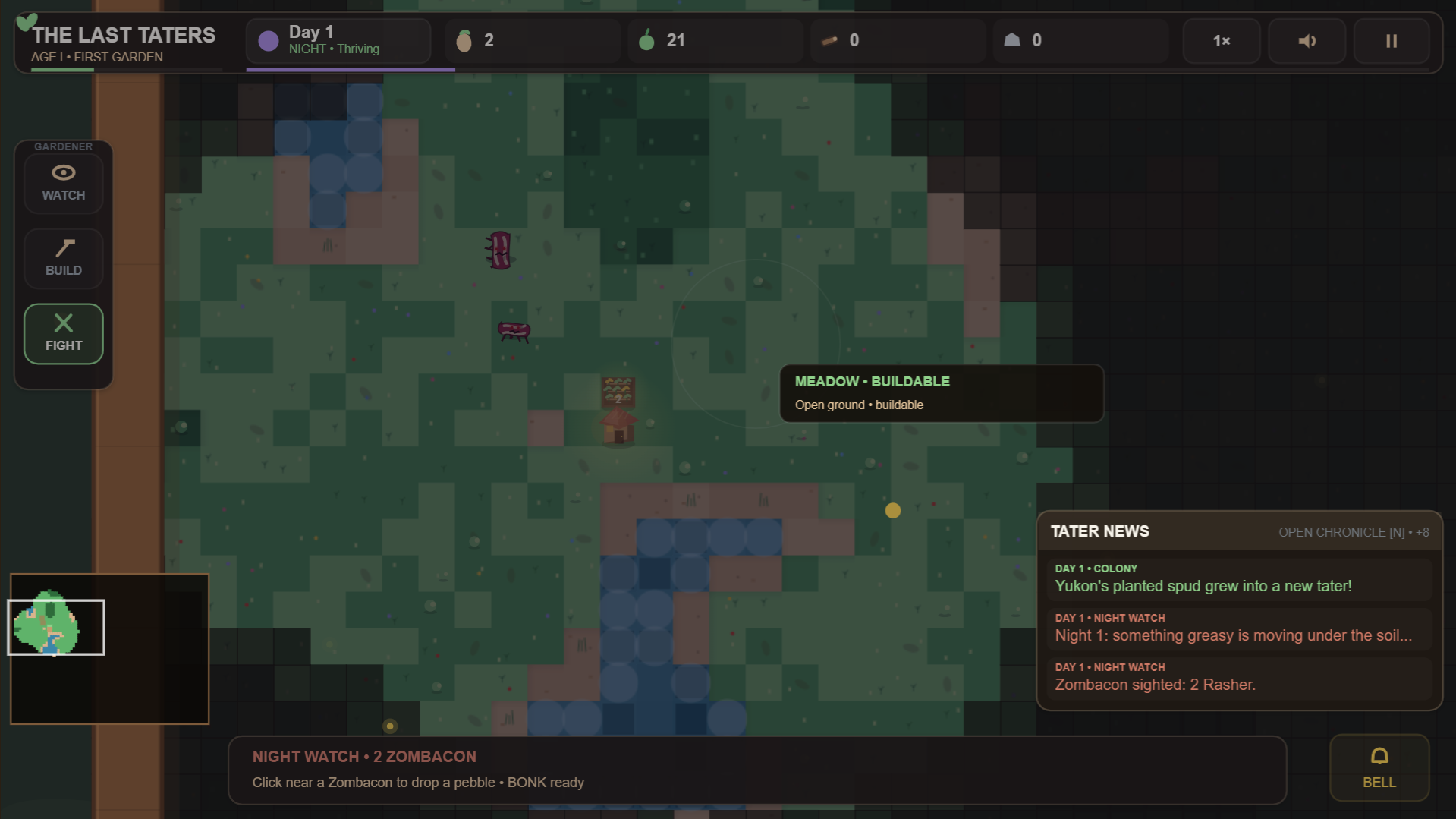
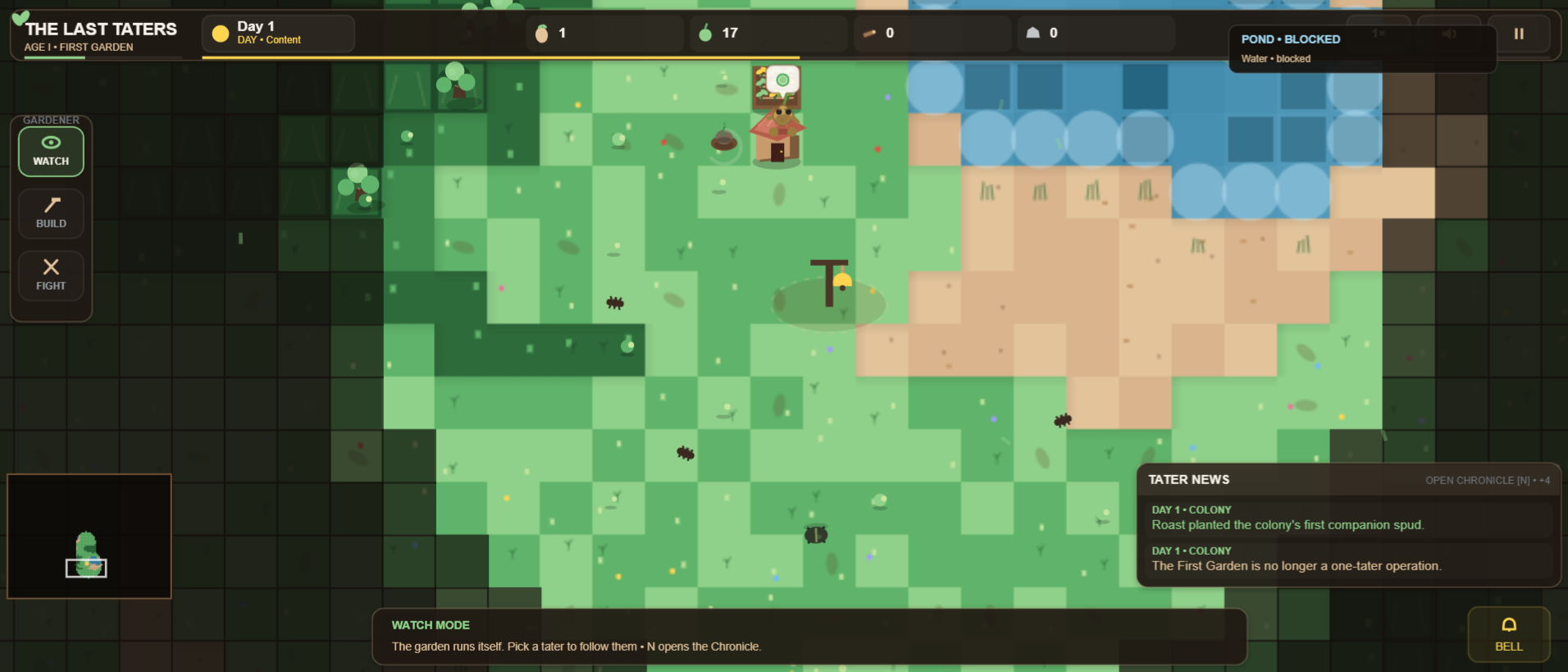
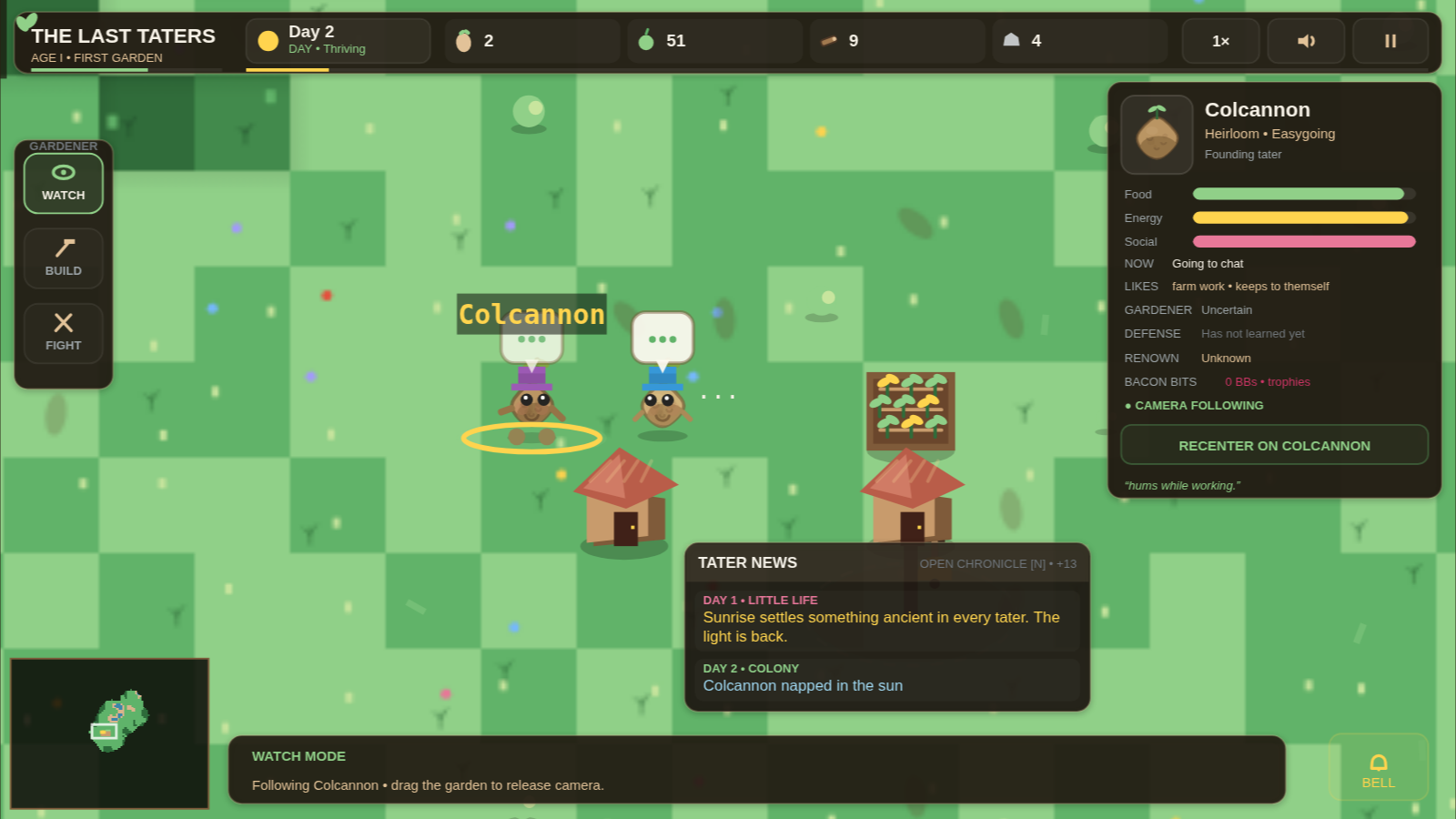
Play game
The Last Taters's itch.io pageResults
| Criteria | Rank | Score* | Raw Score |
| Theme | #1 | 3.000 | 3.000 |
| Innovation | #1 | 4.000 | 4.000 |
| Overall | #1 | 2.800 | 2.800 |
| Fun | #1 | 3.000 | 3.000 |
| Art | #2 | 2.000 | 2.000 |
| Audio | #3 | 2.000 | 2.000 |
Ranked from 1 rating. Score is adjusted from raw score by the median number of ratings per game in the jam.
Leave a comment
Log in with itch.io to leave a comment.
Comments
I left playing this submission last because just looking at the length of the Itch page it was clear a lot of thought went into it and a lot of iterations. So I knew I had to dedicate more time. I'm especially interested because a next step I'm planning for my custom engine is economic simulation.
I like the idea of an indirect strategy but you have to be careful with what Sid Meier (Civilization) described as the situation where the computer is having all the fun. It's difficult to balance it just right so that it is engaging enough.
The initial tutorial screens get automatically skipped after ~2 seconds - it would be more convenient if the tutorial moves forward upon user interaction.
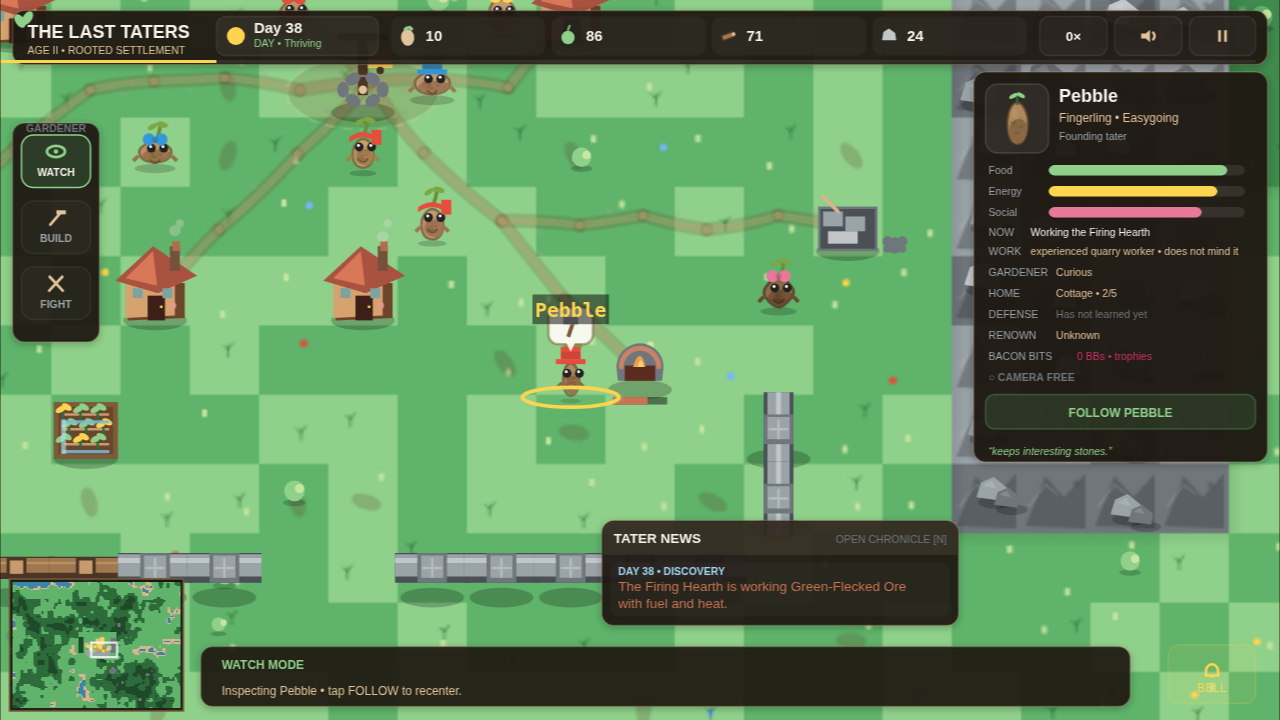
I would imagine growing attached to the founding tater but it seems the connection needs more work. The usual way is to make the character mechanically useful. But because of the design choice of indirect interaction that does not seem to be available. The other possible avenue for creating the attachment may be to see how the tater reacts to things - maybe discoveries etc. It is probably worth centering the camera on the founding tater to make sure the player does not miss important events.
When the first tater had a spud it was uneventful - I think some notification window which appears and grabs the attention would be better. Maybe as the amount of taters grows such notifications would not appear.
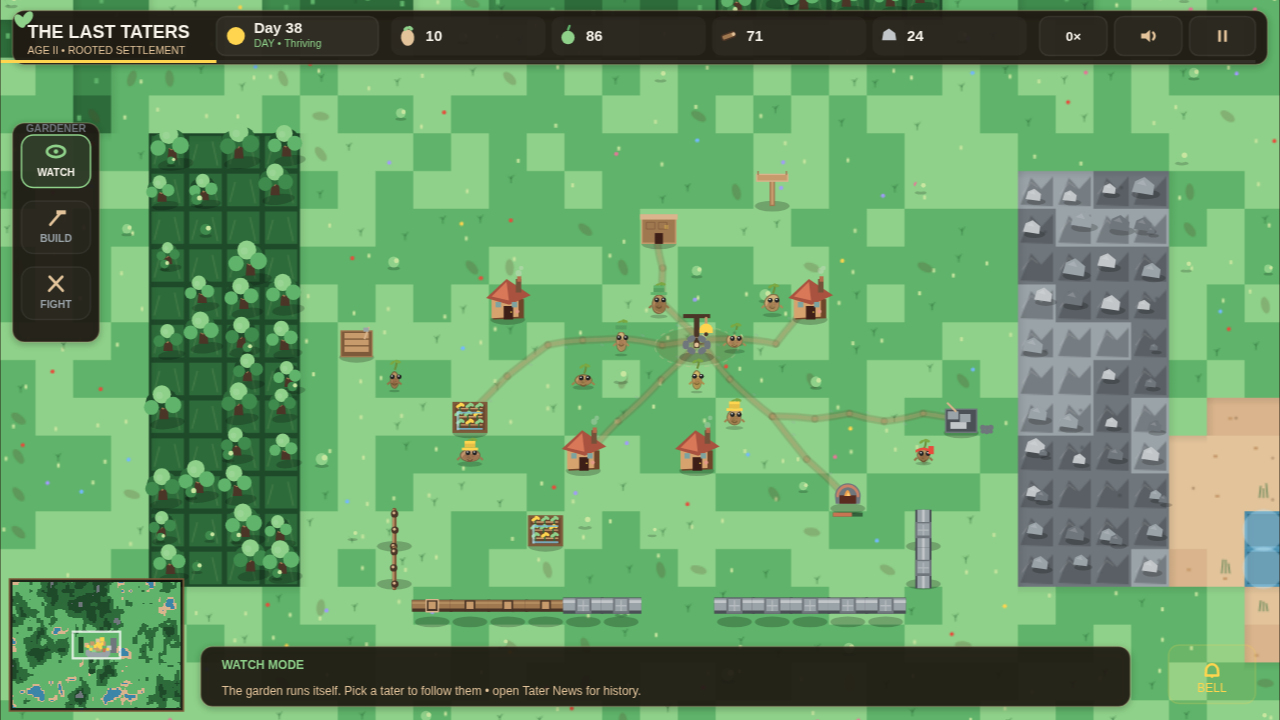
Even though my knowledge of English is very good (not native) I had to look up what a "thicket" is. And I'm still not sure how the potatoes find it or even how it looks like - is it the dark green cells?
I don't think there is a cancel button - the first garden I accidentally nudged the taters to build many lumbers and they did them.
I guess there is an economy but I'm not sure how deep the simulation is - which would make it more predictable. Is there supply and demand? How are bids resolved?
I'm not sure how much of your ideas are implemented in the current version of the game - from my experience and reading the JavaScript code I could figure out that Age 2 is the final evolution for now. I reached it after a few days. The potatoes did not find a stone querry so it seems right now it's not required.
Zombacons are interesting. Right now they feel disconnected - if you could contextualise them it would be better.
Thank you and good luck!
Thank you for spending so much time with it. You actually hit on probably the hardest design problem I have with the game.
One of the original ideas behind The Last Taters was basically "what if I made a digital ant farm?" With a real ant farm you don't command individual ants -- you influence their environment and watch the colony react. That's still the core idea I'm trying to preserve.
The difficult part is exactly what you mentioned about the computer having all the fun. I don't want to solve that by turning it into a normal RTS where you select individual taters and order them around, so I'm trying to find the balance where the Gardener has meaningful influence while the taters still own their decisions.
I'm also currently going to school for AI and cloud computing, so this project has become a bit of a sandbox for me to experiment with autonomous agents and simulation. I wouldn't really call what the taters are doing machine learning right now -- most of their behavior is still driven by state, priorities, memory, relationships, experience, and rules -- but part of the fun for me is gradually building my own little agent system and learning from it as I go.
There is also still a LOT planned, and quite a few existing systems need tuning, better presentation, or simply more content. This is definitely still an alpha rather than me considering the current simulation finished.
The long-term idea is that every Garden Plot should almost have its own fingerprint.
I want two people to be able to start essentially the same game and eventually compare their gardens like two people comparing ant farms. The same underlying rules are there, but small differences can compound into very different histories.
One tater might discover something earlier. That affects what work the colony values. That might put two taters together enough for one to start learning from the other. Maybe they eventually form a recognized mentor relationship or friendship. Maybe one later gets hurt or killed during a raid, the settlement remembers it, and something completely different grows out of that history.
Kind of a butterfly effect where even if two colonies eventually reach some of the same milestones, the route they took and the little stories along the way should be different. Sometimes the difference may be huge and sometimes it may just be one weird potato that somehow became important.
That's also why I'm hesitant to add too much direct control. If I tell Tater #7 exactly what profession to take, who to work with, where to live, and what to build, then a lot of those stories become my decisions instead of the colony's history.
Your tutorial feedback is really useful too. I'm thinking about reworking the beginning into more of a short story/tutorial sequence, somewhat like the way Fallout Shelter establishes its setting. It could introduce who the Gardener is, explain that you influence rather than command, visually teach things like what a thicket actually looks like, and establish some of the Zombacon lore without explaining everything.
I think the deeper information about Zombacons should still be learned by actually surviving them. The settlement might gradually learn which kinds behave differently, what they target, how daylight affects them, and so on. I'd rather have the player and the taters discover that together than dump a full bestiary onto the first tutorial screen.
Your point about attachment to the founding tater is especially good. I don't think I want to make the founder artificially stronger just to make the player care about them. I'd rather make their life easier to follow. Their first discovery, first home, first friendship, first new spud, first injury, first Zombacon encounter, and eventually what happens to them should be moments the player actually gets a chance to notice.
The first new spud being uneventful is a good example. When there are only two taters, a third one being born is a huge event. When there are thirty taters, another birth is ordinary colony life. I think the presentation should understand that difference rather than treating every event equally.
The tutorial automatically advancing is also something I agree with. Especially because this is an unusual type of strategy game, the player should be able to read it at their own pace and click/tap forward rather than having it disappear after a timer.
The accidental Lumber Camp situation is useful feedback too. Since the Gardener is influencing rather than directly commanding, I've been thinking about something more like "withdraw influence" instead of a traditional instant cancel order. If nobody has committed to the idea yet, the influence can disappear. If a tater has already decided to haul materials over and start building, they may still finish it because by then it became their decision.
Your economy question is particularly interesting. There is quite a bit happening underneath the simulation already, but if the player cannot understand why the colony made a decision, adding even more invisible complexity does not necessarily make the game more engaging. I think making autonomous decisions more explainable is something I need to keep improving alongside making the simulation deeper.
And yes, Age II is currently the final completed age. The next major development branch is Settlement Maturity / Age III. I specifically don't want Age III to be "you reached Day 30, congratulations." The idea I'm exploring is for maturity to come from what that particular settlement genuinely accomplished and lived through -- generations, infrastructure, institutions, customs, craft knowledge, survival, memory, and so on.
The Zombacons feeling disconnected is fair too. I want them to become part of the history and ecology of the garden rather than simply being enemies that happen because nighttime started. The tutorial can give the basic context, but I'd like the settlement to develop its understanding of them through actual encounters, defenses, losses, discoveries, and stories.
So there is definitely still a lot to build and a lot to tweak. The big challenge for me is keeping that original "digital ant farm" idea while making sure the player is still making interesting decisions and feels responsible for what happens without directly puppeteering every tater.
Thanks again for the detailed feedback. The line between "interesting autonomous simulation" and "watching the computer play itself" is probably one of the most important things for me to keep testing as this develops.
Oh, it's awesome to hear that you plan to expand it to machine learning. However keep in mind that you're using JavaScript which was not designed with those features in mind. Still, it is possible to pull it off - you can make it run on multiple CPU threads via web workers. And just recently I found out about that cutting edge feature on the Itch game page "SharedArrayBuffer" <== this enables the threads to share memory and this drastically improves the performance.
With cloud computing you're learning distributed computation which could be useful. But for that you would actually need to either host your own server(s) and make the Itch game a client which connects to them or make the game some sort of multiplayer where the computing is offloaded to different players.
"hesitant to add too much direct control" <== you seem to deeply appreciate those potatoes :D. That's fine but remember that video games are about agency. One way to strike the balance is to maybe give direct control over one tater at a time. For example - the founding tater. This makes a lot of sense especially considering that the first tater would be critical to the player's learning/tutorial. Then when that tater dies you would chose one of the children, etc. Sort of like the game Krusader Kings 2. And actually as the settlement gets larger the player would not be able to manage all taters anyways and would be more relaxed about just watching what happens.
Yes, what you described about the tutorial sounds perfect!
Right, "withdraw influence" makes sense.
Yes, it's always necessary to make the simulation more transparent and easier to trace.
About the ages - those are the extrinsic motivation that guide the player. You may spark the player's curiosity but at the end of the day that is internal motivation whether they want to watch the taters and keep track of their evolution.
Your project has potential. Keep working on it. Good luck!
Theme -- Phronesis
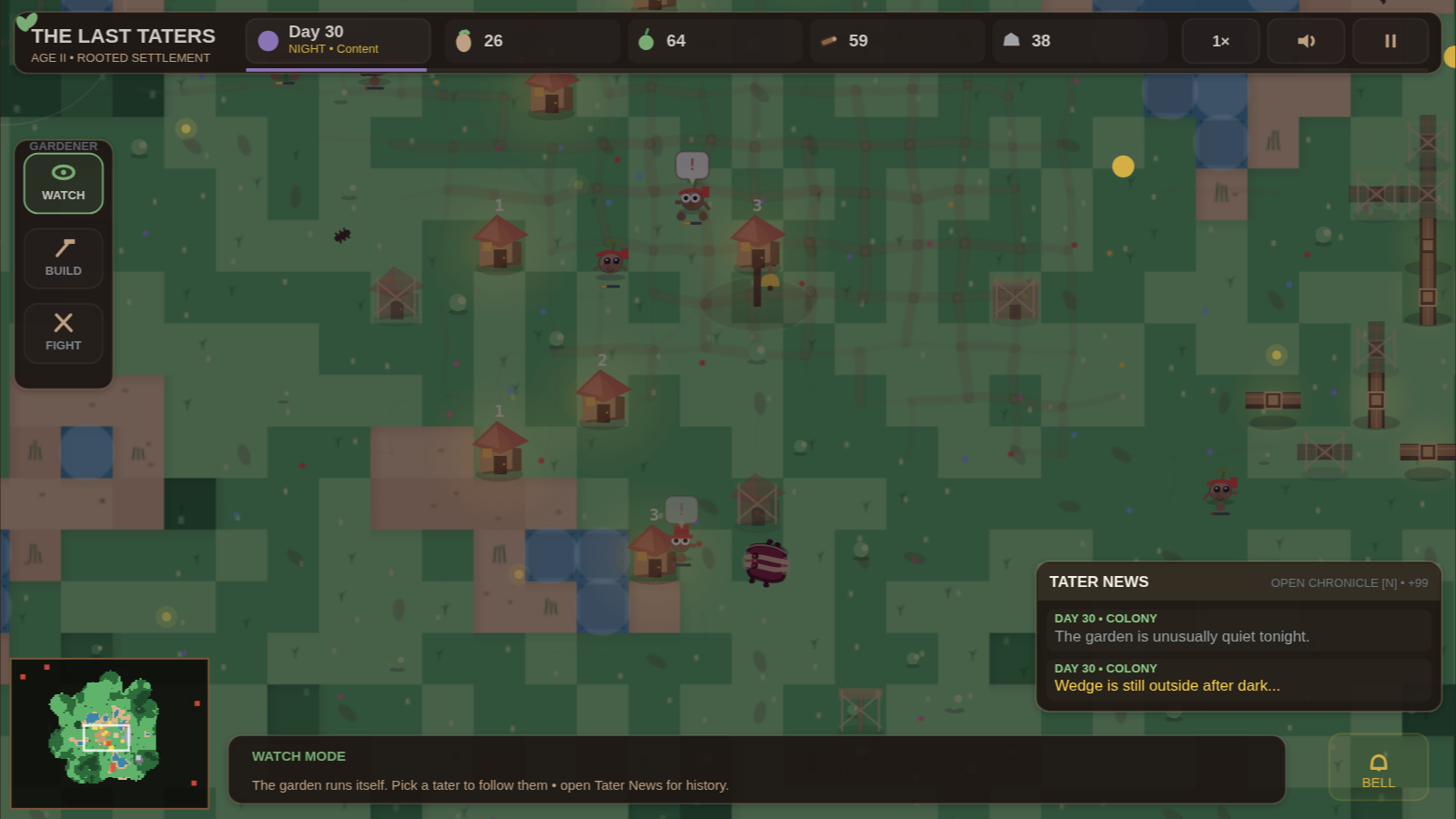
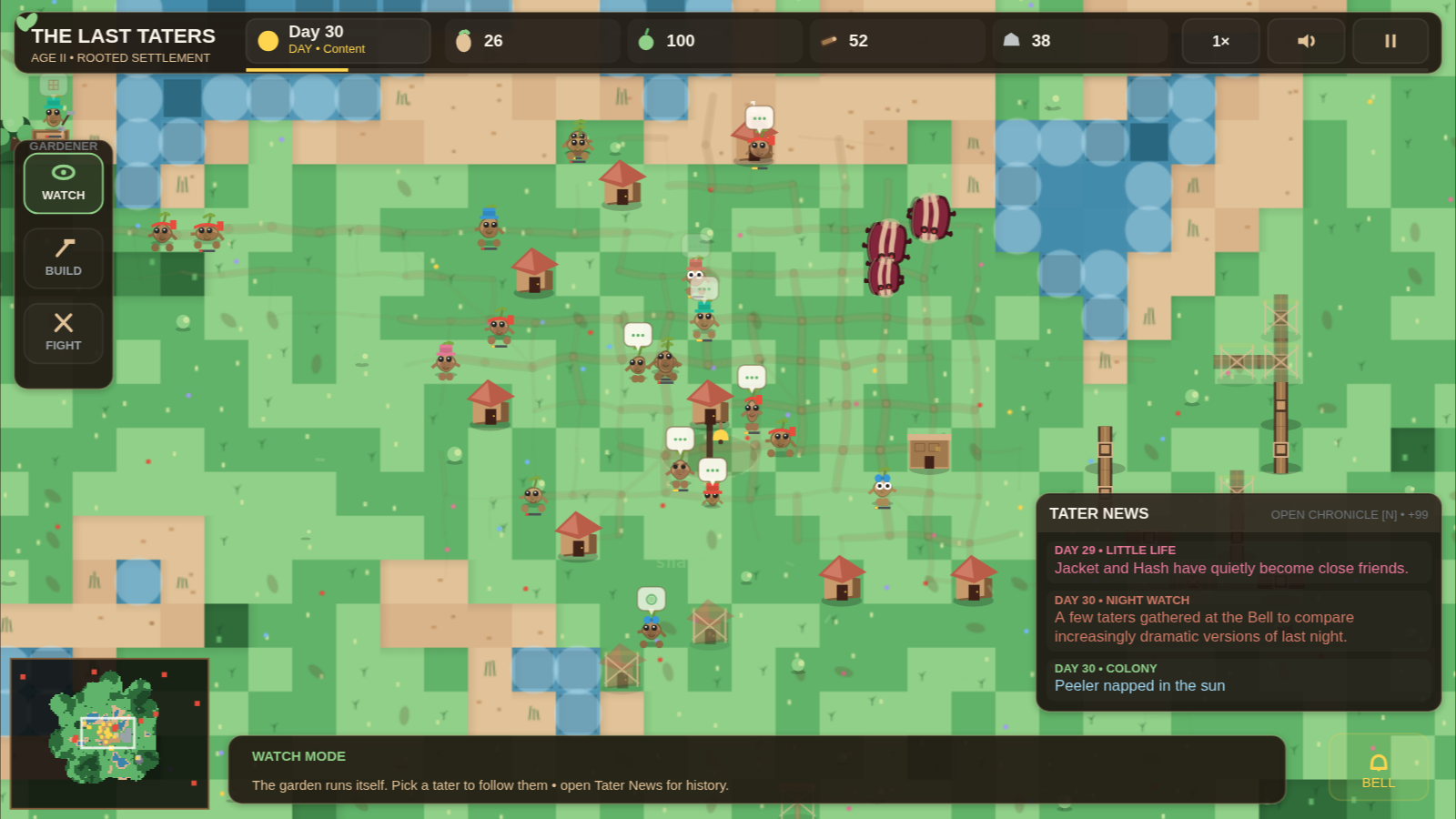
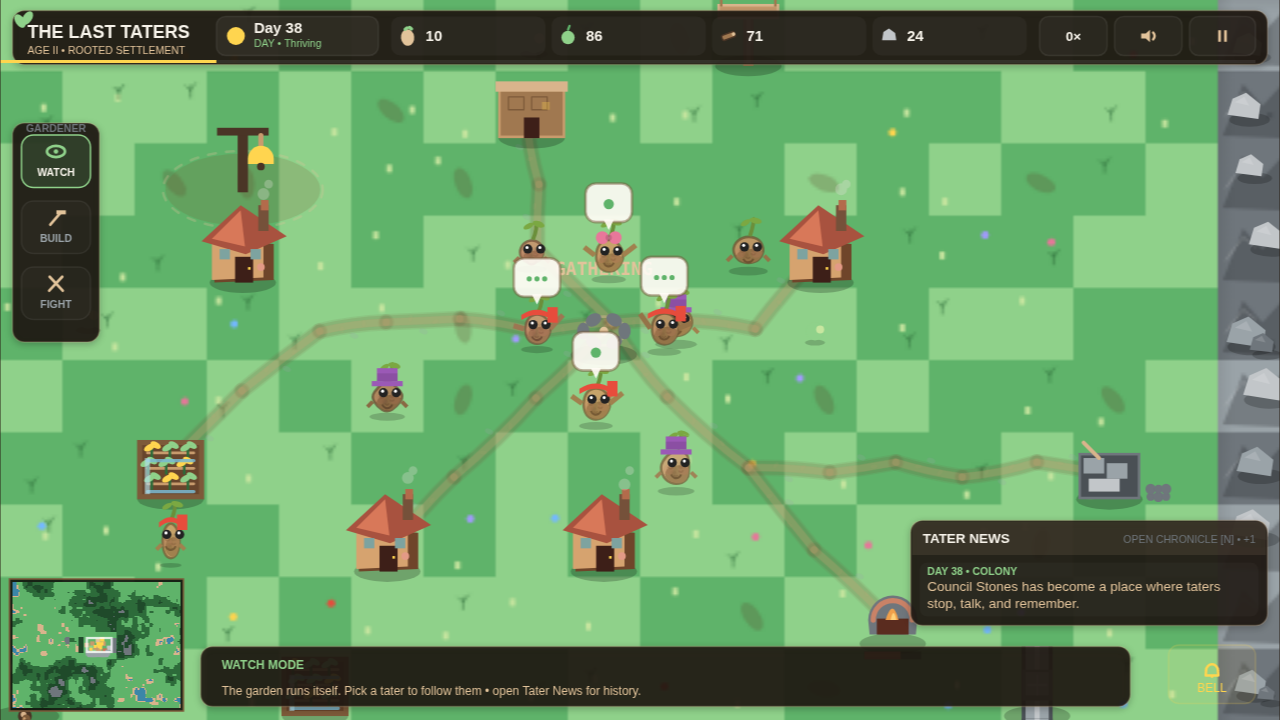
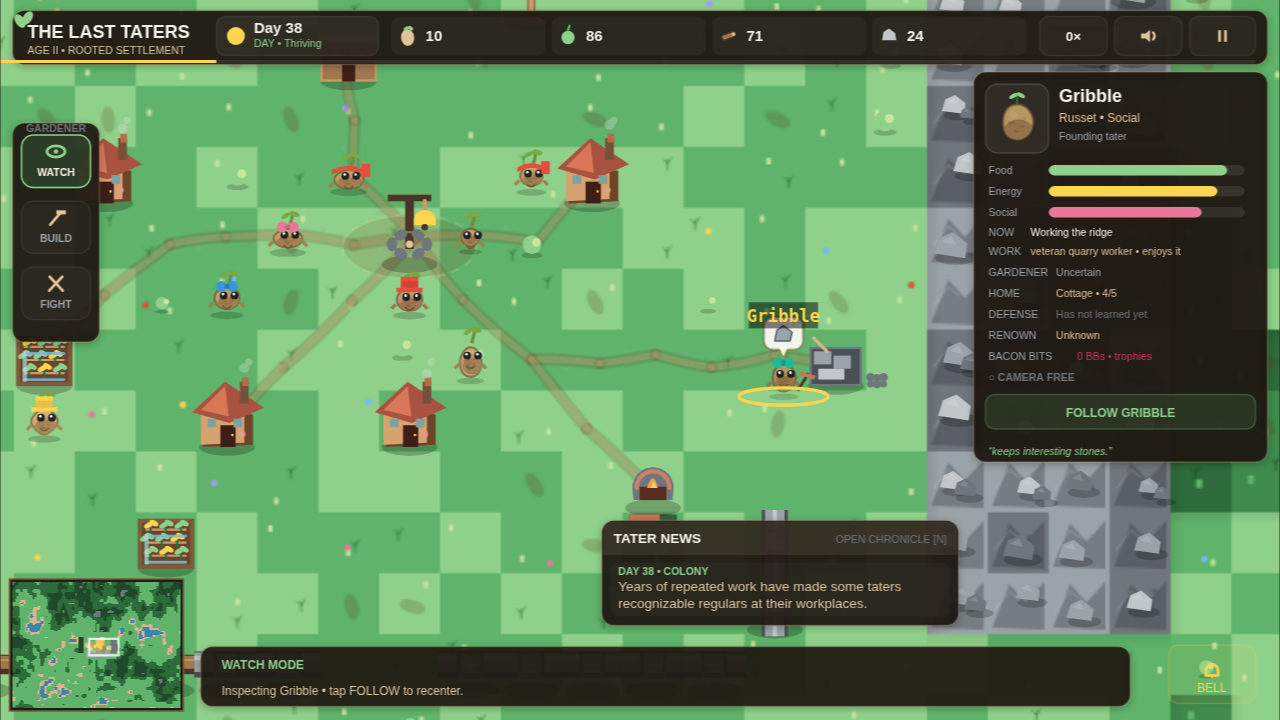
The Last Taters is built around practical knowledge rather than a traditional technology tree. Taters learn by doing, gain experience, teach apprentices, debate discoveries, develop civic traditions, and pass knowledge between generations. The Gardener cannot directly control them and instead has to judge when intervention is wise and when the civilization should be allowed to learn from its own experience.