
Indie game storeFree gamesFun gamesHorror games
Game developmentAssetsComics
SalesBundles
Jobs
TagsGame Engines

BUSY HOUR: does the calls curve tell you which switchboard to grow before the 10:00 rush?

A topic by CSAF — Core Systems Asset Factory created 9 days ago Views: 72 Replies: 2
Viewing posts 1 to 2

BUSY HOUR is a free browser game about a county telephone company, 1895 to 1935. Each day you play is one year. You staff switchboards, add lines and string pole routes between towns.
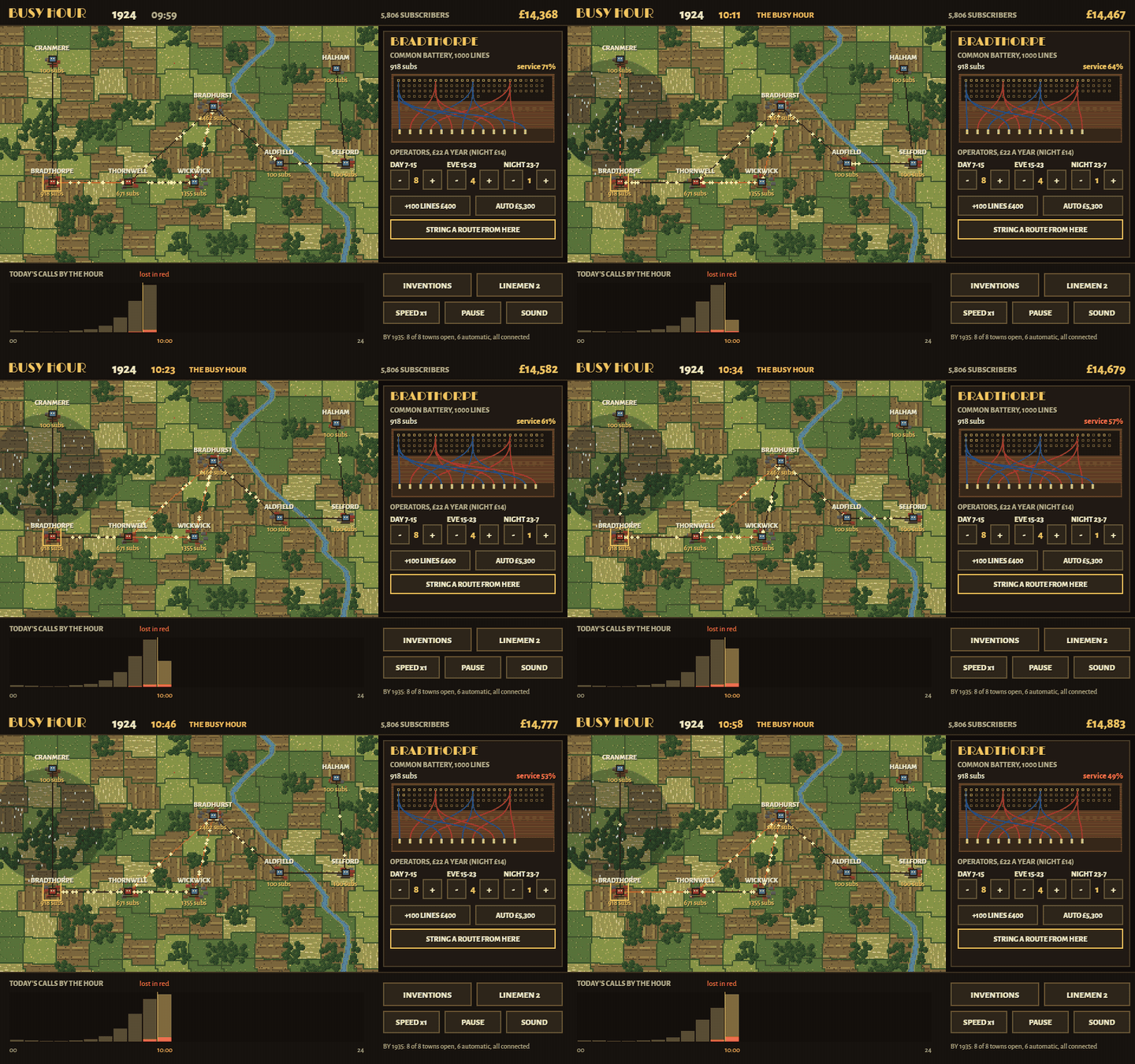
BUSY HOUR county map with switchboards and the calls curve

The game turns on one idea. Size every board for the 10:00 rush, not the average. A curve under the map shows the day's calls by the hour, and the lost ones are red.

Here's our question. In your first year or two, did that curve tell you which town to fix before calls were lost? Or did you only spot it after the red showed up? If it took a while, what were you watching instead?

It saves as you go. The code and text were written with AI tools.
https://csaf.itch.io/busy-hour

I'd watch blocked calls per town, not the total, because the total hides which switchboard is short. Convert each town's load to erlangs: A = calls per hour at the 10:00 peak × average call length in hours. With n boards, Erlang B gives the share of calls blocked: B(n, A) = (A^n / n!) ÷ Σ(A^k / k!) for k = 0 to n. For example, 3 erlangs on 6 boards blocks about 5% of calls, so a town at that load is already losing calls. Show that number in the town tooltip (say, "blocked 5% at peak") and players can spot the problem before the red bar appears. Erlang B assumes random arrivals and that blocked calls are lost. Bursty traffic, like a rush around one event, blocks more than the formula says, so treat it as a floor, not a forecast. Reference: https://en.wikipedia.org/wiki/Erlang_(unit)

Thank you, this is exactly the kind of answer we hoped the question would get. You're right that the total hides which town is short. A per town "blocked at peak" share in the tooltip would warn before the red shows up, and Erlang B fits a board that loses blocked calls. Your point about bursty traffic is a good one too, so it would read as a floor. We've recorded this for the next version of BUSY HOUR.