

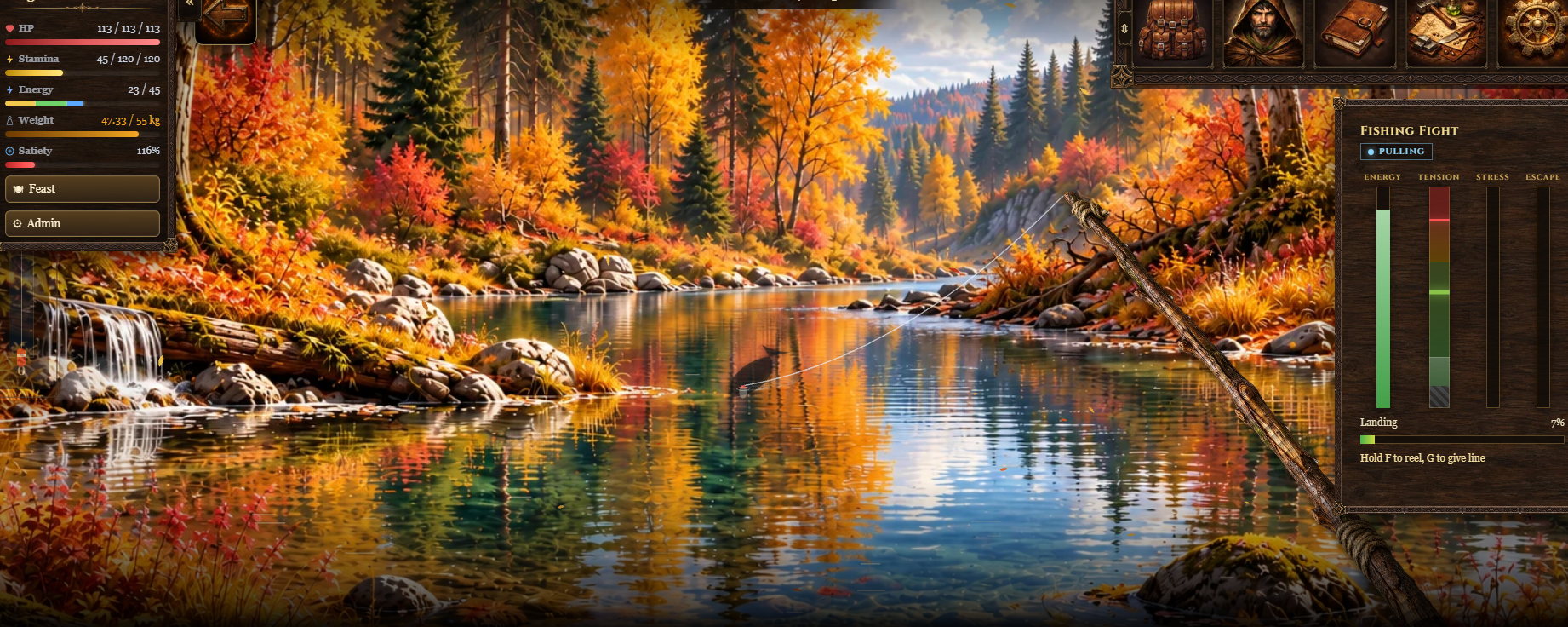
Second book (Symphony of Graemour) a bit of autumn fishing, and more.
Graemour: the tamers' book
Fragirdemorium is the book for people who fight with a weapon in their hand. Graemour is the one for people who fight with their creatures.
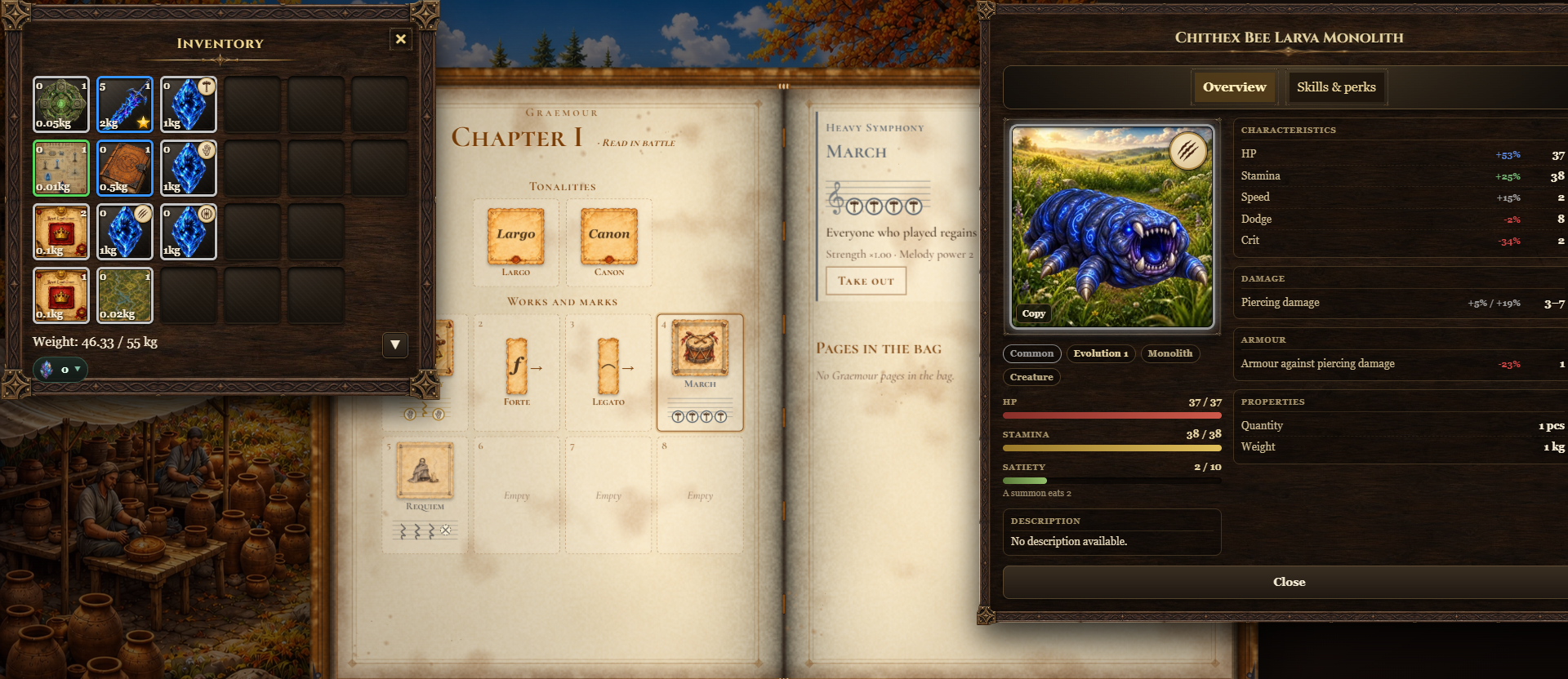
The idea is simple: your pack plays music. Every creature has a role, and every role is a note on a staff, from do to si:
- do — your Voice (anything you do yourself)
- re — Tank, mi — Bruiser, fa — Support
- sol — Damage, la — Caster, si — Assassin
A creature that strikes or casts plays its note. A creature that lets its turn pass plays a pause. Summoning a creature plays its note too. Everything your side does in one of your turns adds up to a bar, and when your turn ends, the bar is over.
Pages
Each page in Graemour is a work: a short melody with an effect. If your bar ends with that melody, the work sounds. Say a page reads Tank → Pause → Tank: you order the golem to hit, let the crow wait, hit with the golem again, and the page fires.
There are six symphonies, each with five works:
- Heavy — protection, taunts, knockback
- Hunting — bleeding, marks, crits, finishers
- Choral — healing, cleansing, leadership back
- Mystic — cooldowns, blinding, stuns
- Dance — extra actions, swaps, movement
- Quiet — rewards waiting, stealth, cheating death once
Every work has a recognisable shape. Soar always climbs up the staff and March always repeats the same note, but the actual notes are rolled when the page drops. Two copies of the same work can ask for completely different packs.
On top of works there are marks and tonalities:
- Marks sit next to a work and change it. Forte makes it stronger, Reprise lets it play twice a turn, Legato forgives one wrong note.
- Tonalities go at the head of a chapter and bend the rules for all of it. Allegro makes a bar last two turns, Canon lets your enemies' moves count as notes, Conductor makes your own voice count as any note.
A chapter holds 2 tonalities and 8 slots for works and marks. When several melodies finish on the same note, the longest one wins, and each work sounds once per turn.
In battle
You don't need to read music to play it. Every note carries the sigil of its role: a shield, a claw, an eye. Next to each work in your battle panel you'll see what it's waiting for, like "next: Tank", and that note glows on the staff. Ordering creatures in the right sequence costs leadership, so a good tamer spends it where it completes a melody.
The book shelf
Your character now has four book slots under the battle pocket. A knowledge book only works in battle if it sits on the shelf, though you can still open and arrange it from either place.
Pages will be rare finds. Collecting the right melodies for your pack is the long game.