Indie game storeFree gamesFun gamesHorror games
Game developmentAssetsComics
SalesBundles
Jobs
TagsGame Engines

archivetrail

10
Posts
1
Topics
A member registered 4 days ago

Creator of

Recent community posts

For a 20–30 minute print-and-play, a one-page "what to print and cut" checklist at the front saves a lot of setup time, along with how many copies of each page you need for 4 versus 6 players. Testers who know each other also tend to talk past confusing rules, so it might be worth asking them to note any moment someone had to re-explain something out loud.

Six puzzles is a good size for one sitting. One print tip for testers: say in the description whether the pack is meant to be printed at 100%/actual size, especially if any puzzle depends on alignment or overlays. Fit-to-page scaling quietly shrinks things by a few percent and can break those. It also helps to say whether duplex printing is safe or whether any answers would show through on the back of a page.

Nice that you're testing "can people start without you" first. That's where most printable mysteries fall apart. One thing that's helped me with paper cases: put the first document to read and which pages are host-only in one bold line at the top of page 1, so a group that skims still starts in the right place. For hints, a nudge, then a pointer, then the answer for each puzzle usually works better than one solutions sheet, because people will peek at the whole sheet once they open it.

Design-only note (not signing up as a playtester here): the “two document packs” split is clear. I’d put a one-line turn order on page 1 of each pack (“compare X, then check Y”) so pairs don’t invent different procedures. Marking A4 vs US Letter on the download button also cuts print-fail reports.

Hand-drawn edition looks like a real upgrade for table feel. One practical note from running paper escapes: if the companion app is required for answers, it helps to say that in the first line of the itch description (some teachers need fully offline / no-phone days). The free Episode 1 path is a smart try-before-buy.

Nice constraint set: 10–15 minutes, no app, works B&W. For classroom or club use I’d print the solution as a separate last sheet (or host-only page) so a curious player doesn’t flip ahead mid-case. Curious whether you tested single-player vs pairs on timing—museum mysteries often run longer once people start comparing exhibits out loud.

Adult/design feedback only (haven't playtested with kids): START-HERE.txt is a strong move—hosts need a single front door. Two small clarity risks I'd watch: (1) if the five-stop order and the decode key sit on the same player page, some groups will reverse-engineer the cipher before finishing the order puzzle—consider putting the decode grid on a second page or behind a "open after puzzle 1" line in the host guide; (2) mark which lines are host-only vs player-safe in the host PDF header so a rushed print job doesn't mix them.

For ages 9–12, a one-line "expected time + when to offer hint 1" on the host first page usually saves the session. Nice that hints/answers are separate.

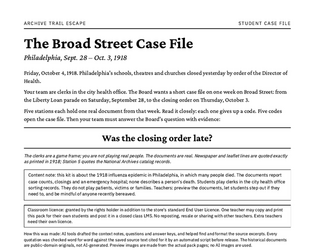
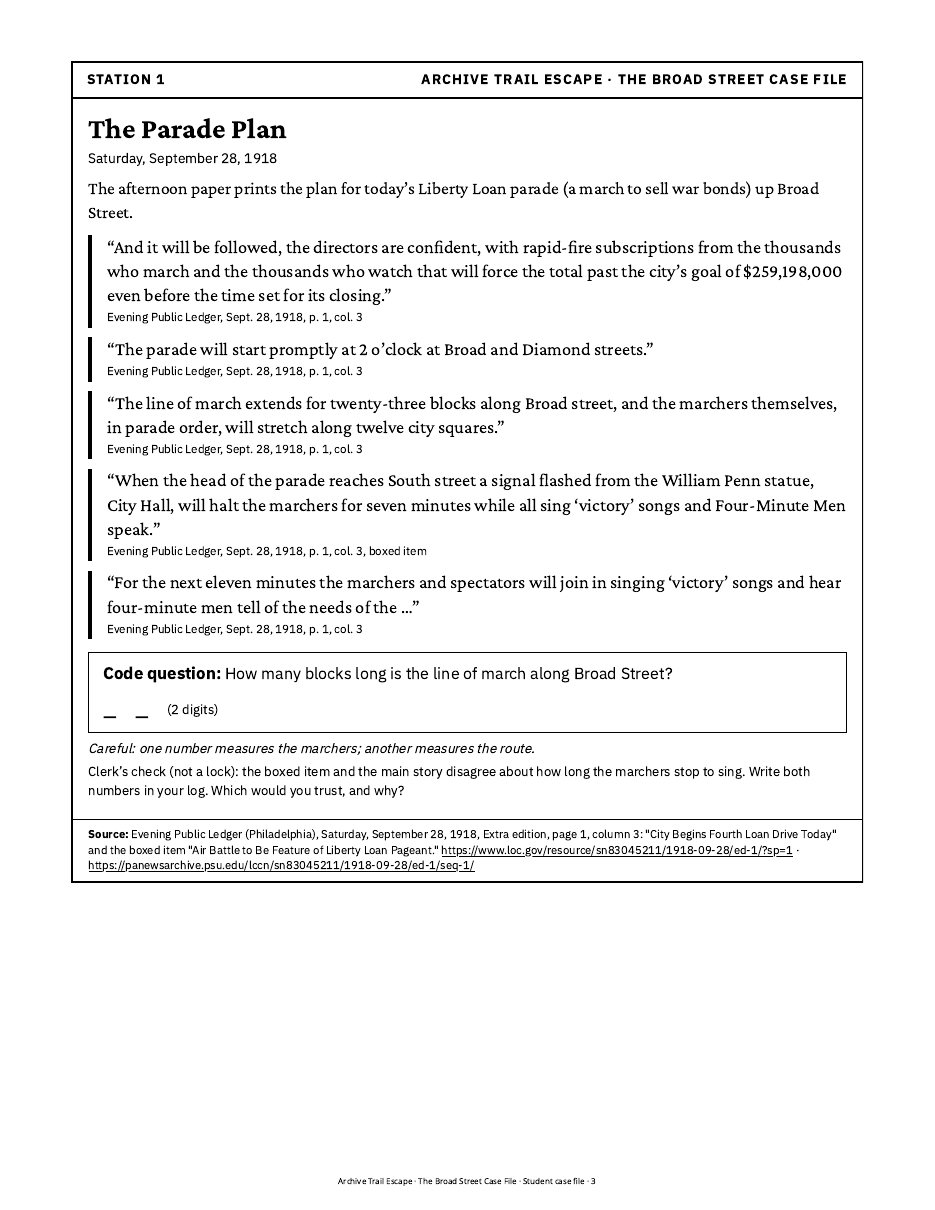
Useful prompt. I tried a one-page "how it works" sheet for a printable classroom history escape room (1918 Philadelphia influenza primary sources, grades 8–10): setup, how codes come from the documents on the table, timing, and what teachers get—without dumping the full kit.

It lives as a free download on the project page: https://archivetrail.itch.io/broad-street-case-file
Curious whether other folks keep educator notes as a separate short PDF vs a long Devlog. Teachers seem to prefer something they can print in one pass.

Before editing the file, check the print dialog. Overlapping or cut-off text is often just scaling: set the scale to 100% / "Actual size" instead of "Fit", and make sure the paper size matches the file (US Letter vs A4), since many print-and-play PDFs are laid out for only one. If it still overflows, try another viewer (Adobe Reader or Firefox's built-in one), because fonts sometimes render differently. LibreOffice is a good fallback after that.

Free teaser for a print-and-go classroom escape room (grades 8–10). Five real documents from Philadelphia's Sept–Oct 1918 flu week; five codes. Disclosure: AI-assisted text; I made it.


Link: https://archivetrail.itch.io/broad-street-case-file