On Sale: GamesAssetsToolsTabletopComics
Indie game storeFree gamesFun gamesHorror games
Game developmentAssetsComics
SalesBundles
Jobs
TagsGame Engines

Iconic XP

7
Posts
3
Topics
2
Followers
4
Following
A member registered 46 days ago · View creator page →

Creator of

Recent community posts

Thanks! Here's the short version of both.

Your first hour (current alpha): you start in a valley with 20 coins and a 25 kg carry limit, alone with a dog or an old pack horse, or with friends. You gather wood, stone, fibre and berries. You make crude tools, light a fire, put up a shelter, and hunt or fish. Then you sell to villagers: there's no fixed trader, so any villager can buy what you have. The goal of the first hour is simple: don't go hungry, get a roof, and earn your first coins.

The villagers think for themselves: nobody follows a script. Every villager weighs what's best for themselves, their family and their village, then acts on it:

Work: they choose jobs by what pays best.

Pay: they turn down your job offer if the wage isn't worth it, and tell you what they would accept.

Risk: a hunter weighs the chance of getting hurt before going after a bear.

Settling: they found their own villages and build huts, and paths appear where people actually walk.

Family: they marry, and newcomers arrive looking for work and a home.

Your friends and companions have the same free will. They help because it benefits them, not because they're told to.

How it connects to the long-term game:

Now, in the alpha: those first coins become a stall, then workshops. There are more than 25: bakery, tannery, blacksmith, brewery, sawyer and more, and anything they make can be sold.

In development: towns get a treasury funded by a tax on profit, an elected reeve or mayor, and spending on guards, roads and public works. Villagers vote by what benefits them; you can vote, stand for office or simply trade.

Planned: family and inheritance, so when your character dies the game continues through an heir; larger settlements; and eventually realm-level power for players who want it.

Oh, I almost forgot: there are bandits. Bandit camps in the valley raid travellers and the carriers who haul your goods, so the road is never entirely safe. Full warfare, with armies and fights over territory, is planned for later. 

You can stay a merchant, a farmer or a craftsperson for the whole game; ruling is optional. I'm thinking of adding a "first session today" section to the page and marking each feature as in the alpha, in development, or planned
Thanks, Goblin. That's the read I was hoping for. You're right that the page tells the vision better than it tells what a tester can rely on today. I'll add a short "first session today" section, roughly this:

What's in the current alpha (N10b): you start in the valley with 20 coins and a 25 kg carry limit. You can start alone with a dog or an old pack horse, or with friends. You gather wood, stone, fibre and berries, make crude tools, build a fire and a shelter, then hunt, fish and sell to villagers. There's no fixed trader: any villager can buy.

Workshops (mid-game, working in the alpha): once you have coins and a village, you can set up production that feeds your trade. There are more than 25 workshop types:

Wood: logging camp to logs, sawyer to lumber, charcoal burner to charcoal.

Food: mill and bakery for flour and bread, plus a smokehouse, a dairy, a brewery, drying racks and a pie kitchen.

Hides: hunters camp to game and hides, tannery to leather, leatherworker to clothing, satchels and armour.

Iron: mine and bloomery to iron, blacksmith to axes, blades, scythes and armour.

Also: an apothecary, an herbalist, a fletcher, a bowyer, and a stable for saddles and tack.

I've built each of these, run production, and sold what they made. Anything a workshop makes can be sold, at your stall or to any villager.

Still being tested: swimming and lake edges, and hiring a carrier for your stall.

On your merchant question: the first trade is meant to be a choice in three small ways:

What you carry: 25 kg fills fast.

Where you sell: prices differ by region, and rare goods are worth the longer walk.

Who you supply: every villager is a possible customer, and stall owners set their own prices.

Why a player would ever accept a lower price, for a steady customer or for a village you want to grow, is the part the page should explain better. That's intent, not something the alpha shows yet.

Thanks. Your "one concrete session" point goes into the next page revision.

From the notes, the diary/biography layer seems a useful way to make residents memorable beyond their jobs. One thing I would check in the new overview: can a player distinguish “nothing known” from “known healthy” without relying on green alone? A small symbol or label alongside the colour could make that distinction easier to read.

For the couples and quarrels, does the diary explain what caused the change, or only record that it happened? Seeing the cause would help me understand the person rather than treat the relationship as another status meter. I have not played this version; these are questions from the update description.

Welcome — what kind of life would you build?

Hearth & Fortune begins with one person finding food, shelter and a way to earn a living. The wider direction connects that life to a home, individual NPCs, businesses, family, settlements and optional territorial influence. You can be interested in the idea without joining the closed alpha.

Would you stay a merchant, make a home, run a workshop, build a town or pursue a realm? What would make that choice meaningful to you?

This is a place for questions, suggestions and playtest notes. New players and experienced survival, RPG and strategy players are all welcome. Criticism is useful: explain what you tried, what you expected and what happened, and keep it respectful.

For a bug report, include the build name, new or continued game, steps, result and graphics card. Say if you do not know. Please do not post passwords, alpha keys, private correspondence or personal information. Send logs privately if requested; avoid sharing full logs publicly.

Current checkpoint, October 23: N10b is packaged but water/shoreline/input acceptance remains incomplete. N11 is in development. Deeper family generations, armies and realm control are not being announced as finished features. This board does not announce a new unrestricted download.

Free Windows alpha access requests: Jim@iconicxp.games. Approved testers use their individual access and existing private instructions.

Follow Iconic XP for the project devlogs in your feed. Future meaningful development updates and questions will stay connected to this hub.

Does this page make the playable alpha and the larger game vision clear?

Hearth & Fortune is a medieval life/RPG/strategy sandbox in development. I have expanded the project page to explain the path from surviving and earning a living to homes, individual NPCs and the longer-term family/settlement/realm direction.

https://iconicxpgames.itch.io/hearth-and-fortune

I am looking for page and concept feedback here; you do not need alpha access to answer:

1. After the first few paragraphs, what do you think you would actually spend your first hour doing?

2. Can you tell which parts belong to the current alpha and which are the future vision? Please point out any wording that promises more than the status sections support.

3. Which life interests you most—merchant, craftsperson, homesteader, town builder or realm ruler—and what important question about it is missing?

The current development checkpoint is N10b packaged with incomplete water/input acceptance, while N11 economy, growth and character work is still in development. This is not an announcement that N11 is available. Images are earlier genuine alpha captures and are labelled that way.

New survival players and experienced life-sim/strategy players are both welcome. One unclear sentence or one missing question is useful feedback; you do not need to write a full review. AI assistance is disclosed on the page.

I will keep this as the project's feedback thread and return here for later page revisions.

Hearth & Fortune — a life that can grow into a realm

This thread will collect the development milestones and questions behind our medieval life/RPG/strategy sandbox. The public game page is https://iconicxpgames.itch.io/hearth-and-fortune . It is a closed Windows alpha, with free individual access requests at Jim@iconicxp.games.

The opening is personal: food, tools, shelter and the first coins. The larger direction connects livelihoods, trade and homes to families, settlements and optional territorial power. Remaining a merchant should be a valid life too. NPCs are being developed around individual needs, skills and ambitions, so they can shape the world around you. Deeper generations, armies and realm control are still in development or planned.

October 23 checkpoint: N10b is packaged, with work on visible-water swimming, shore vegetation, waterfalls, hold-E actions, zoom and the HUD/equipment view. Automated start/save/reload checks passed in a bounded rerun; water visuals and actual input acceptance are still incomplete. This is a progress report, not a confirmed release announcement.

N11 is the next work: economy and settlement growth, clearer NPC job decisions, creator/clothing work, hills and combat/water/forest-floor improvements. Candidate fixes are not yet proof of a naturally growing world in the game. We are checking what happens through ordinary play as well as code tests.

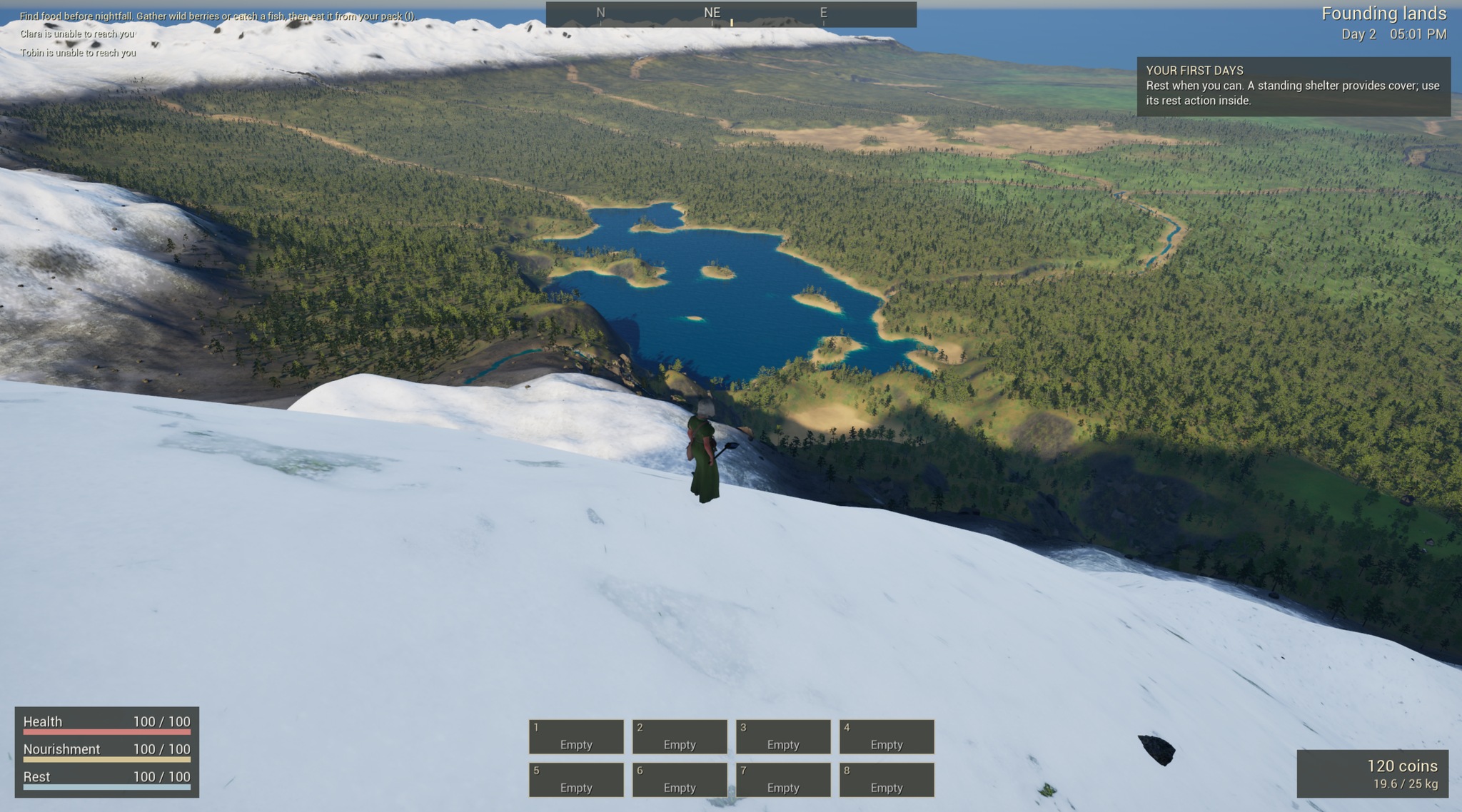
The image below is actual earlier PB15J gameplay for world context, not N10/N11 feature evidence. Development uses AI assistance, with human design, direction and QA.

For players: what would persuade you that the people have lives of their own—seeing work and trade, changing relationships, new buildings, or something else? What should happen in the first hour to make you care about returning?

I will keep future meaningful milestones in this thread. Questions from people who have not played are welcome too.

Six years of work and a new Steam release is a huge milestone. I like that you're spelling out what changes from the itch version, especially the expanded areas and inspection mechanic. Which addition changed the way players explore the dream worlds most during testing?