





Thank you for taking the time to write such kind words! They brought me a smile on a Monday morning back at the day job ;-)
SeveralSeals
Creator of
Recent community posts
A puzzle game whose mechanics - hopefully intentionally! - encourage you to plan your whole solution before you make a move... which is unfortunately a style that I really don't gel with, but that's a personal preference!
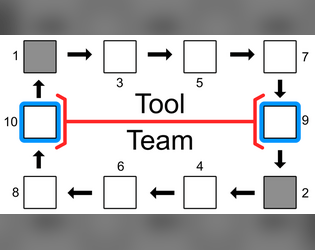
Another personal preference is labelling rotation in terms of "clockwise" and "anticlockwise". With the timer so tight, you can fail an entire puzzle if you accidentally have to go the long way around even once.
I really enjoyed the presentation! I love to see ascii art, and I the framing and gameplay matched well - it really makes you feel like spiderma- I mean, like a defragger. The added dimension of *avoiding* matching too many of one type is interesting. I appreciate the inclusion of a settings menu. One drawback is that you sort of have to wait around for a bit at the start for the belt to fill up. My first few attempts saw me running out of energy dragging boxes across empty space to try to make just one match and get some energy back.
Oh! And there's one visual puzzle that deserves a special shout out, because it leads to a delightful 'aha' moment. Even if it does, admittedly, only make sense if you think about it exactly the right amount, and don't worry about the whole 'suspension of disbelief' thing I mentioned, which honestly doesn't matter anyway :-P
Having run Break This Game, I also ran this one with my friends last week. I think BtG is the better of the two, but that's not surprising because the author had more experience when they wrote it!
Where BtG is delightfully sandbox-like while still evolving over time, this room presents basically all of its interactables right at the very start, which was a little overwhelming - both in terms of the time taken to interact with everything, and the memory overhead of remembering information and things to go back to.
Nonetheless, the room does a good job with its premise, without being too obtuse or pushing the "suspension of disbelief" (if you allow yourself to beileve in a world that happens to be full of puzzles) too far. It's a fun setting that is exploited well - for example, my players enjoyed the spatial reasoning of figuring out the central puzzle, and then how to get the pieces needed to solve it. The least "believable" part was the motivation of "getting to work on time", rather than having fun meddling with the observatory (and maybe robbing them a little as payback for locking the players in.)
(Crossposting my review, since apparently by default it's not visible to anyone except the creator)
This room stood out to me while scrolling through the archive of Escape This Podcast, and I wasn't disappointed! After listening to the episode, I read up and ran it for my friends as a change of pace for our usual online game night.
The room is very nonlinear in a way that encourages exploring, experimenting, and chipping away at curious corners so that you always feel like you're learning and making progress. If the players are cunning, they can discover and solve a lot of "mid game" puzzles right from the start, which makes them feel smart.
On that note, there's a lot of "aha" moments packed into this room, and a lot of what makes those "ahas" satisfying is the commitment to the theme of videogame mechanics. The clever solutions make sense in the game world, and reward a love of the subject matter without being unsolvable if you're unfamiliar. The milestone marking the shift into the back half of the game comes with a sort of diegetic hint sheet that helps players catch up if needed without patronising them.
Along with the mechanics, the narrative of the room also makes good use of tropes and presents a more interesting overall story than you might expect (no spoilers here, though!). As a very minor criticism, the final sequence is quite narration-heavy, with two large blocks of description / speech separated by only a short vignette of player agency in the form of one last anticlimactically trivial puzzle.
On the "production" side, the actual document was generally clear and readable, though I'm sure I would have found it harder to grok if I hadn't already heard the room played through on the podcast. The highlighting and hyperlinks are good, but I think the doc could benefit from an outline near the start, summarising the goals / main puzzles of each phase of the room.
It took my two players (one familiar with the theme, one less so) a little under two hours to complete the whole thing, so I'd say the estimate is pretty accurate.
Overall, this was a great evening's entertainment that was generally smooth and fun to run from the gamemaster's perspective, too. Though the different media are not entirely comparable, I feel it's worth saying that I enjoyed the room more than some physical escape rooms I've played. Thanks for sharing your work with the world!


