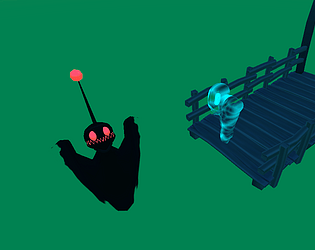
Very nice game, very simple to play but fun and addicting. The only thing a bit bothersome is that there are some moments where I feel the RNG would not allow me to survive no matter what, but maybe I just need to git gud.
This does seem really cool on the onset, I like the mood and I believe others who say it’s very fun. Unfortunately, like some players, I do not understand the mechanics. I don’t need necessarily an in-game tutorial, but just some way to understand what I’m doing. Sometimes I push a thing; sometimes I switch places; sometimes the thing can attack me; and sometimes not. I find no logic to these different events. Just an image card with some base interactions would get me going.
Same here. We’re considering itch as a primary store, but we need regional pricing for two reasons:
ethical: we want our products to be accessible to the largest amount of people
financial: by making our products affordable to people in emerging markets, we can sell more
From a purely cynical and interested perspective, not having regional pricing leaves a lot of money on the table. A $80 product is simply out of the reach of half the planet; the same people would pay $40 or $20 happily though, and that can double, tripe, or multiply by ten your addressable market.
From an ethical perspective, regional pricing is necessary for justice and fairness. Otherwise, you send a “poors not allowed” message; this is always true, no matter what the price is. A $3 game on itch is cheap to me, but could really sting for someone in a poorer country. Putting it at 0.22c for them makes it cheap for them too, and they can make a purchase decision with the similar constraints to mine.
Further; regional pricing is challenging to implement, but not overwhelmingly so. You need to detect where people are from, show a banner that allows them to opt-in the regional price, and then create a coupon of sorts. The complicated parts are:
Deciding on the rate per country. There are databases and heuristics for this, and it could be a communal project. Alternatively, you could leave it completely open to creators. Creators decide which countries get which discount.
(optional) showing a control panel so creators on itch can decide which discounts to apply (if automatic) or a UI to set the pricing per-country (if manual).
My keyboard won’t let me press 3 keys at the same time, so any move requiring more than 2 was off-limits for me. Maybe if I could rebind some moves to the mouse. For example, I don’t think there are moves requiring 3 keys if the arms are mapped to MRB and MLB.
I tried in a Chromium browser (Vivaldi) and was able to get unstuck. Can confirm that in Firefox, nothing worked, tried for minutes and after refreshing the page.
I like the game, I think there’s a good loop and fun gameplay.
I think there are a lot of small problems as of right now:
progression is not fluid; first levels seem repetitive, then difficulty suddenly spikes (in the level with trebuchets)
weapons are not introduced in a way that they can be tested well. Since they have a limited amount of uses, I tend to keep them for a difficult enemy, but then often die before. I think the items should unlimited, or given space to try in a safe area (at least after dying?) or given a sample of at the beginning of a run… Not sure how to solve it.
The enemies are different, but they’re not combining to make new interesting scenarios or challenges. The combat is always sort of the same, despite the enemies (ranged, melee, etc) seeming like their composition should change the challenge.
Not enough tell on when the archer is going to shoot. I often avoid too early.
But overall, pretty fun loop, pretty neat gameplay, I’ll be waiting for the next version!
I like this, but it was impossible for me to beat the two bosses, mostly out of confusion because of the bright colors which make it difficult to read what’s going on, and random slow-downs/speed-ups.
What I disliked:
Last boss room
Enemies can shoot you from offscreen and through walls
You can get the same item if you pick an item box again, which is disappointing
Lack of feedback on hitting enemies or getting hit means the action is hard to decipher
What I’m not sure if I disliked or if it’s interesting:
Enemies can pass through walls, but you can’t! Even though you’re the ghost!
These are good, no-nonsense, practical patterns that can be useful in almost any game. There’s also good illustration on how they work, and why/when someone would want to use them. Kudos! This is good work.
Very impressively refined gameplay, it was fun all along and gives out a mature, experienced game designer vibe. This is at least a few notches above what’s expected in a gamejam. Kudos!
There’s something extremely interesting here which I enjoyed playing, but I have a legibility problem with it. I genuinely have to squint to see my character and understand what’s going on.
I think the camera should be more zoomed in, or, alternatively, colors should be more contrasted.
It’s pretty fun in its own right. You can also teleport your car to ceilings and to far away tracks, which is fun, but unfortunately not sequence breaking.
But yea, I got indeed no clue how it could be taken further. Interesting idea though.
I think there are no such rules. Terry has said before that individual submissions are preferred, since this is a learning jam, but in the end we’re here for fun, so do whatever you feel makes sense to you!
We have a room, #game-jams, that can be used to coordinate and collaborate, or just show off stuff. Threads are allowed there, so people can create sub-topics easily
I’ve been using Godot for long, but never for 3D, so as weird as it might seem, I have almost 0 experience with 3D programming. That’s probably what I’ll focus on
I am one of the moderators of the Godot Discord, and a huge huge fan of your work, Mr Cavanagh. Super happy to see you try Godot!
Despite moderating the community, I don’t know everything about the engine, so if I can find the time, I’ll definitely pick up a new aspect to learn this weekend. Looking forward to participate.
And I’ll try to answer any questions here too, if anyone has any (though asking them in more public spaces like the Discord is probably more likely to be fruitful).
Interesting style, good music, fluid gameplay, cool ideas. I like it, would play more
Problems:
At the moment, it’s way too easy to avoid bullets. Their pattern makes them essentially impossible to hit you as long as you sit in one of the numerous safe spots
Because of this, the strategy is to stay in place and shoot at the core for every enemy, occasionally moving away from bombs, until the Hammer thingo with auto-lasers, where the difficulty suddenly spikes. I also didn’t understand the lasers were hitscan and hitting me before noticing my life go down.
This is a very fun game, with a good hook, beautiful style. I would have the following wishes:
some way to ward off or escape from sharks. Basically, once a sharks locks on to you, you have to exit. that’s not very fun
ability to get oxygen by surfacing anywhere, not having to go back to the ladder
some rarer, weirder, bigger creatures that lurk in the depth (maybe there are and I happened to not see them?)
some weird mysteries to ponder and invent lore about
If there were some more mysteries and if the game was a tad longer (not too much! Maybe twice as long), I’d easily pay money to buy it. Heck, I’d ave bought it as it is, but there’s no “pay what you want” button?
I would like to store JSON values as properties of characters, as well as be able to procedurally create dialogues from bits and pieces.
I propose that the method Dialogue.start_dialogue(json_path) receives a sibling method Dialogue.start_from_data(data, character), where data is pre-parsed json (or, in my case, generated).
A possibly better API would be:
Dialogue.set_data(data)
Dialogue.set_data_from_file(json_path)
Dialogue.start()
Then the external Dialogue.start_dialogue API could stay as it is, but use the underlying set_data_from_file.
An additional though: if the two set_data* methods return self, then one can do:
Dialogue.set_data(data, character, context).start()
# or
Dialogue.set_data_from_file(json_path, character, context).start()
I’m looking to use it in an RPG where talking with people might trigger actions on those people. For example, a person might be able to barter with you.
Or, a person may like/dislike you for saying certain things.
I know I can run global actions, but I would want to run methods in the context of the character you’re speaking to.
One way I’ve found to do this would be to have an autoload singleton like so:
# Interact singleton
var character

func dislike():
  character.love = character.love - 1

func open_barter_dialog():
  character.barter.popup()
Then, before starting a dialog, setting Interact.character = current_char, before Dialogue.start_dialogue.
Then, my script nodes can call dislike() and open_barter_dialog.
That works if every character has the same actions, but that means it’s very hard to call a specific command for a specific character.
A more flexible solution would be:
# Interact singleton
var character

func command(command_name: String, args: Array):
  if character.has_method(command_name):
    var func = funcref(character, command_name)
    funcref.call_funcv(args)
And then use in my scripts: command("invoke_devil", ["candles", "sulfur"]).
That seems overly cumbersome and very easy to get wrong.
Slightly different, but related:
How would I get local variables in text variables?
For example, I need a class of characters to change their text based on if they saw the player steal before or not. But each character individually tracks if they saw the player steal or not.
How can do: if current_character.<some value>: branch 1 else: branch 2?
Seems to me like the only way is also to set the character, then read character.has_seen_player == true. Which is ok, but also less practical than having access to a context.
Much easier for both problems would be to be able to do:
Dialogue.start_dialogue(json, character, context), where context is usable to call methods or retrieve values. The @ could be used to denote the local context, rather than global context. Otherwise, another character could be used.
Luciano I have a request from you also, please package all your belongings and tell me when you’re ready, I’ll tell you where to send them.
It’s ok if some of your clothes are old, I’ll accept them. I need your stuff, all of it (you can leave one pair of pants and one shirt for yourself). Please hurry.