Indie game storeFree gamesFun gamesHorror games
Game developmentAssetsComics
SalesBundles
Jobs
TagsGame Engines

[Devlog] Camp

A topic by A Fals Fiction created 9 days ago Views: 81 Replies: 4
Viewing posts 1 to 6
(4 edits)

Devlogs in the jam community area? That’s an excellent idea! I want to participate. On the other hand, it’s halfway through the jam period, and all I’ve got is vague character bios and a backstory that might not make it to the game! I’m sure this is fine.

Developer: Acin

Themes: found family, identity, culture clashes, living in a forest (because I will squeeze every story into one if I can), queer history, late 19th Century US military

Blurb:

Lieutenant Reneau lacks a certain confidence on what to do with the feared Corpsetalker sent to his camp. The ungodly consultant’s arrival is complicated by the soldiers’ whispers of “Do not suffer a sorcerer to live”. Upon their meeting, Reneau is not entirely convinced the Corpsetalker is alive….

He is about to learn how choices are not made easy around this stranger.

(Sorry, it isn’t clear, but these two are potential lovers, depending on the choices made. (And either way will fit in with “Spirit of the Latch”.))

Word Count: 2300/?????

Sprites: 0/3? One has character sprites I can use as a base for his younger form. The other I’ve had an mental image for a while, which is actually rare for me. We’ll find out if I can apply that to a drawing.

Backgrounds: :whistles-innocently: Look, I’ll find references eventually. In time, maybe. Everyone enjoys vague color blotches in the meantime, don’t they?

Audio: Uh… yeah, the timing is not fun. My preferred source for sound effects is undergoing a big discussion on “AI” labels, and I’m not really in the mood to listen to old recordings of military marches. …so maybe I’ll recruit help to sing old folk songs and record more sfx than what I’ve stored.

GUI: I’ll build something. Believe it or not, this is one of my favorite parts of game design. A few unpublished games have helped me better understanding screens and effects in the interface; that might help here.

Logo: This is one of the last pieces I put together. It might be the very last, uploaded minutes before the deadline if my past jam history is an accurate pattern.

Title: TBD. Above is a “working title” as a placeholder.
Sprites update: I’ve started on the main characters. Ash looks adorable with shorter hair.

Reneau is currently darker and has more rectangular features than intended, in my attempt to make the mixed-race character too pale. He’s supposed to be passably White, but I made the mistake of grabbing a deep shadow on a historic figure drawing of uniforms and going with it until I stopped to compare him with Ash’s sprite. Oops.

His skin is a pretty brown in this version, however. I might start over without a reference and squeeze in a background character using the misdraft.

A half-formed plan for the game artwork is to scarcely use it. The GUI can set up the scenery, the character sprites can be worked in to look less like dolls in theater and more like book illustrations.

The characters are bookish, as in bibliophiles. That illustrated prose style could suit them.

Speaking of suits, the US Army uniforms of the time are kind of funny. There’s a distinctive look to 19th Century cavalry, evil and creepy in view of the massively cruel crimes against humanity committed in the real history of the time; yet edging up to 1900, the Army overall was trying to figure out how French it wanted officers to look. Sashes? Badges? Medals? Tassels? Stripes? Functional or decorative hats? How important is underwear? Especially as I’m not intending to stick entirely to history, this gives me leeway to play around with what looks good to me on the characters.

Music: Good news. Popular love and comedy songs that originated in the late 1800s were recorded in the early 1900s and preserved by the US Library of Congress. My search for music to use in “Spirit of the Latch” was overly restrictive, because I didn’t have a list of titles to search up.

I’m removing the backstory from the word count for as long as that’s my reference, not a part of the game.

Word Count: 1k for the opening scene.

Sprites: Maybe halfway through drawing full bodies for the main characters. Additional expressions later?

Only the the head and shoulders might be visible, most of the time, but even if I don’t do much else, I would like a reference for character graphics.

GUI: This has been sketched out on paper. I’ve decided to use my photos of historical sites and rural public spaces as art assets.

GUI development has started. This will be fun. The interface will be like a(n optional) game in itself.

One custom background / main menu screen has been sketched up digitally.

The colors on the sprites’ uniforms are giving me trouble. I’m digging into books and public domain websites for better references.

Story writing is on hold, too, while I research potential scenarios and terminology.

This period in US history is often ignored. Many of the best known authors were gay men, married women at least as famous as their husbands, Black (by today’s definitions), and/or freed from enslavement. Drag balls and dances were kind of frequent in the military, Washington, D.C.; vaudeville, and the Wild West. Quite a few notable photographers, painters, and performers were openly queer or associated with famous queer groups. Oscar Wilde was setting trends from oversees (while his noble mom was advocating for Irish culture through children’s books of folklore?); and before the massive chilling effect of some legal trials, there seemed to be considerable hope for progress between the deepest horrors of the country. But because it was relatively peaceful, the end of the 19th Century is something of a burned out hole.

The records exist. Finding them without the AI corruption or entirely lost context during this period of censorship is trickier than I feel it should be with access to the internet, historic museums, and a big library system.

Making up details from imagination when there’s a chance of including actual history that’s on the verge of being lost would make me feel bad.

(2 edits)

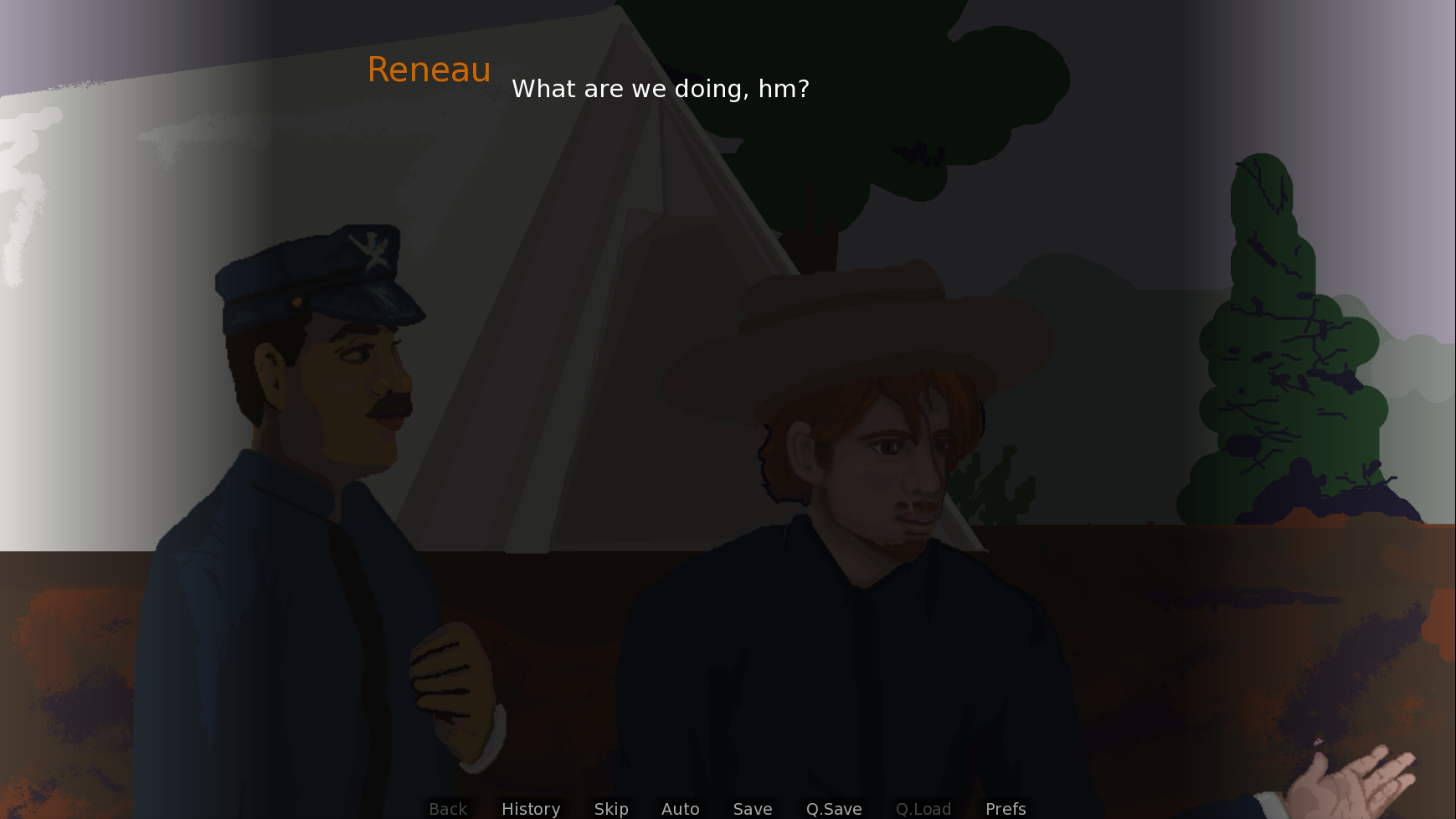
Mockup with NVL screen over a digitally painted scene of two men in front of a large tent.

Everything in this mockup is subject to change. Some of it I already know is wrong and expect to redo later this week. The screenshot is to show that there is visible progress.

Latest developments:

  • I picked a general setting, further south than what I as initially thinking, because I have photos, museum notes, and access to books from trips that would be useful.
  • The blues in the uniforms and the skin tones are feeling closer to correct.
  • An outline is coming together, and I’ve got ideas about how to cut it down to a manageable size.

Some thoughts from story worldbuilding research:

Relatively peaceful doesn’t mean the US military or the businesses or any property owners stop committing cruel acts with massively devastating consequences. This shouldn’t surprise me by now, and it is part of the story. The big trick is to writing in general is to use enough of the real world that the story world is believable or interesting without showing too much of its horrors.

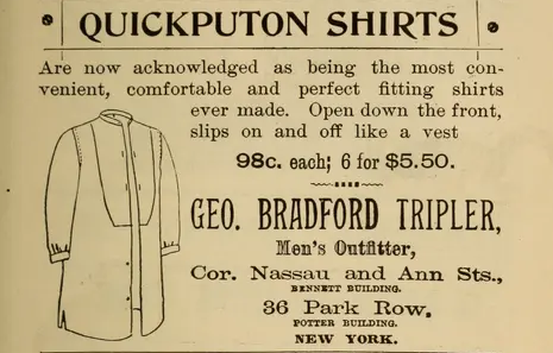
Quick Puton shirt One of my favorite ads, found in Pussy: Her Language (1895)

Men’s shirts were a competitive fashion industry. Nevermind (for our purposes) the politics of fabrics or the arguments about whether or not the maiming factories were evil. The styles are different in every ad, drawing, or preserved garment from the time period. I was hoping to figure out which style to go back to use in “SotL” before its next version release, but uhhh….

Nineteenth century uniforms were far less consistent in style, materials, and colors than what museums and books tend to let on by selecting the stereotypical examples to display. Is this relevant? Yes! The US Army and its members experimented with uniform materials and styles for several decades after the Civil War officially ended. In the specific decade I’m researching, 1890s CE, the US Army was using the light tan color for cavalry and its (wait, WTF?) tropical invaders. Everything from the specific color to coat length to decorations could vary from person to person, especially among the officers, who would present themselves according to personal preferences. That means there’s freedom to mix and match and still be able to justify my decisions. I like that.