
Indie game storeFree gamesFun gamesHorror games
Game developmentAssetsComics
SalesBundles
Jobs
TagsGame Engines
(1 edit) (+1)

Hey,

I'll answer by numbers, so it's easier to follow:

  1. It's not possible to change the normals of a plane (this is not a limitation of the tool, it's just how 3D works, because the normals are all the same on a plane. If you create a plane on Blender and set Shade Flat or Shade Smooth you can see it doesn't make a difference).
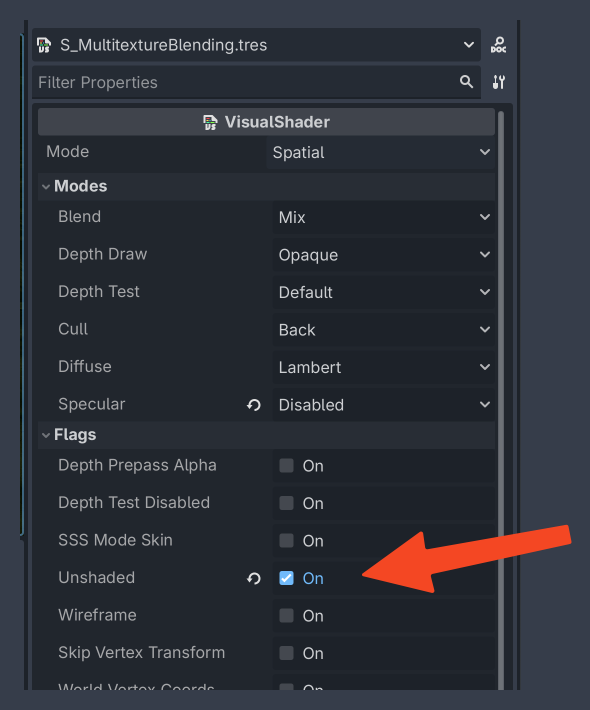
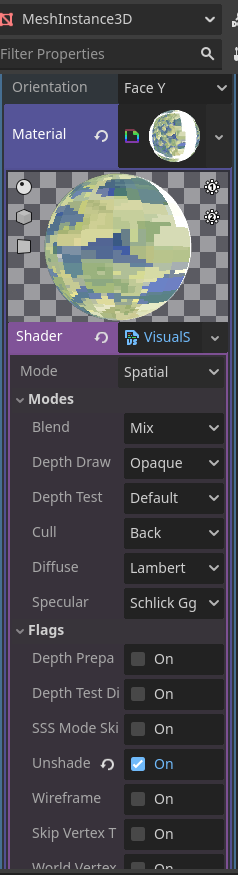
  2. "how to combine unlit and splat mapping here" - since you are painting in a custom material, you have to keep using "Original Material", otherwise you won't see your texture blending. In this case to have it unlit, you have to change the shader to Unlit. If you created the shader following the tutorial, it's a Visual Shader, so double click it and set to Unshaded:
(+1)

Thank you for both of these. I'm now scratching my chin trying to decide how to approach this problem... I might just put two flat planes with backface culling riiiight next to each other, facing opposite each other, and try to pass it off as double sided. I'm doing all this for a background prop that you might notice if you're swinging the camera around to deliberately look for it, but if you're just progressing through the scene, it shouldn't be noticeable. 

(1 edit) (+1)

One other question for you alfred, as I'm still getting used to using Godot and thinking about materials like this. How do I enable "Alpha scissor" transparency for the custom shader we made? I found "unshaded" and it's great, but I'm also trying to apply some fancy effects to some textures with transparency and I just can't seem to make it work right.


Scroll down here, there's a section about Alpha Scissor in visual shaders: https://danielilett.com/2024-02-06-tut8-1-godot-shader-intro/