


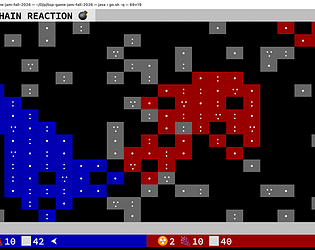
Play game
chain-reaction's itch.io pageResults
| Criteria | Rank | Score* | Raw Score |
| Enjoyment - how fun is the game? | #10 | 3.000 | 3.000 |
| Presentation - how does it look/feel/sound? | #12 | 3.444 | 3.444 |
| Overall | #12 | 3.074 | 3.074 |
| Creativity - how original is the idea? | #15 | 2.778 | 2.778 |
Ranked from 9 ratings. Score is adjusted from raw score by the median number of ratings per game in the jam.
Leave a comment
Log in with itch.io to leave a comment.
Comments
No problems with Konsole, OpenJDK 25 on CachyOS.
Nice implementation. It seems like it's meant to be a two-player game, and I didn't have another person to play with, so I probably didn't get the full experience.
It didn't run on my computer until I installed JDK 25 (You did document, that though). I would recommend building the uberjar with an earlier JDK unless you really need new JDK functionality.
Unfortunately one of the Java libraries used by this game (compiled by the maintainer of that library) is only distributed as Java 25+ bytecode. I considered forking and recompiling their library targeting an older JVM myself, but given the time constraints that didn't make the cut.
Sadly they also don't have an issue tracker for their project, nor is their release script part of the source code (meaning raising a PR against it wasn't possible), so the (better) option of requesting that the maintainer recompile for older JVMs wasn't possible either.
Oh dang, I guess you were really stuck. At least 25 is an LTS version!
Yeah if I'd had more time I would have recompiled that library myself (probably targeting JDK 11), but time was tight, and I figured most people who either already had a JVM or were willing to install one, would either already be using 25 (in part because it's the latest LTS) or would be ok with downloading it.
FWIW I generally have all LTS versions of the JVM from 11 onward installed, as well as the latest FR (currently 27), and switch between them quite frequently, but then I've developed for the JVM almost exclusively for ~25 years, so am somewhat familiar with the pitfalls of supporting multiple JVM versions (and Clojure helps a lot with that!).
Worked out of the box with guix openjdk@25 – bash ./chain-reaction.sh
Sometime in between it switched the sound output from the speakers to the headphones.
I didn’t understand the game, but it was pretty fun to try out.
Thanks for trying it out!
The rules of the game and usage instructions are in the README, which is also bundled inside the ZIP file (both the binary ZIP file and the source ZIP file). The section entitled The game gives an overview of the game's mechanics and winning conditions, while the section entitled In game key controls describes the keyboard controls that are used to select different types of bomb.
The game uses the JVM's built-in javax.sound package for the sound effects (specifically the digital audio / "sampled" APIs) for sound generation, and how that interacts with your computer's actual sound hardware is both JVM implementation dependent, and specific to how your OS switches audio output when multiple output devices are present, or the available output devices change (e.g. headphones are plugged in). I've never used that JVM core API before, so don't know too much about the specifics of how that works, but on macOS (my development OS) I observed that it appeared to respect my system settings (i.e. if I switched my system audio output device in the macOS control panel, the game automatically followed that change). Other OSes may behave similarly?
Thank you for the details!
I’m using GNU Linux, and usually that should work. But I have two user accounts, and when one plays sound on some device, the other cannot use it. So if the game releases the audio hardware every time its sound stops, the other account may use the hardware, so the first has to switch to headphones.
(this is only across different user accounts)
Other games usually capture the audio device and then keep it. Could it be that this is different here?
Ran on the first try with OpenJDK and my GNOME terminal worked just fine. Once I read the README I understood the basic mechanics. I didn't have a second player to play with me so I just placed bombs around the board and watched what happened. I couldn't figure out how to use the nukes so I never got to enjoy the explosions. While I didn't play a real game with another person I have a feeling that the game board is way too big and it would take a long time to complete a game. What has your experience been playing this with other people?
Nukes and cluster bombs are enabled using key strokes - `N` for nukes, and `C` for cluster bombs. This is described in the in game key controls section of the README.
The running section of the README also suggests making your terminal window small (in terms of dimensions), then enlarging the terminal font until it's almost full screen. An example dimension of 60x20 (resulting in a board size of 18x17) is quoted, and one can go even smaller if that's still too large.
Thanks for trying it out!
Ah, of course, the terminal size determines the board size. Now I feel silly for missing it in the README. Thanks for pointing it out!
Plays great on my `foot` term in linux! A full tui game is by default extremely impressive to me, and this particularly shines. Realized that the initial size of the terminal you run it on will define the play area. Also, yes, the sounds here feel right, but some kind of mute would be good too!
The command line option `-s none` will turn off all sound. Also check out all the other options with `-h` - there’s some other stuff worth playing with in there!
Thank you for giving it a go!
This is a unique submission. I like the style of it. The TUI is really well executed. I noticed the nice semitransparent blue and red overlays for the cursor selection, the frame with the title bar, and the chevrons in the scoreboard.
It’s fun to watch the chain reactions resolve. I was thinking, a kind of time-based animation for that could be really cool. Think of getting a combo in Puyo Puyo or other real-time puzzle game. I was also thinking of Devilition with its animated chain-reaction explosions.
I got the game running in xfce4-terminal with the font Monospace Regular selected, on Debian 13 (trixie), after installing the openjdk-25-jdk package.
There’s a delay in the “chain reaction” animations, since without one it rendered too fast and lost some of the spectacle. But I didn’t spend much time tuning it so it might not be enough on fast machines / terminals.
Thanks for checking it out!
I got a report that someone got this working on Windows with WSL and the Kitty terminal. There's also a Windows-native fork of Kitty called Kitsu that may be worth trying.
Please note that the core game concept is NOT original (though this implementation is). The core game logic was published as a Pascal source listing in either BYTE or PC Magazine in the mid-late 80s, and that's where I learned of it. In the intervening decades I've re-implemented it several times from scratch; in Borland C as a Windows 3.1 app, in Java, and now (finally!) in Clojure.