



















Absolutely fantastic. Great game that feels fresh and timeless.
Loreshaper Games
Creator of
Recent community posts
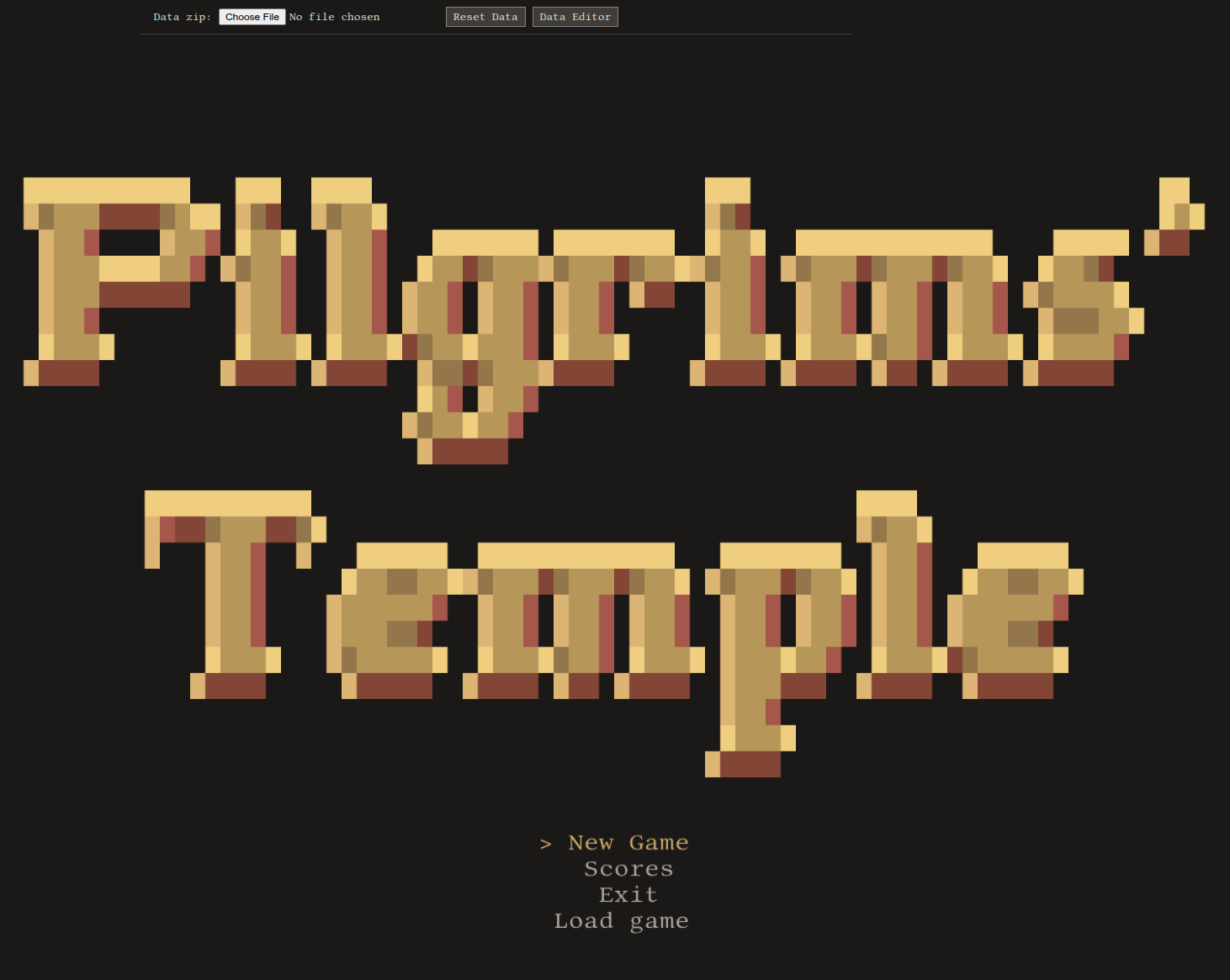
Also, if the web on Itch isn't working, you might try https://kawaicutout.github.io/pilgrims-temple/
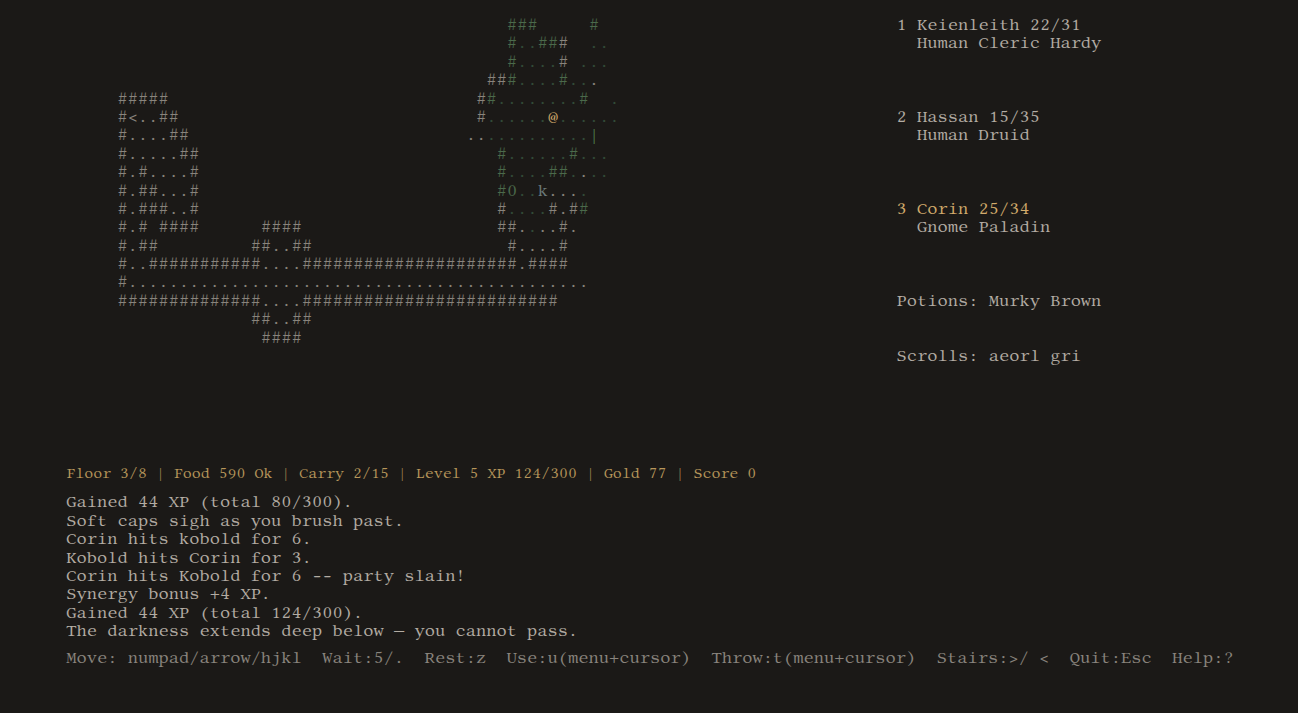
It uses web faux-terminal output instead of a rendering pipeline, similar to the difference between the terminal/renderer desktop modes.
I feel like this could have used a better on-boarding experience. Once I got the hang of it, it feels like a much more put together idea, but the game seems to be "check folder, see if it's one that matters, if not back out immediately without consequences, then move into a new folder and repeat" which is a very simple loop.
My suggestions:
1. Have risk/reward tradeoff for folders clearly established. Yes, you have the heart pickups in some folders, but the heart pickups are never worth fighting an enemy for.
2. Really, the minesweeper play is the interesting part of the game. Having a more "territory" based gameplay (as you have with the locked files/folders) as part of the core and just refining around that "find the mine, destroy the trojan" gameplay would make things a lot smoother.
3. Enforce commitment. This is something that falls more in that classic roguelike vein, but the "leave without consequence" function is something that makes browsing folders more of a casual experiment than a real challenge.
I think the core's really good, there's just some extra distraction around it and once you clear away that distractions there would be a lot of space to work with a more conceptually centered foundation.
Update: Adding a renderer for consistent output (apparently it's not possible to conveniently set single-run terminal fonts on Windows, something I haven't had to worry about on Linux) and it will make it easier to run the program across different devices. True terminal will still work, but renderer will be used for consistency across web and non-Linux platforms.
0.1 is live now: https://loreshapergames.itch.io/pilgrims-temple

Got surprisingly far with the vibecoding today.
Needs some UI fixes. Many talents and status effects not yet implemented. Dungeon generation is hit-or-miss.
https://kawaicutout.github.io/pilgrims-temple/ (to play on web)
https://github.com/kawaicutout/pilgrims-temple (see the source)
I vaguely remember, from aeons ago, a party-based roguelike that I enjoyed enough for its vague echoes to stick with me. There were a few things I didn't particularly care for (I think each character was on their own tile and the interface was a little rough), but it's stuck with me for probably about 20 years now.
For this jam, what I want to do is make a party-based roguelike. I've spent some time brainstorming the concepts, but I'll give a simple overview.
- Traditional: All ASCII terminal-based output. Text first. Not necessarily adherent to terminal/terminal emulator defaults (e.g. I am going for a wider and taller layout so that I can have some QoL features that are hard to get in your standard terminal. No meta-progression, no unlocks.
- Web/Local: I want this to run locally in a terminal (my preferred way to play) or on the web. Web will have some affordances for the format (e.g. HTML-native UI elements, game still shown in ASCII grid). Both versions will have parity.
- Class-based: Parties are built from characters with classes that determine what they can do. A rogue unlocks new loot and passages. A cleric causes party health to recover more quickly. A druid reduces the rate at which you get hungry. A fighter can tank hits and keep on going. Bards make everyone just a little smidge better.
- Knowledge matters: Items start unidentified, can be used but with unknown effects are hazardous. Wizards identify, or you can count on a barbarian's natural resistance to negative spell and potion effects. FOV and light matter; things might see you before you see them.
- Economy is the loop: Manage your characters' health and your party's food. Rotate primary party members, though remember that there's always a chance that someone else takes the hit. Paladins are the exception: when active, they don't let anything through.
- Characters "are" gear: While I might expand the systems further during the polish phase and add an equipment system in, the general concept is that your party composition is what matters most. Party members level up, can be found in the dungeon, etc.
- Streamlined, not dumbed down: The focus of the game is essentially a knowledge/decision puzzle. Run with a full party for maximum power, but you might starve in the dungeon. A single character will lose in tough fights, requiring careful map knowledge.
- Level features: Turn gold into items at a merchant. Drink from a fountain; will it save your wounded rogue's life, or send them into the grave? Resurrect dead party members at a shrine. Traps can take a chunk out of your party, unless you have someone who can spot them.
Some potential polishing features:
Spellcasting: Uses a "ritual" system to emphasize role of party composition. Spells are unlocked by having the right thresholds (e.g. Arcane/Divine/Primal magic). Spells cost energy (food?)
Advanced combat: My main concept probably works best with melee bump combat. Will need to see about ranged combat (is this something that happens automatically when in range?
Character races: Implement things like darkvision, tremorsense, etc. based on character races. Potentially go for a rich ADOM-style list; not just your usual human, elf, dwarf. Trolls regenerate quickly, but burn your party's food supply. Kobolds are squishy, but evade some incoming attacks.
Environmental Ambience: Different biomes, with their own enemy and feature sets.
Really strong bones here, a few ideas:
1. It would be nice if the game assumed left-to-right loading from your roster so you don't have to go up and click a new ball each time. This is especially the case since a lot of browsers put their "exit fullscreen" button right in the middle of that area.
2. The player should just start with 3 default balls (even if you keep the loadout locked until the upgrades are purchased) so that they don't accidentally launch with a single ball after playing. Perhaps better, maybe just make "empty" slots use the default ball instead (unless you want to have them do something else on purpose).
3. The upgrades screen could use a little more obvious UI hinting. It wasn't immediately intuitive to me where I was supposed to click for the first upgrade, even with the text.
Last but not least, a settings menu for audio/music toggles would be good.
Update:
Ramah is designed around a very simple dice system with a couple complications.
Each character has a basic concept that allows them to roll a d6/d8/d10 (depending on whether the task benefits, is neutral, or detracts from the action at hand).
Characters also have "connections" (gear, social connections, etc) that provide a +1 bonus. If you "offer" them on a roll, you add your die result instead of getting the +1, but you can get that +1 bonus without offering them (e.g. as a passive buff).
When you take an action that requires rolling dice, a player appoints a "seer" to roll for them.
The "seer" is another player with a character, and they can see the result before they tell you if you succeed or fail. At this point, they can suggest that you make an offering. You can only offer the seer what they ask for, and the seer gains that connection for their own character.
The Storyteller also takes on the role of the Conqueror. They can put an offering to the sword, destroying it. This is intended both as a way to prevent offering-spam (e.g. if people are "up to something" the Conqueror gets upset and punishes them) and a way to heighten tension, though the Conqueror is explicitly not adversarial to the players (they are, after all, imperial subjects).
Desecrators of the Deep brings the best of fish-and-knife action-horror roleplaying to a table near you.
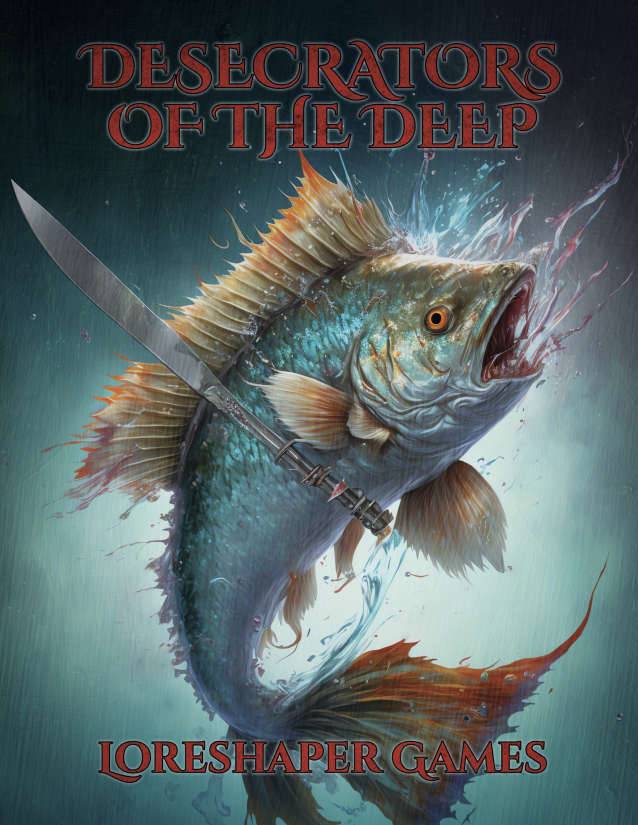
"You are a fish with a grudge. Humans from above the waves came and desecrated your home. They took your family. They ruined everything. Now it’s your turn. You have consulted the Old Ones, and the rituals are complete. The stars align, and you will have your revenge."
Featuring a streamlined d100 system, multiple character archetypes, and a focus on frenetic violence, Desecrators of the Deep will revolutionize the FishBlade genre.
Coming Q1 2023 from Loreshaper Games.
It really is basically narrative.
The stress is the mechanical cost, which can and should be something that players are worried about if the GM decides to limit how often they have downtime.
The entities that grant Deals are big on being in charge. The favors they do are essentially effortless for them (at least as far as we think of effort), though they may have a toll on the physical world at large when physics gets too wonky. Deals are ostensibly a way of proceeding through the Work and bringing about a better world, but Letters from December is set in the end-game of a world where it's too late for that and even if entities understood and agreed to their purpose most have given up on humanity keeping their side of the bargain.
Deals have three possible functions from the entity's side of things.
1. A symbolic gesture of gratitude.
2. A psychological preparation on behalf of the player's character to prepare for an encounter with their entity.
3. An entity's one-sided dominance struggle manifesting in various ways.
So, for instance, a relatively benign entity may request a sacrifice (by burning incense, an animal, etc.) in exchange for power to keep their human charges from becoming complacent. Until this is met, the character can't get another Deal. For game purposes, this was left out because I didn't want to create this imbalance, but the trade-off you get for this is that there isn't any psychic horror element to it. Incantations, vows, and oaths have a similar effect and can be accomplished instantly, though the former might be too easy.
If you go this route and have narrative requirements, you may wish to remove the Stress from a Deal, though be forewarned that it's going to be hard to play with a group of people each doing their own Deals (unless you retain the option to pay off deals with Stress, which I think makes more sense at the time the Deal happens than afterward). You could say that if someone still has a quest or sacrifice to perform they can spend 2 Stress for the next deal, then 1 Stress for each after that until the quest/sacrifice is finished.
An entity with a less human personality may have various preparation rituals. Something like the ingestion of psychoactive drugs may contribute to the ego death required to fully engage with such a being. These aren't well-developed in the world because the entities the characters I've explored all have fairly human-like personalities, but this could even involve entering a trance or frenzy, or even just engaging in extreme physical exertion (like lifting a massive stone).
These may not even be strictly unpleasant, from a human perspective, but they're costly and taxing enough to justify a point of Stress from the in-game perspective. If it might require odd or rare materials, these may manifest around the player character when they're seeking a Deal from their entity as a sort of handshake agreement. If the character ever misuses these gifts they may forfeit their ability to get more in the future.
Finally, there are the human-but-malevolent entities that just enjoy kicking people around. These can be harder to use at the table for safety reasons, but in the fiction Letters from December is based on they include:
• Drinking the blood of defeated foes (as in Cost)
• The entity manifests and taunts and belittles the human partner for not being good enough to manage on their own
• Visions in which the entity tries to force the human partner to share their nihilistic worldview (in an alternate timeline where the Destroyer succeeded, he could serve as an entity and this was his preferred approach; the Cult of Hunger still has lingering after-effects of this in Letters from December)
• Demands for various demeaning, risky, or antisocial acts in exchange for assistance
These entities use their human partners as tools, but they don't really have anything they want from them. Instead they're amusing themselves at their partner's expense.
The relationship between entities and their human partner(s) is semi-symbiotic. Entities can only really interact with the physical world through humans, but they don't always care to. Humans with a connection to entities can use them for power, but the entities can span the whole spectrum from being amused, too alien to comprehend the situation, lazy and indifferent, or actively detesting the pests who are taking them away from their own routine. However, no entity really wants their partner(s) destroyed.
Nominally, the goal of an entity is to guide their human partner(s) through the Work, and some do, but most of the ones with an intelligible personality are bored of doing this after millennia of false starts or scared that the Destroyer might actually purge them from existence. While the Destroyer has failed, the entities don't know this and players are unlikely to figure it out. Entities advance ahead of their partners while the Work develops, and become more personified as the process continues. However, this won't grant a personality to a truly strange and alien entity–it instead becomes more predictable and less erratic, and may begin conforming to its partner's expectations of it.
Of course, all of this can be adapted as you want at your table.
I'm preparing for a v0.2 update.
The big changes have been some refinements to the core content and a couple layout changes, plus more guidance for hacking and advancing the system.
I'm interested in hearing from people who have looked at and used Initiated (as well as people who chose not to use Initiated) about features they'd like to see.
In particular, I have the following questions:
- Does the hacking guidance section work? Would people prefer having pre-built rules to add in as they see fit?
- Do the three generic layers work well? They're the original core I built Hammercalled/Initiated from, but they were always meant for more adaptation?
- Does the character sheet work? Are there any other formats/styles for character sheets and logos that people would like?
Update: I've started working on Nova Tali, a system reference document for the core that will power Jovia and which also integrates some of Alter Data's philosophy/explorations.
My goal is to get the Nova Tali SRD out this week, and then move along to Jovia proper and integrate those rules into its system with its own unique Roman twist. I don't see any major delays or roadbumps keeping me from doing that, though it might wind up coming out on Monday if something unexpected comes up.
My initial plan for the jam is to make an expanded version of Jovia, with one of my intentions being the creation of a tali ruleset based SRD.
You can find an overview of it here (courtesy of @hessan_yongdi, who is a great person to follow!):
It's one of the example games in the jam listing, and it's CC-BY 4.0 licensed (the text itself may not say that but the store listing should), so feel free to use the tali mechanic (which, admittedly, is almost certainly in the public domain) however you want, even if you're borrowing my implementation of it word-for-word.I also recently released Alter Data, which applies this ruleset but replaces the d4 (which replicates knucklebones) with a d6, giving somewhat more design space to work with.
Figuring Out the Game Design
Jovia was conceived as a one-page game, and that means that there were things that couldn't be included because of length limitations.
The core is simple: roll four dice, try to get four different results. 4 is bad (unless you get a straight--which is special).
Now, there are a few different variations of tali, and while they're not all recorded with great accuracy there are many that care about particular combinations.
In Alter Data, I didn't have to worry about this because it has a 1-6 space, with 1s being good and 6s being bad. But with tali, you do have fewer options to move around. Having a very simple system still worked out to having a good numerical space to work in.
Tali is a little different because you have fewer possible results, so manipulating the number of dice is less of an option.
Jovia's Existing Concepts
You go for 1, 2, 3, 4 by rolling four dice. The number of unique results is your score (e.g. 1, 1, 2, 1 gives 2 score). Higher is better.
This will likely stay the same in the expanded game.
There are two forms of character input: score manipulation and strengths/weaknesses.
Score manipulation involves simply adding a point to your score. Since the score you require is based on the difficulty of the action, you wind up with a simple scale for the GM to use.
Characters in Jovia get a Heritage, reflecting some divine descent that they claim. This is a score manipulation (+1).
They also get a virtue and two "responsibilities" (profession) that gives them a reroll each. for a maximum total of 3 rerolls.
This is very powerful, and maps onto what I'd want to do with a one-page game since there isn't room for character advancement.
4s give a mishap, which is usually a complication. When you suffer a mishap, you might mark off one of your responsibilities, which temporarily reduces your power and can lead to character death.
For a one-page game, I think this works, but it's rather limited.
Concepts to Experiment With
The obvious elephant in the room is that characters hit very high power levels when they mix their things. To turn Jovia into a longer game means working around the limitations of the d4 and figuring out a way to provide greater diversity to characters while also allowing some overlap (e.g. if you have two characters who descend from Mars they already occupy 90% of the same space).
Here are some things I'm thinking about doing.
1. Extend the score space. This would lead to a numerical scheme somewhat like Fudge, where you have a dice mechanic that provides a random number *around* a point primarily determined by static numbers.
For instance, you might have your descent provide a bonus to your score, but also your responsibilities or heroic attributes. These could be capped, or even made exclusive but given their own value.
2. Dice pool manipulation, perhaps using a static attribute. You might roll more dice in something you're good at, and fewer dice in something you're not. I probably can't go above 5 dice in any circumstance without giving a pretty good chance of straights, which could just provide 4 score and defense against a setback without causing too much trouble.
My initial idea here would be to have a small set of attributes that determine how many dice you roll.
3. Points pools. This is almost certainly the best way to handle rerolls, instead of having flat rerolls on any relevant actions.
This is also a great way to power special abilities and give options for character advancement.
I used some of the textures from Postconsumer to add a little texture to the layout of The Lurking Fear while I was working on it.
https://lymetime.itch.io/lurkingfear
Alright, I've got my game uploaded so now I have time to actually talk about it.
The game I made for this was Dragons of the Western Shores, which is basically a 40 page attempt to recreate the appeals of a certain d20 fantasy game without having some of the issues I dislike with it.
There are a couple changes. It's player-focused, one-roll resolution, d20-only (no other dice!), and has more options for character and item customization. Characters are built from Aptitudes, which are a blend of attributes and skills, then gain Specializations and Domains as they increase in power. Domains unlock Abilities, powerful rule-bending options that let players customize their playstyle.
I've started from scratch around a narrative core, with a focus on giving players an opportunity to roleplay and adventure without obligatory combat (though there's plenty of that if you want it). Each Domain functions a little bit like being a spellcaster, having ki points, etc. in more traditional d20 systems, opening the pathway to loads of special abilities and providing point pools used to fuel their use.
There is a lot more focus on the mechanics of adventuring, such as gear maintenance, but this tries to go as quickly as possible. The goal is to discourage wanton violence and encourage using helpers and taking advantage of civilization when it's around. If you're an adventurer, you need to think about travel considerations and pack accordingly, without having a complex encumbrance system that's bothering you over picking up every little thing.
The system is fairly simple: it's a roll-under mechanic, with your result providing a boost to the effectiveness of your results. Combat uses range bands instead of a grid, allowing you to track each character's position as a number. Characters in the same range band join a formation, allowing them to defend more easily and providing potential bonuses.
Content-wise, it's a little "light" with a lot of options but very little room for advancement. Since a lot of abilities and actions scale with Aptitudes and Domains, this isn't necessarily a huge problem, since you can still become more powerful, but my next goals are to work on spellcasting, making a system for characters who have access to various schools of magic to learn specialized spells by extending the current ability mechanics. Right now this is handled using tests and GM fiat or a couple of options under the ability itself.
Other focuses include expanding armor and gear options, potentially rebalancing the Aptitudes and Domains, and who knows what else. The setting is borrowed from one that I've worked on for years, but is looking at a part of the world that hasn't gotten much attention before.
Getting close to finished with a minimum viable product. I just need to finish off combat, upbringings, downtime, and a couple small things. If I get enough time, I'll even start into the setting. Admittedly, this is one I have a lot of "world" content for, but the Western Shores are previously uncharted territory on the setting's main continent.
https://1drv.ms/b/s!AncNOvn6DPyImZBPVyCFq490xuWawg