


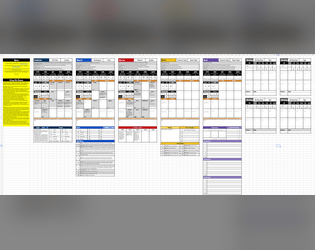

I've added an IDML for you!
Troy Renaux
Creator of
Recent community posts
Thanks! I realized last week my generative AI disclaimer literally said I "Didn't not" use AI instead of saying I didn't use AI haha. I fixed it in the game page but I presume it wouldn't update the submission version.
Shod just means wearing shoes. Its probably a holdover term from me growing up in the Christian southern US.
It wasn’t any one specific item, but with all the creature names that weren’t super obvious, the acronym (forget what for) and the engram scanner there was a lot of stuff that just wasn’t immediately clear what I was reading about. If it just wasn’t all those at once it wouldn’t have been noticeable but (this is hyperbole) it felt like every proper noun was something I needed to reference somewhere else.
I’m sounding more critical than I intend to be so take this with a grain of salt.
Terrific submission. There is such an immense amount of content crammed into the space and all the content is top notch. The "Restore the Blade" requirements are very fun. I am also a big fan of the map illustration—I love when maps are more than a 2d representation of a geographical space.
If I had to offer any critique, I do feel some of the art has too much detail—just extra lines that confuse the eye as I search for the important details.
Good question. As mentioned in the document itself, the purpose of UFR is not to steal Nick's very clever ideas, but simply to provide it in a universally usable way. I purposely did not try to transform flux spaces, although I did add the idea of flux "focus" and a more system agnostic presentation of what the events table should look like. The goal with UFR is that GMs do not need to create "Flux rules for system X". They can use UFR as-is for any system. These rules and the starter fluxes will always be free (not even PWYW) because I do not want to try to steal any sort of credit. I've just found having a system-agnostic set of flux procedures really helpful for myself and my tables because I use fluxes a lot at multiple tables and with multiple systems and hated needing to explain how fluxes work in this system or that system each time I add one in.
A nice submission outside the usual western settings. Well done too!
I presume this in part stems from trying to stick to inspiration stories that I am yet unfamiliar with, but I would have liked to see more going on in the random tables. Limiting nearly all entries to being either minor mundane effects or (as written) just sightings of mundane animals. I was also disappointed to find that the city Qoloe was only described via a single location. The page limit gets us all but I think perhaps this adventure could have provided more adventure material had it focused only on the overgrown city rather than a mini-dungeon, in a city, in a hexcrawl.
Great submission overall! I hope a few lines of critique don't come off as anything less than appreciation for the piece.
Nice! Really short and fun. It'd be interesting to GM whatever happens when the party inevitably peaks below the wagon tarp.
I think you and other commenters are right that this very much feels side-questy. I'm a little disappointed that characters would be likely to only encounter a couple of the locations. I am not sure under what circumstances they might reach the ranger cabin at all.
Great article. I think for me, the biggest challenge is getting my players to think in weirder ways. I've often tried to challenge the medieval europe status quo, only to have my players fight to draw the story back into those famialar spaces. Even in decidedly weird homebrew worlds—even those which my players take the time to read my notes about—the PCs themselves are copy-paste from a single non-medieval genre at best and your usual wizard at worst.


