
On Sale: GamesAssetsToolsTabletopComics
Indie game storeFree gamesFun gamesHorror games
Game developmentAssetsComics
SalesBundles
Jobs
TagsGame Engines

yangjy15033

3
Posts
2
Topics
A member registered 9 days ago · View creator page →

Creator of

Recent community posts

That’s exactly the tension I’m trying to get right. My intention is for the creature to offer an invitation, not a deadline.

I’d rather have it wait while the player is actively moving blocks, then demonstrate only after a period of inactivity. And if the player starts experimenting again, the demonstration should yield rather than compete for their attention.

The tricky part is making the creature feel alive without making its patience feel like a countdown. It should be there when you need a nudge, but never make you feel late.

I’m glad you brought this up — it’s a good test of whether the hint feels like a companion or just another system trying to manage the player.

Before writing the real game I read about 4,000 reviews of 77 puzzle and level-editor games on here. The pattern in the ones that ship a hint-giving companion: players do not hate difficulty, they hate being handed the answer in a form that turns the puzzle into reading. The companion that explains is the companion people get angry at.

So the creature in It Tries gets verbs and no words. It walks, jumps, falls, bumps into a wall, and looks back at you. That is the entire vocabulary. It never produces text, an arrow, a number, or a path overlay.

What that constraint buys:

  • Failure is the hint. Stay stuck long enough and it sets off on its own and fails in front of you. It never says where the wall is; you watched it fail, so you already know. Then it walks back and waits. The return is the invitation.
  • Memory is the reward. Place the first block of a route it has already seen and it finishes that route by itself. No fanfare, no text. You taught it something, and you watch it use it.
  • Zero-text completion. With no words in the feedback loop, the whole game can be finished without reading a single string. That is the accessibility feature I care most about, and it fell out of the design constraint instead of being bolted on afterwards.

What it costs, honestly: the first level has to teach everything by itself, and the palette has to carry meaning by brightness and shape because colour alone is not allowed to be the signal (no red/green pairing). And the canvas still has no screen-reader description of the grid, so a screen reader gets an empty canvas today. That is the first item on the v1.1 list.

The game (browser, no download, $0 pay-what-you-want): yangjy15033.itch.io/it-tries
Launch devlog with the full notes, including how the par numbers were proved by exhaustive search: It Tries is live

Disclosure: the code was written with an AI coding assistant. Design, levels, and par values are human-led and machine-verified. No AI-generated art, audio, or text.

It Tries is live: yangjy15033.itch.io/it-tries — plays in the browser, no download, $0 (pay what you want).

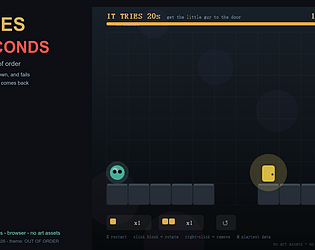
The mechanic. There is a little guy inside the puzzle. Get stuck for too long and it gets up and tries the level on its own — in front of you — and fails. Then it walks back and waits for you. Show it a way once: place the first block of a route it has already seen, and it finishes that route by itself. Six levels plus a free-play sandbox.

Two things I care about, said honestly:

  • The creature never produces text, arrows, or hints. It walks, jumps, falls, bumps into walls, looks back at you. Early prototypes had it spell out the solution, and playtesters hated it. Behaviour is the hint. A side effect: the game is completable with zero reading — every cue is motion, position, or sound.
  • Par is a proof, not a guess. For each of the 6 levels I ran an exhaustive search over placements to depth par-1 and proved that no shorter solution exists. Level 4 is par 3: three placements, and the search proves two placements cannot finish it.

Accessibility, including what is missing. Luminance-coded palette (no red/green pairing), interactive tutorial level, keyboard-only play, no timers, autosave with one-step rollback, English / Simplified Chinese toggle. What is not done: the canvas has no screen-reader description of the grid yet — a screen reader currently gets an empty canvas. That is the first item on the v1.1 list, and I would rather say it here than have you find it.

AI disclosure. The code was written with an AI coding assistant. Game design, levels, and every par value are human-led and machine-verified. No AI-generated art, audio, or text — visuals are drawn by code, audio is synthesised by code.

Launch devlog (EN + 中文, with the full design notes): It Tries is live

What I want from you: the exact cell where you got stuck, and what you tried first. I read every reply, and the next build is built from them.