Indie game storeFree gamesFun gamesHorror games
Game developmentAssetsComics
SalesBundles
Jobs
TagsGame Engines

t0m_ok

21
Posts
8
Topics
2
Followers
A member registered Aug 03, 2024 · View creator page →

Creator of

Recent community posts

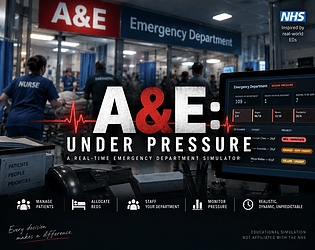
Hi i'm the solo developer of A&E: Under Pressure, a UK emergency department management/simulation game I've been working on.

The game started as a fairly small project and then got considerably out of hand 😭

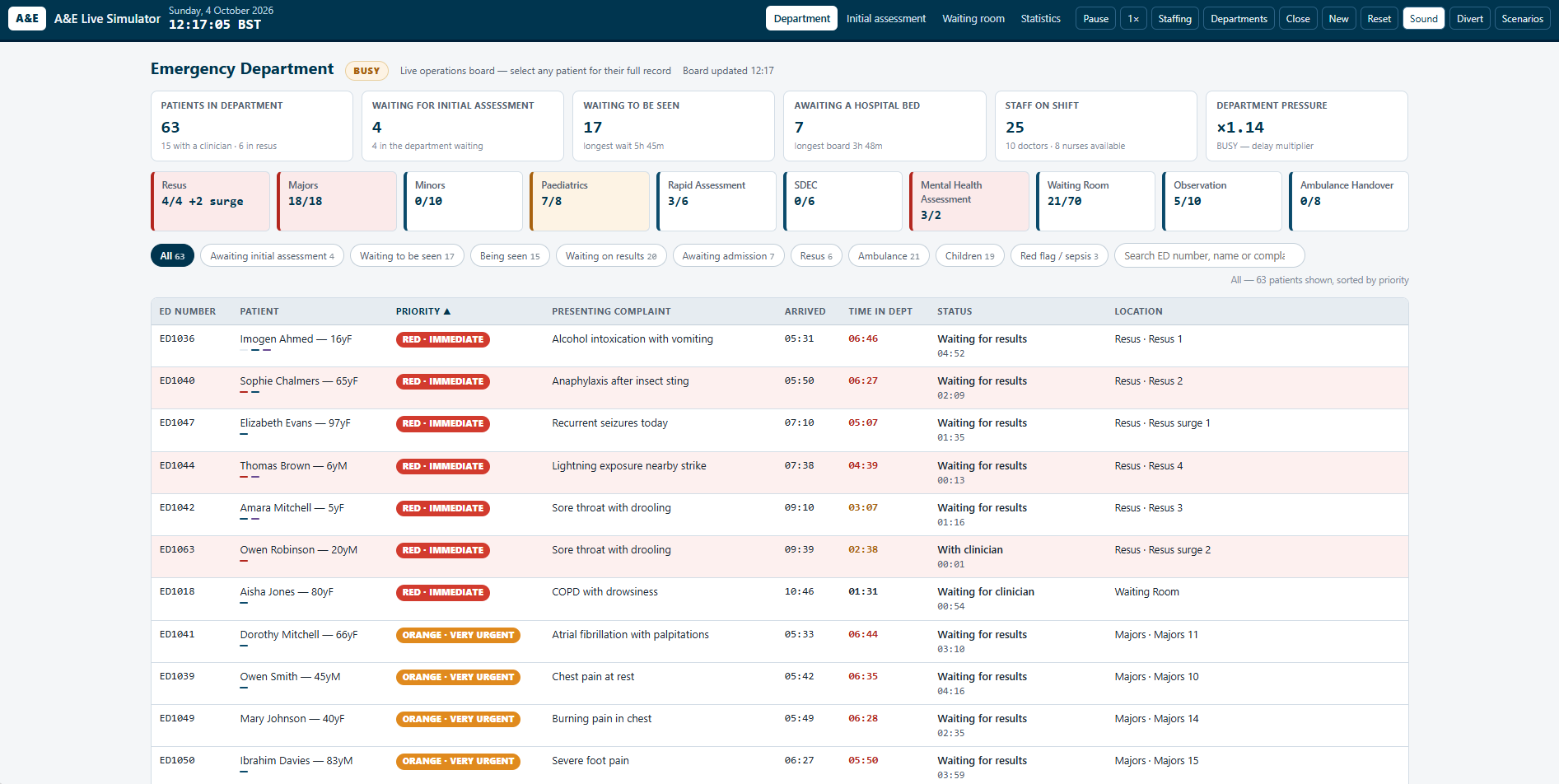
It now simulates a living emergency department with individually generated patients, 196 medical conditions, 300+ presentations, triage, deterioration, investigations, staffing, ambulances, inpatient wards, boarding, exit block, emergency scenarios and configurable department capacity.

I've learned a huge amount building it, but I've also made a pretty big decision about where the project goes next.

I'm temporarily retiring the current version on 20 October 2026.

This isn't because I'm abandoning the project. It's actually pretty much the opposite.

I released A&E: Under Pressure far too early.

I was excited that it worked and wanted people to play it, so I published it before the foundations were anywhere near as tested or polished as they should have been.

That then turned development into a constant cycle of:

Add something → find a bug → fix it → find another bug → add another system → somehow break something completely unrelated 😭

Some of the updates massively improved the game, but I've spent a lot of time fixing things that really should have been sorted before a public release.

Recently somebody playing the game gave me a really simple bit of feedback:

"Other than reassessing, closing out someone, or adding staff - what am I supposed to be doing?"

That stuck with me.

A&E has become quite a detailed simulation, but I don't think I've done enough to make it a good game.

You can watch an entire emergency department operate. Patients arrive, get triaged, deteriorate, undergo investigations, wait for beds, board in ED and eventually leave.

  • But what exactly is your role?
  • What are you trying to achieve?
  • How does somebody who's never played before learn what they're supposed to do?

Those are much bigger problems than something I can solve by adding another button to the current UI.

So I'm stopping.

There will be no further updates between now and 20 October, when the current version officially retires.

I'm currently developing another simulation-style game which releases on 1 December 2026. It's being built as a complete desktop application from the beginning, and I want to avoid making the same mistake again.

I'm giving that project the time to actually be finished, tested and polished before releasing it.

Once that's released and settled, I'll be coming back to A&E.

So what happens to A&E?

The current plan is to begin testing the rebuilt version around March 2027, with a wider return around Spring 2027.

And I'm not planning for this to just be A&E v1.4 with a few extra features.

I'm looking at a much larger rethink, including:

  • A completely redesigned interface
  • Reworked underlying systems
  • A proper interactive tutorial
  • A clearly defined player role
  • Actual objectives and responsibilities
  • More meaningful decisions for the player
  • Better explanations of what is happening and why
  • Potentially moving the game to a dedicated desktop application
  • Much more testing before the new version is publicly released

None of that is a final feature list yet.

Testing

I'm planning to open testing for the rebuilt version through BetaHub in March 2027.

That'll hopefully give me time to put the new systems in front of actual players, discover what doesn't work, change things and squash the horrible bugs before calling it a public release this time.

I'll post more about testing here when we get closer.

Can you still play the old version?

Yep.

Even after the itch version retires, I'm leaving the current web build available for as long as its existing deployment stays online:

https://a-e-under-pressure.vercel.app/

It won't receive further updates and should basically be considered an archived version of the original game.

What's next for this thread?

For now, development on A&E itself is stopping while I focus on the December game.

When work on the rebuild begins, I'll use X for things like:

  • New UI concepts and screenshots
  • Changes to the actual player role
  • Tutorial development
  • Simulation/system changes
  • Desktop development if I go that route
  • Beta testing progress
  • Things testers inevitably manage to destroy 😭
  • Progress towards the Spring 2027 return

For more frequent updates, I post pretty much everything I'm working on over on X:

https://x.com/tomsmadethis

Releasing the original game too early wasn't ideal, but I've learned an absolutely ridiculous amount from building it.

So rather than continuing to pile features onto something I'm not completely happy with, I'm going to give it the time it needs.

A&E: Under Pressure will be back.

Hopefully better designed, better explained, better tested, more interactive and considerably more fun.

See you in the rebuild 🚑❤️
Hello, you can absolutely submit a macOS-only downloadable build! Will love to check it out!

I’ll definitely consider adding this, thank you! A proper beginner tutorial that actually walks you through managing your first department would probably make it a lot easier to understand what you’re meant to be doing 😭 Really appreciate the feedback!

Thanks! That's actually really useful feedback. At the moment you're essentially managing the department rather than directly treating every patient, so you're monitoring flow, taking over triage/reassessment where needed, managing staffing and capacity, opening/closing areas, managing ambulance divert, responding to pressure, admissions/boarding, investigations, handovers, shift objectives, etc.

But your comment has made me realise the game probably doesn't do a good enough job of actually explaining that or giving you direction when you first start 😭

v1.3 adds things like the Bedside Board, shift objectives, handovers and ambulance pre-alerts which give you more to actively monitor/manage, but I definitely think I need to look at making the player's role and goals much clearer. Thanks for the feedback!

Account Recovery: One Final Check is out now 🔐

One final check. Probably.

You’ve been locked out of your account. Recovering it should be simple: confirm your email, answer a security question, enter a code, and prove you’re you.

Unfortunately, Bramble keeps finding reasons to ask for another final check.

Account Recovery: One Final Check is a comedy puzzle game about getting through a fictional website’s increasingly ridiculous account recovery process.

What’s in the current version?

  • 20 requests across four acts
  • A simulated inbox and clues to collect
  • Different puzzles throughout the recovery process
  • Three optional hints for each request
  • An ending that responds to some of your choices

The game is £2 in early access. You download it from itch.io and play it in your browser.

What’s next?

I’ve had this game sitting in my files for months and finally decided to release it while taking a wee break from my A&E: Under Pressure project. I’m hoping to add new levels in the next couple of days.

If you give it a go, let me know which request made you start doubting Bramble’s definition of “security.

Account Recovery: One Final Check by t0m_ok

Hey! I'm Tom 👋

I've been working on A&E: Under Pressure, a browser-based simulation of a busy UK emergency department.

Rather than being a traditional hospital tycoon, I'm trying to make the department behave as one interconnected system. Individual patients arrive, get triaged, wait for clinicians and physical space, have investigations, deteriorate, get reassessed and eventually leave or get admitted into the wider hospital.

Which has also meant discovering increasingly creative ways for the entire simulation to break 😭

🚑 v1.2

I've just finished the biggest update I've made to the game so far.

The medical library has gone from 42 to 196 conditions, with more than 300 different patient presentations now possible.

But most of the work actually ended up being underneath the surface.

One of the biggest changes is that clinical areas now have actual physical capacity.

Previously, an area could say Majors 18/18 and the simulation could still quietly put another patient there. During testing I managed to get things like:

Majors: 39/18
Paediatrics: 24/8
Mental Health: 10/3

Not ideal. 😭

Now when an area is full, it's actually full.

Patients have to wait for appropriate space, Resus has proper surge capacity, stable Resus patients can be stepped down where appropriate, and ambulance patients can remain with their crew if there genuinely isn't anywhere safe for them to go.

🛏️ This then broke the hospital

Once I made physical capacity real, another problem became much more obvious.

Patients waiting for hospital beds were occupying A&E bays for ridiculous amounts of time.

In one test, the median boarding time reached around 7 hours and the longest was nearly 25 hours.

So the hospital bed system ended up getting reworked too.

Patients can now be considered for clinically suitable alternative wards, long-waiting patients are reconsidered more frequently and newly available ward beds can actively trigger another attempt at placement.

Specialist placements such as Critical Care, Paediatrics and Mental Health are still protected.

🚨 Emergency scenarios

v1.2 also adds 16 emergency scenarios across six types:

  • Mass Casualty Incident
  • Influenza Surge
  • Staff Crisis
  • Heatwave Emergency
  • Bed Block Crisis
  • Chaos Mode

Most have different difficulty levels.

And then there's Chaos Mode.

It sends 500 patients into the department.

There is absolutely no sensible operational reason to press the button, which obviously means people will press it.

🚑 Ambulance divert and department closure

You can now close the department to new arrivals while continuing to treat everyone already inside.

Ambulance divert can also become available when Resus reaches 75% of its normal capacity.

Walk-ins can continue while ambulance demand is redirected elsewhere.

These systems have been interesting because I don't want them to just be buttons that magically remove pressure. They need to interact properly with the rest of the simulation.

👤 More patient variety

The patient generator also needed some attention.

During testing it produced highlights including elderly patients apparently injuring themselves while sprinting and some extremely questionable age/presentation combinations.

Generation is now much more age-aware while still allowing genuinely unusual cases to occur.

The game now has:

  • 196 medical conditions
  • 300+ patient presentations
  • Individual observations
  • Medical histories
  • Medications
  • Allergies
  • Deterioration
  • Reassessment
  • Investigations
  • Admission and discharge

💾 Saving nearly became the final boss

A&E: Under Pressure is designed so you can leave a department running over multiple sessions.

When you come back, it works out how much real time has passed and catches the simulation up.

That sounds fairly innocent until you're trying to simulate hours of missed activity without freezing someone's browser, replaying every sound simultaneously or destroying an old save.

v1.2 substantially reworks saving, loading and catch-up, including support for repairing older save data where possible.

🧪 Testing

I've also started using a separate Testing Department build for updates before they reach the main game.

The final v1.2 test suite reached:

89 tests passing.

Alongside that I've been running longer simulation probes looking for capacity breaches, stuck patients, broken arrival chains, duplicate events, staff problems and other issues that only become obvious after the department has been running for a long time.

One of my favourite bugs was extra staff being reapplied every shift change.

3 → 6 → 12 → 24 → 48 → oh no.

🔜 What I'm working on next

I'm already starting work on v1.3.

The first thing I've been experimenting with is a proper main menu rather than immediately throwing you into the simulation.

I'll add a screenshot of that below 👀

I'm also looking at what should come next without making another update quite as enormous as v1.2.

Some things I'm considering are deeper operational systems, better statistics, achievements, ambulance pre-alerts and more things to do with long-running departments.

I'll keep updating this thread as development continues.

I'm particularly interested in hearing what people think makes a simulation feel detailed without crossing the line into unnecessary complexity.

That's actually a really interesting opposite example. I hadn't really thought about removing something as fitting this too, but it definitely does.

Sometimes you add features because they feel like they're "supposed" to be there, when the game actually plays better without them 😭

And SFX are honestly ridiculous for this. You can have the exact same attack before and after adding a decent sound and suddenly it feels about 10x more powerful lol.

That's such a good example because I genuinely wouldn't have thought to test that 😭

It's mad that something which takes a few minutes to fix can be the difference between "the controls randomly stopped working" and everything just working as expected.

Also 7 out of 38 is way more than I'd have guessed. Definitely adding the click-outside-the-game test to my list for HTML5 stuff now lol. Thanks for sharing!

I've been building a fairly detailed emergency department simulation, and I've reached the point where one of the hardest parts isn't adding new systems. It's stopping those systems from accidentally destroying each other 😭

The basic patient flow originally sounded fairly simple:

arrival → triage → assessment → investigations → treatment → discharge/admission

But then I added staffing, different clinical areas, deterioration, ambulances, investigations, ward beds, boarding, exit block, shift changes, configurable departments, emergency scenarios, saving/loading, etc.

Now almost everything affects something else.

One recent example was allowing clinical areas to be disabled.

The UI knew Resus was disabled.

The department configuration knew Resus was disabled.

The arrival system did not.

So RED patients happily continued arriving for a Resus that technically no longer existed 😭

Another involved additional staff.

Extra staff requests needed to survive shift changes, but instead of remembering the existing request, part of the system effectively added it again at every handover.

So you could get:

3 → 6 → 12 → 24 → 48 → oh no

After enough simulated time this could turn into thousands of staff records.

I've also had patients deteriorate after an admission decision and accidentally restart parts of their clinical journey, causing repeated assessments, investigations and referrals.

Saving has probably been the most interesting problem.

There can be hundreds of patients at different stages, future events waiting in a queue, investigations due back later, staff working shifts, ambulances arriving, patients waiting for beds, etc.

The player can then close the browser and return hours later, at which point the simulation has to rebuild all of that and work out what happened while they were away.

It's made me realise that every new interconnected system potentially increases the number of weird interactions between all the existing ones.

I'm curious how people working on simulation/management games deal with this.

  • Do you try to keep systems deliberately isolated?
  • Do you have really strict interfaces between systems?
  • Do you rely heavily on automated tests and simulation runs?

Or is a certain amount of "why are there suddenly 4,000 nurses?" just an unavoidable part of making this sort of game? 😭

I've been thinking about how sometimes the smallest additions end up making a game feel significantly better.

Not huge new mechanics, maps, characters or anything like that. I mean the tiny things that probably took nowhere near as long to make, but somehow changed the whole experience.

Things like:

  • a satisfying little sound when you click something
  • remembering where the player left off
  • a tiny animation that makes a menu feel less dead
  • NPCs reacting to something they previously ignored
  • changing one number that suddenly makes the balancing feel right
  • some completely unnecessary detail that players ended up loving

I find it interesting because it's really easy to spend ages working on massive features, only to add some tiny thing afterwards and think "why does THIS make the game feel 10x better?" 😭

So I'm curious:

What's the smallest feature or detail you've added to a game that made a surprisingly big difference?

And was it something you deliberately planned, or did you just add it randomly and realise afterwards how much better it made the game?

I really like the point about feature creep applying to realism too. I hadn't really thought of it that way, but once you start simulating one thing accurately it becomes very easy to think "well, I could simulate this too..." and suddenly you're modelling toilet breaks 😭

The Potion Craft example is a good one as well. Something can feel really immersive the first few times, but if the player has to repeat it constantly then realism can basically turn into busywork.

I think that's probably the balance I'm trying to find. Keep the realistic systems where they actually create interesting decisions or consequences, but let the boring parts happen "offscreen" where possible.

Yeah definitely. I think “fun” is probably too broad to have one answer anyway. For some people the fun is literally learning and mastering a ridiculously realistic system, while for others that would be awful 😭

I suppose realism is just another tool really. If it adds something to the experience, use it. If it starts restricting the player without adding anything interesting, sacrifice it.

Yeah I think I’m leaning towards that too. Realism can definitely help build the experience, but if being realistic actively makes the game less enjoyable then it’s probably defeating the point 😭

Yeah I think that’s a really good way of looking at it. Realism probably works best when it actually serves the point of the game rather than just being there because it’s technically possible to simulate it.

I especially like the pinball comparison because both approaches can work, they’re just trying to achieve completely different things. I suppose the difficult bit is figuring out which realistic details actually add to the experience and which ones are just making the player do extra work 😭

Yeah, giving the player something meaningful to do during the wait is probably the key. I think there's also a difference between the player waiting and the world waiting, in a management game, things can realistically take ages in the background while you're busy dealing with everything else.

Yeah I definitely agree that variety makes a massive difference. I was thinking more about realism in terms of gameplay/mechanics rather than graphics though, like whether accurately recreating waiting, repetition or complicated real-life systems can actually make a simulator less enjoyable to play.

Really enjoyed this! The movement feels super smooth, I love the pixel art style and the UI fits the game really well. It’s also dangerously addictive lol, I ended up playing for much longer than I planned.

Just a heads up, the download was showing as quarantined by itch.io for me, so I had to accept the risks before it would let me download.

Great work, especially for a first game! :)

I've been thinking about this quite a bit recently: at what point does realism actually start making a game worse?

Especially with simulation or management games, it's tempting to recreate everything as accurately as possible. Real systems are complicated though. They involve waiting around, repetitive tasks, things happening outside your control, and sometimes just... nothing happening for a while.

Obviously you can simplify all of that, but then there's the opposite problem where a "simulator" starts feeling more like an arcade game with a realistic theme.

I'm curious how other developers approach this.

Do you generally prioritise realism and then remove the parts that aren't fun, or build something fun first and add realism afterwards?

And have you ever implemented something realistically, played it, and immediately realised it was absolutely terrible gameplay?

Hi! I've just released A&E: Under Pressure, a free browser-based emergency department simulator I've been working on.

The idea is to simulate a living UK A&E rather than a traditional level-based hospital game. Patients continuously arrive with different conditions, histories, observations and levels of urgency, then move through triage, assessment, investigations, treatment and admission.

You can also get involved yourself. You can carry out initial assessments and choose triage priorities, monitor individual patients, manage staffing and watch the department respond as demand and pressure change.

There's quite a lot going on behind the scenes, including:

• 40+ medical conditions and 208 different patient presentations

• Five-level interactive triage system

• Patient deterioration and improvement over time

• Resus, Majors, Minors, Paediatrics, SDEC, Observation and other areas

• Staff shifts and additional staffing controls

• Blood tests, imaging, ECGs and investigation backlogs

• Ward beds, boarding and exit block

• Ambulance arrivals

• Live department pressure and performance statistics

• Persistent saves

• Real UK time with 1x, 5x, 15x and 60x simulation speeds

One of my favourite parts is that there's no scripted order in which everything happens. You can have a relatively manageable department and then gradually watch the waiting room fill, investigations back up, beds disappear and patients begin waiting longer. Or you can speed the simulation up and watch everything descend into chaos fairly quickly 😭

It's an educational simulation rather than a clinical tool. All patients are fictional, clinical systems are simplified, and it isn't affiliated with the NHS or intended for real-world medical decision-making.

It's completely free and runs directly in your browser:

https://t0m-ok.itch.io/ae-under-pressure

This is the first public release, so there may still be bugs I've missed. If you try it and something breaks, I'd genuinely appreciate a comment on the itch page telling me what happened so I can look into it.

Thanks for checking it out :)

I’ve just pushed a revamp to my Queue Simulator.

This update focuses mainly on the UI and overall experience, making it feel much more like a modern real-world ticket queue. It now includes a cleaner layout, smoother animations, live updates, realistic wait times, and a full booking flow with seat selection.

It’s still a simulation, but the goal is to replicate the stress and flow of high-demand ticket queues as closely as possible.

If you check it out, I’d really appreciate any feedback, especially on the UI, realism, or anything that feels off. Always looking to improve it 👍

Queue Simulator by t0m_ok

Sick, you should totally add some random events etc