


Play soundtrack
Time Gears Ending Credits's itch.io pageResults
| Criteria | Rank | Score* | Raw Score |
| Production quality | #15 | 3.333 | 3.333 |
| Memorability | #17 | 2.917 | 2.917 |
| Overall | #23 | 2.900 | 2.900 |
| Overall enjoyment | #25 | 2.833 | 2.833 |
| Composition quality | #26 | 2.833 | 2.833 |
| Match to the brief | #28 | 2.583 | 2.583 |
Ranked from 12 ratings. Score is adjusted from raw score by the median number of ratings per game in the jam.
Description
Time Gears is a fictional steampunk game. This track is its ending credits theme.
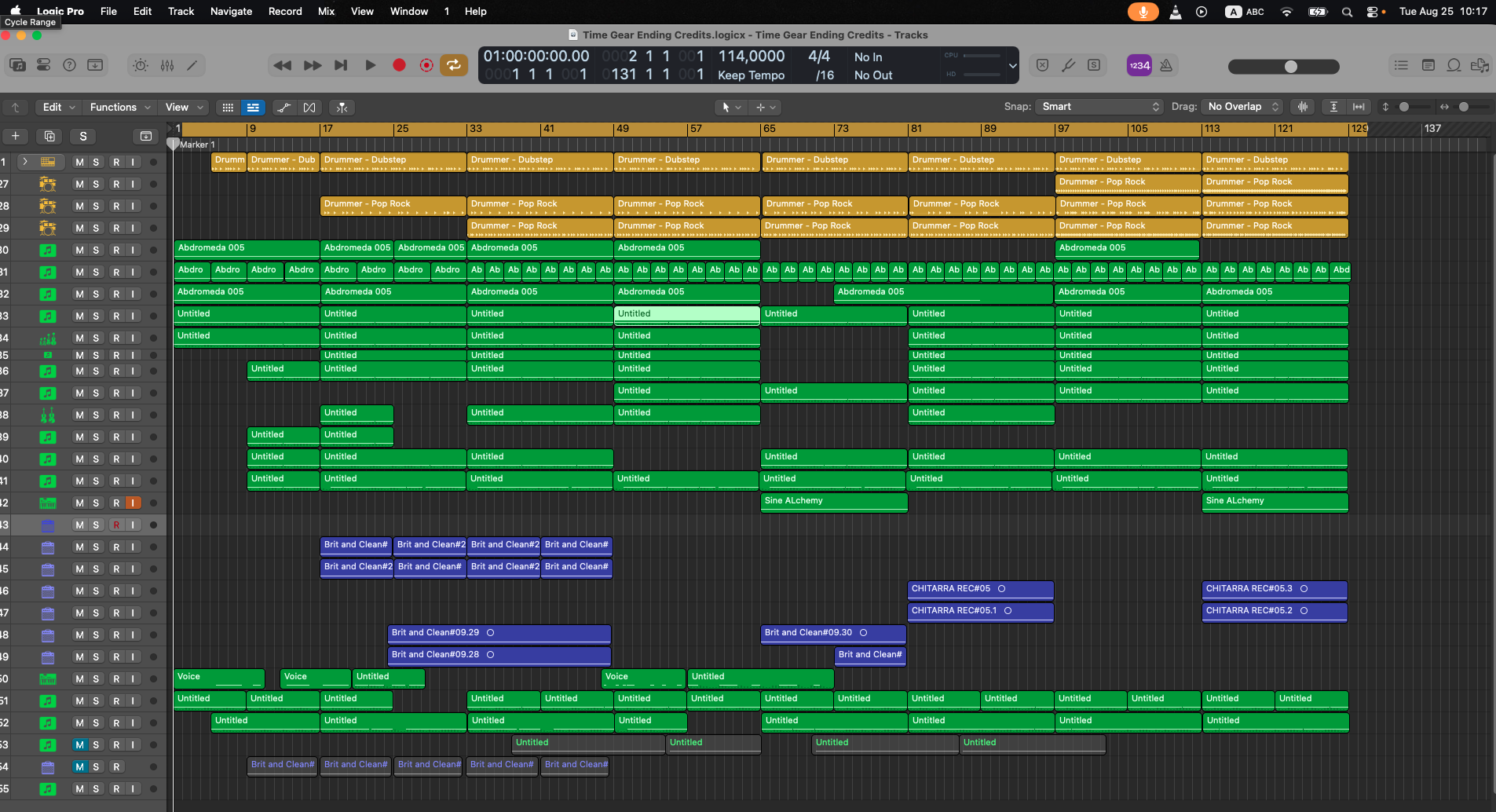
The atmosphere starts slow and nostalgic, then builds in a gradual crescendo of energy, with a heroic undertone in the chord progression. Composed in D Dorian around a Dm–G pendulum with layers arrangement over drones.
Leave a comment
Log in with itch.io to leave a comment.
Comments
This felt very captivating, the world-building, per se, in the music was phenomenal. I for sure felt like I was able to picture the aesthetic that this world was built around. I believe that this would make a really nice end credits for something both pretty dark yet with some bittersweetness in it. The ostinato throughout feels good too, it's not too active nor too slow, it's got just a right amount of motion to keep these going without taking away from the subtle changes. Really great stuff!
Good production, I like the theme, the electric guitars and it's immersive. I find the addition of the electric guitar on the left ear at 3:56 really well done, it breaks the monotony of the music. The rythm of the drums is good as well.
I just got an issue with the length of the piece, it's really monotonous and repetitive and acts more like an ambiance music where you listen to it and do other things aside more than just close your eyes and enjoy. That's why at 3:56, I find refreshing that electric guitar on the left ear.
Nice work overall !
i'm getting serious Nine Inch Nails vibes from your track - good mix and interesting sound effects.
I'm struggling a little to imagine a steampunk game that would fit this track, I keep returning to night clubs where information brokers are sampling the newest street-pharmaceuticals under neon lights... This is a total cyberpunk piece for me.
Also, the main riff is a little monotonous over time, I think it would help the track to vary that a little either by putting other elements of the piece more often into the foreground and letting the guitars stepb back a little or by changing what is being played. Then again, it's supposed to be for end credits, so you might not want to take too much attention away from other things happening on the screen.
Overall, I like your piece and I'll certainly take some inspiration for guitar tone from you.
Thanks uyGuy, the NIN reference is a compliment I'll take gladly. You're right about the cyberpunk drif, the electric guitar pulls it that way, and it's exactly the element that made the opening less nostalgic than the brief asked for. Agreed on the riff too, it needed the other layers to take over more. Glad the guitar tone is useful to you, feel free to ask about the chain.
I'm somewhat limited in the amp sims I have available, but if you have some suggestions to get a wall of sound to rock me out of my socks, I'll take anything you have to offer =)
And please don't say "practice muting with both hands" because I'm already confusing myself with skipping strings in alternate picking XD
Honestly, the amp sim is the smallest part of it , and that limitation is easy to remove: NAM (Neural Amp Modeler) is free, and Tone3000 is full of free captures. I run NAM Gateway with a 5150 and a VH4 capture from there and never look for anything else.
The wall comes from three things, none of them the amp:
- Double-tracking. Two separate takes of the same part, hard panned L and R. Not a duplicated track nudged in time , an actual second performance. The small differences between the takes are the width.
- Less gain per track than feels right. Gain stacks when you layer, so two tracks at moderate gain sound bigger and tighter than two maxed out. Both maxed just turns to mush in the middle.
- Different IRs on the two sides, and a high-pass around 80–100 Hz on each. The weight isn't in the guitars, it's in what sits under them, if the guitars keep their own low end there's nothing left for it.
And on my end the wall isn't only guitars. A good part of the weight is synth: I use Omnisphere for the bass and for dark ambient layers behind the riff, and that's what pushes it towards industrial rather than just loud. The bass is often a pure sine at the bottom, layered with something richer on top , the sine alone has no harmonics, so on phones and small speakers it disappears; the upper layers are what make it audible there while the sine carries the actual weight. The plugin doesn't matter, Vital and Surge are free and do the same job. The principle is that the guitars carry the mids and the attack, and something else carries the size.
No muting homework from me. The only honest catch with doubling is that two loose takes panned hard sound twice as loose, so it's worth tracking in short sections instead of full passes.
I used to do a kinda similar trick recording rock guitar: two different mics on the cab (usually one dynamic one condenser) and double track. That way I got four tracks total: take A mic 1, take A mic 2, take B mic 1, take B mic 2 and then I would pan A1 and B2 hard left and B1 and A2 hard right. Feels like four guitars, but without phase issues on either side. You could just do the same with different IRs and get an even more pronounced effect.
I didn't consider actually using different impulse responses, I'll definitely give that a go. And while I have listened to some argent metal, I never actually thought about using a synth for the sub-bass instead of an actual instrument or an octaver plugin.
Thanks for the tips, I'll definitely enhance my repertoire with your suggestions.
I really like your track, super atmospheric!
I do agree with some of the other comments on the repetition and lack of the nostalgic feeling described in level 2. While listening I found myself waiting for a point where the more muddy background sound effects would maybe quiet down a bit and take a backseat to allow room for a larger and more clear melody/progression.
Overall though, the track totally matches the style it set out for, and would certainly be effective for a credits scene in that style.
Hi Arievix, fair point on the background layer: it never really steps back to give the melody room, and that's part of why the nostalgic arc from level 2 doesn't land. Sound design is where I'm focusing my work right now, so it's good to know that side comes through. Thanks for feedback
The sound quality is really good and I like the endless kind of feel that the Dm-G pendulum gives off, especially for an end credits scene. I agree with the other comment about repetition but I quite like the opening and also the gradual increase in texture works very well. Just needs a bit of variation to spice things up.
The pendulum was the one idea I was sure about, so I'm glad it reads as "endless" rather than just repetitive. You're all right that it needed variation on top of it. The texture build is the part I'd keep. Thanks for comment ChwrlueThe4th.
Hey, I've just listened to your track!
I really liked the work on the sound effects and textures; I think they add a lot to the music and help create a strong atmosphere.
However, I found the track a bit repetitive, even for an end credits theme. I would have loved to hear more development throughout the piece, whether through an evolution of the main melody or the introduction of additional melodies that interact with it.
I also didn't find the beginning particularly nostalgic. That may be due in part to the electric guitar, which gave the opening a different feel than I expected from the brief.
Good luck with the rest of the voting period!
Thanks for listening, and for the precise notes, I agree with both.
On repetition: the whole track sits on a Dm–G pendulum in D Dorian, and the melody is essentially one cell that gets re-orchestrated rather than developed. The build is all texture as layers and drone thickening over time, not melodic. What's missing is a second voice that answers the main line and eventually interacts with it. I suppose the harmonic frame could carry that easily,
On the opening: it's mainly a timbre problem. The electric guitar goes in too early and with too much edge, so the first minute reads as tension rather than memory. A cleaner or more distant sound for the entry was maybe what it needed.
Most of my effort went into sound design, so it's good to know that part lands. Useful feedback for the next one. Enjoy the rest of the jam!