Indie game storeFree gamesFun gamesHorror games
Game developmentAssetsComics
SalesBundles
Jobs
TagsGame Engines

leeevans

132
Posts
10
Followers
25
Following
A member registered Mar 04, 2024 · View creator page →

Creator of

Recent community posts

(2 edits)

Ohh I hadn't thought of storing signals like that, that's a good tip. 

You're right that too clever can smell. Too terse also, like big regexes and clever one-liners. Don't ask why I know that :)

Tough question, how to make something easy to debug and remain extensible. The Godot State Charts addon is a good example. It comes with a GUI debug control, so internally its organization is concrete enough to build tooling for. But it's also very flexible to use, I think because it's not highly abstracted from vanilla Godot.

I'd love to spend more time on tooling, speaking of writing code for myself. 
(16 edits)

Don't know if this would be applicable for your system, or maybe you've already tried something like this, but I've been implementing my events using Callables (basically function references in Godot). I was annoyed by my original approach, which was to have the main event loop be responsible for event dispatch logic, and an Event object being sort of "instructions" to be read and executed. Having the Event object execute its own logic is surely an improvement but faces similar long-term complexity if it has to know everything or maintain derived types.

Callables kind of solve this complexity. The main event loop knows nothing, and is only responsible for running a Callable and awaiting a signal to proceed to the next one (sometimes have to wait for user actions like dialogue box dismissal, or signals like timer timeout and animation/tween finished), and the Callables themselves only dispatch event logic, and are not responsible for implementation.

For the most part, these Callables are just signal emitters that get appended to the event queue. Most are just like

EventBus.signal_name.emit.bind(args)

but you can use normal functions, lambdas, and I think closures should work if you need them. A complex event could be loosely composed of several general purpose Callables. The response to a signal is handled locally by individual systems that subscribe to it, stuff like UI or spawn managers, helping keep things decoupled.

I'm finding this approach very freeing and expressive, and also tidier than I expected. I sort of stumbled into it in my last jam game, staring down the path of cutscene god objects in horror, and then remembered a chat with another GBJammer about callbacks. My next game's cutscene system will build on this from the ground up, and hopefully result in lean, flexible code.

(3 edits)

Are you familiar with the Sam & Max games/media? It might be a good reference for the tonal balance you're trying to strike; it's essentially a comic interpretation of crime and law (after all, they are the Freelance Police). Although weapons are featured as sort of characterization devices, the actual physical confrontations in the games are slapstick, and real world vices are mostly alluded to with innuendo and suggestion. The worldbuilding starts in a familiar grimy, jazzy, urban setting but the story scenarios are wacky and nonsensical fun. 

My favorite humor in Lowball Hockshop is all about the comic mischief, like all the combinations of things Timmy gets in trouble with. This, juxtaposed with the affably menacing Family business and the sort of low-life but cultured environment.

I've found the mood indicators function very well as flavor enhancement, and I've developed a sort of different intuition as I've learned to read them. Like my initial expectations about their meanings were way off, but I seem to have learned to recognize some patterns that I can't articulate yet. The mystery is very fun, and I never want to find out how it works under the hood.

Narrative and subplots would be very cool! Keep chewing on these big picture ideas; I think you'll find something really compelling. I think it's wise to avoid realism about pawning, for the same reason you opted for simplified haggling. I'd personally love to see a bit more of the crime theme explored, comedically or otherwise.

You've got such a good vision here and it's so cool to see it go through the process. Thanks for entertaining my ideas, it's a lot of fun to spitball about game design.

(16 edits)

Composing with leitmotifs is a really clever way to tie it all together thematically. It inspires me to see you so stoked on it. I've been in a funk about making music for years and seeing so much musical creativity from you and everyone in GBJAM is starting to dispel it.

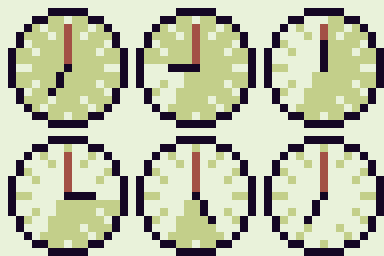
I wanted to try out a UI idea for practice. I thought maybe the clock could pull double duty to communicate both current time and how long until closing time. Attached a GIF of a mockup. I think functionally it works pretty well, but I don't have an artist's touch for pixel art, and the colors of the UI are already so subtle and well done. 


Right now the game is in an interesting emergent state where the random chemistry creates some fun and unexpected sequences. I have some feedback brewing about balance and gameplay, but I haven't fully digested the Game Feel and Length post. So the following is just about 1.2.0 as it currently stands.

One thing I really enjoyed from my first playthrough was that I felt pressure to hawk stolen goods because of the financial pressure of coming up short. I did another playthrough this morning and once you understand the system it's too easy to keep your nose clean. Maybe something that messes with / threatens your inventory, like nighttime burglary, requiring management of shop security or something, which could add a meaningful choice for the player, like pay for peace of mind, or take the risk because money is that tight. Some of the game jam incrementals I've played lately have started to really make me appreciate upgrades, and similarly from roguelites where they can have cost/benefit balances, I could see something here like pay to install bars on the windows to prevent smash and grabs, but it hugely debuffs hype. Start/End of day provide good slots for choices like this, like before opening you can decide on Flash Sale, Accepting Junk, and at closing time, informed by rumors you heard during the day, you can decide on security measures.

I came across the damaged mechanic today also, which is pretty cool, the idea being not to overhandle the merchandise? Until now, I hadn't been doing a lot of window shuffling, which is now incentivized by the immediate feedback you see as you re-arrange the display. Very good.

Additional agency is always a good idea, and I was thinking maybe some kinds of wildcard events could be cool. Maybe interference from the family, who provide the motivating scenario of the core premise, but it might be fun to have their presence and malevolence felt during the week. Maybe they need to "borrow" a valuable piece of displayed inventory. Or maybe as part of a burglary system, you can pay them per night of security.

I finally got back around to playing this since GBJAM. I started here, which included seeing all the 1.1 updates for the first time. Lot of visual, audio, UI polish added and it's really very nice and you know how much I like the detail work. But once hot goods started showing up at the shop, it finally hit me: the real game is here, at last. 

I took a lot of risks my first playthrough, too many, but I got to see the various events that play out whenever you cross that line. I ended up a couple hundred short, but during the whole game over sequence I had a big grin on my face.

Second playthrough, I took fewer risks, got rid of questionable merchandise quickly, and on the last day, after I'd secured my lease on life, I refused to buy anything, sitting in an empty shop. I was wondering how the game might incentivize continuing to play after you hit $1500, then saw that it does actually come out of the money in your possession and whatever's left is a high score of sorts. Given the sorta arcade vibe of the game, that seems alright. It's not like losing is a big deal, but I can't help but wonder is there a better way to incentivize taking risks on day 5?

I was so into the game, I found myself nodding along to the music for a couple minutes before realizing that these were new tracks. Sometimes I'm kind of dense but my body knows when good tunes are in the air. Did day 5 get its own track? Felt appropriately anxious for the looming deadline.

I wanted to catch up here first before reading the next devlog, which I see is going to concern a lot of broader design decisions, so I guess the point of my post is how much fun I had with this!

When I was a kid, my baseball coaches found I batted better when I didn't wear my glasses. Sometimes you just gotta vibe.

I think your process is really good at cultivating emergent gameplay. That is the coolest thing, to just set up simple intersections of conditions and something unique and dynamic emerges from it.

(1 edit)

Hey I don't know, you just might beat Barrie if I can keep persuading you

(also the skill ceiling in this game is absurd)

I love trying out PICO-8 games, they have such a charm.

I love exploring maps in games, and Cold Night creates a good additional incentive to check out every corner. 

I got to 19 remaining, missing a key somewhere I think. I'm going to come back and finish the game after sleep.

I'm not very good at dodging ghosts. But if the only penalty is you lose some leaves and thus lose time, that's not too bad, I seemed to have pretty abundant time. Probably would benefit from balancing both.

Wish I had come across this during the rating period. I saw you didn't feel so warmly towards this game but there's something pretty good here. Looking forward to your next work!

(3 edits)

I'm going to do my best to give this a fair, hopefully encouraging review but my main goal here is to offer honest and constructive feedback now that you're getting back into jamming, because I think you have what it takes to succeed. It looks like this was your first game ever, and it's actually a strong effort for that. I'll explain (to my understanding) what worked, what didn't, and why you probably picked the wrong game jam to start with.

As far as snake-with-a-twist games go, this one has a pretty interesting mechanic, and fun to discover after being hinted at that it wouldn't be normal snake. Playing it the intended way, I started to see the value of using oranges to slow down. Think my high score was 8.

Now as you know, I found a very fun way to play by only collecting oranges. Sometimes QA testers will find stuff that is "wtf ... actually wait, could be a cool mechanic". The game needs more mechanics, like how the the orange has tactical value to help you control the speed. Another fruit type that causes you to go backwards could be interesting. Not as a punishment, like you go backwards but rewards skilled movement by removing projectiles from the board when you collide with them. (Not saying that's a particularly good idea, but it offers balance, relief, and raises the skill ceiling a bit).

Here is a snake game from the recent GBJAM 14, there are several good examples of twist mechanics. https://retromoddogg.itch.io/kotachomp

This is also a good one to study because the runtime of the game is much longer than a typical Serpent Zero playthrough. The difficulty curve ramps up more gently, giving the player time to get into a flow state, get comfortable with the mechanics. Serpent Zero does not give much time to the player to git gud, and requires very, very tight reflexes without any chance to recover. Which, there are definitely players who crave that level of difficulty, but ask yourself if your current audience is made up of those kinds of players. Unless it's the snake world championships, probably not.

I think in most jams, people are only gonna give your game 5-10 minutes and they might walk away discouraged from being punished over and over. As a game designer, it's up to you to anticipate how the player is going to engage with your game in the few minutes you have their attention. Ask yourself: what must they experience to walk away happy, or become interested enough in your game to keep playing? When YOU play a jam game, what makes YOU feel satisfied or want to keep playing?

For me and a game like this, within 5-10 minutes, I want to feel like I've started to grasp a new mechanic, and see my improvement reflected back to me in gameplay. And to feel like with just a little more practice, that each time I play, I could survive another 30 seconds. I want to feel like mastery isn't impossible.

I think that covers the important game design stuff. One important UI/UX issue I had was to restart, I had to use the mouse, when gameplay was all arrow keys, and because I use my right hand for both, it became very tedious to go back and forth. Easy solution: provide a restart on the keyboard.

So, about the game jam you submitted this game to. It looks like a publisher-seeking-developer and vice versa jam with the goal of a commercial release. That means there are real stakes, and people are going to be especially competitive. Compare that to the Mini Jam and its community, where it's much more casual, and people are there to improve themselves, help others, exchange ideas, and so on. I think Mini Jam will be perfect for you to hop back in, and it's very cool you're trying out a team with a few others. Now your challenge will be to define the project scope (do not underestimate how important this is) and coordinate well with each other. Stay active in the Discord, there's a lot of people with experience who can help guide your team.

Conclusion: your first game is a solid effort, and its strengths/weaknesses offer good insight into game design and player psychology. I'm looking forward to seeing what you come up with next!

Sorry Toby, I saw this and felt a little competitive <3

Unhinged lmao. I haven't won yet but I'm getting a little further each attempt. Having to pull the lever with the mouse is a small mechanic that punches above its weight in creating immersion.

The combos did a pretty good job at making the simple loop more interesting. I see your comment about how you did the 3D-looking effect, it was very pleasant to look at and a clever technical trick :)

(3 edits)

This is an interesting study for getting players into flow state. Really fun remix of arcade shmup. I submitted a rating in case I'm not back before the deadline, but I'll leave some feedback later when I'm free.

Okay I've had some time to sleep on it, and climb the leaderboard muahaha. It is a difficult game, but there is a VERY high skill ceiling, and each time I play I get a little better. Toby and I are leapfrogging each other on our way to your high score ... better watch out!

TouchStar got me thinking about flow a lot this jam. My working theory has been that the game designer can facilitate the flow state experience by requiring the player to process information at a faster rate than they can consciously manage, and thus must delegate some information to subconscious processing. I think that's how this game does it too. I've really gotta put the theory to the test in my next arcade or physics game.

Congratulations on the strong placement in the jam ratings, you absolutely earned it!!

Clickers aren't really my thing but I put myself into the shoes of a clicker fan, to try and evaluate fairly. I'm starting to warm up to incrementals in general, they provide pretty good insight into progression curves,  rewards and incentives. In that regard, Fireing Fox did a pretty good job keeping me wanting to get the next upgrade, as well as reducing tedium by increasing the heat gained per click.

Art is very cute, and seeing the upgrades affect the scene was charming. I agree with others about wanting an ending, and I had the same idea that the fox might combust if overheated lol. Maybe a forbidden final upgrade.

It's raining and dreary where I am, and a warm cuppa sounds perfect. Thanks for playing!

(1 edit)

I really appreciate this detailed feedback! These game jams have been so, so valuable as learning opportunities.

I've started a utility library of reusable QoL features, and audio settings are a high priority. I learned its importance when playing an incremental game where I wanted to still hear SFX but turn off / adjust the music volume. Given the simple UI of this game, I'm considering that maybe a master volume slider could go into a collapsible control in the corner, and maybe individual audio bus volume available behind a pause menu.

Your praise for the cutscenes means a lot! Thank you. It was not my original plan for the game, but as I built the cutscene system, I discovered a pattern that gave me a LOT of control over scripted events, with highly expressive, concise, maintainable code. I think I might focus on cutscenes for a while, maybe release a plugin if it can be generalized enough. If you've seen Godot State Charts, that's a model I have in mind, where, yes, you could write your own state machine system, but it provides an opinionated but flexible way to get you working on your game and not writing boilerplate.

Admittedly, I'm not big on VN's myself, but it seems like this game been well-received by others with similar reservations about VN's. I featured a couple of my favorite things in video games: environmental scale and motion, which is maybe absent from VN's in general.

There are some genre conventions that I should implement, that would start to address your QoL wishlist, like pausing, saving progress, return to title, etc. I should roll this into the utility library.

Interactivity is an interesting design question. In my research into VN's, there doesn't seem to be a clear consensus, which is not to say that a game should try to be everything to everyone. Right now I'm considering the idea of optional interactivity, maybe sometimes just fun graphical "toys" in a scene. An example might be, drawing inspiriation from a game like Okami, when you click/touch the night sky it draws a shooting star.

Thank you again for the constructive feedback!

Fun interpretation of the limitation! Well, and also commentary that is quite relevant. Rage-bait and the incentive structure of social media can foster really unhealthy interpersonal dynamics, as well as social engineering for political purposes.

I'm struggling a bit with the first level, it can take me a little while to pick up new puzzle games. I'll pick it back up later and read the instructions more carefully and try it again.

The UI feels well-made, and the pixel art is really crisp and clean, with skilled use of a limited palette. I also really liked the highlights on the clash "bars". 

I've been seeing more and more examples of great looking Love2D games, I'm getting quite interested in trying it out.

Sorry to hear about the snack ban. But it is also very good to see people taking care of themselves. 💪

Ohh I see now! In 3D, I've seen the use of grayscale SDF masks to control highlights in a similar way, particularly on the modern toon-shaded anime styles.  In 2D, I've started to use black and white textures for alpha masks for particles and other mass instanced sprites, and randomize their color in the shader. 

It's so cool how normal mapping makes 2D art pop as if it was low-relief sculpture. Something I've been exploring is using software like Material Maker to generate diffuse, normal, and specular maps for use on things like walls, similar to this video. It's actually quite viable, but I'm not fluent in the node system yet.

re: film grain, I think it's OK if you like the way it looks stylistically. Some games offer an option to turn it on or off, for example Okami and Neva. I only notice because I've been studying dithering and how to use it to fix color banding, which I've had some problems with in gradients in Godot. Maybe Unity handles it better automatically?

Thanks for sharing these resources and your knowledge! 

(1 edit)

This is a pretty fun twist on Tetris. Once I understood how to play it became very engaging. But at first I did not understand how to move the axe to the sides, I kept trying to toggle it.

GBA looks like fun to develop for. Nice work.

Cute character, like the Ice Climbers but somehow cuter! Nice mood setting between the desolate music and wind VFX+SFX.

Solid interpretation of the limitation. I like the gameplay loop, but there are a couple small things that I'm not sure enhance it. One is getting snagged on colliders, I think from tree stumps after they got chopped. The other was I felt like sometimes the hypothermia telegraphing wasn't in sync with the player health, and I would instantly die after I'd been by the cart for a while, but it's possible I misunderstood.

Pretty cool that you got Unreal running in the browser. Nice job overall and it's always nice to see teamwork chemistry.

(1 edit)

This is interesting game design wise. It is a lot more stressful than I expected, almost like an RTS where you have to micro to stay competitive. Though from looking at the comments, a lot of people can relate it to their IRL circumstance!

Charming pixel art. Really like the leaf animations! It's also nice when you have static views of rooms and can do linear perspective with consistent patterns for diagonal lines.

I am very bad about reading instructions, so I didn't understand how to navigate between rooms. Since the use of mouse is already mandatory to open windows, clickable navigation between rooms could help communicate the idea to players with fewer written instructions, with the added bonus of making the game mobile friendly!

Lot of feedback on this page that I agree with and won't repeat, and I've seen lots of quality commentary from the Halfbar account around the other jam games. Good stuff!

The game is a really great example of minimalism done right, something that's taking me a long time to learn.

I've become really interested in technical art also, so there's a lot in here I'd love to pick your brain about. First thing I noticed were the smooth gradients and some kind of noise / film grain, is that for stylized debanding? I recently learned how to use interleaved gradient noise and blue noise for debanding.

Read your comment about the sharp shapes. The silhouettes and highlights are very crisp and readable. I've been learning vector art to help me compose readable silhouettes out of simple shapes, and then some stylized lighting would be really cool to learn next. Curious what your process was here.

Anyway, I got through the first wave without missing any parries! Felt so cool. I couldn't keep up that performance and failed on the next wave, but I'll definitely play again if just to marvel at the art.

I'm just learning today about Needy Streamer Overload, and DDLC is on my list, can't wait to try them. Psychological horror is so fascinating, it's so effective at examining the dark corners of our humanity.

it's balancing things that would seem simple on the surface, but the struggles are real. and it's okay to not be the best at life at times

A perfect takeaway. 

(2 edits)

Let me get a couple constructive things out of the way first, so I can yap about everything I liked. The game is almost perfect to me, just a couple spots to polish.

Couple of the cards have contrast issues: Evening, Sunshine +Stress and Sunset -Energy

I played a couple rounds on my phone, this game is particularly a good fit for mobile. I'm not sure if I'm imagining it, but it felt like putting the flames to rest was much harder with touch compared to mouse. My guess is maybe Godot Hi-DPI settings make the touch point smaller than a mouse cursor at 1080p.

Okay now that that's out of the way ....

I should know better by now but, the initial gameplay and the lofi beats to study to made me immediately forget the content warning. The first time I got one of *those* cards, I was like WHAT DO YOU MEAN ... oh right. Making a wild guess that Omori might be a source of inspiration here for visceral storytelling through UI.

Morbid curiosity is one of those things where video games are the perfect medium to explore. Maybe an overused example but Undertale/Deltarune exploit this curiosity very well, and I got similar feelings here like when my stress meter was almost full, but energy is low. How bad could a quick GG EZ really be?

Point being, I think it's smart not to tutorialize too much about the stats/resources, beyond whatever the player might need to get started. There should already be an implied understanding that too much or too little will lead to consequences. The UI provided several good hints when this was happening, like music cutting out, or how the colors desaturated when warmth got low. Best to let the player put the pieces together in their head, and I think it worked well here.

The most interesting experiences this game provides are not the result of skilled gameplay or informed resource management, though you can certainly try (and is more or less required for two of the endings)(edit: I agreed with most of Halfbar's critiques except this one). While I was working on the < 50 warmth ending, I had to make some ... *creative* ... decisions to make it through the year, including strategic overd "self care". It's a little tonally dissonant, but kinda funny too.

But really, I don't believe that, as an art piece, this is a game that you're supposed to "win". The final interpretation kind of does belong to the player, but it's clear that you as the creator are trying to communicate to the audience how difficult it can be sometimes to just make it through a year. To me, it's extremely relatable, and people who can relate to this can really benefit from reminders they're not alone in feeling that way.

No worries! I liked the color palette in the cover art and the other comments on the game intrigued me. 

Ice sliding is a solid risk/reward idea, like if you could also slide off yourself. Thematically, I also like the use of environment and terrain for dynamic physics, because of their neutrality. Really interesting stuff to think about.

(4 edits)

I'm with you 100% on the melody staying while the chord changes. Sometimes it's like a tether that ironically gives you more freedom to make bold moves with your chord progression, or make a safer/conventional one feel more earned.

re: Musescore, there's a weird bending-related issue in the solo strings where they just slur together adjacent notes of a scale, just by default without any articulation markers. For the most part though, I was happy with the default articulations, and really didn't want to spend time drawing in lots of details.

But I guess a problem with this approach is how much it can influence the composition. I feel like now I'm seeing it in some of my favorite video game scores, that even if they ultimately recorded with actual performers, some creative decisions were made because of the software ergonomics.

The dynamics really cannot be controlled with precision, but you can kinda dress it up by leaving a lot of headroom in the Musescore mix, export audio and then squash it with a compressor.

Thanks for dropping this feedback! I'm really happy you noticed all the portamentos I peppered all over the piece 🥲

Pretty much agree with all the comments. Janky AND fun. You love to see it.

Something new I can add is about music. I didn't grow up with Sega but the soundtrack really makes me think Sega, like something I'd hear in Outrun. I especially loved the first track, so many sick basslines and chord modulations. I bookmarked this game just to hear it again.

Any chance you have a web or linux build? First game I haven't been able to run through Proton.

The polish of this game really stands out. Sounds like even though there was still crunch, it feels like every aspect of the game got enough attention. Good job to the whole team! Imagine what you could make if you had a whole week.

(2 edits)

Reminded me of playing scoutzknivez back in the day, trying airborne trick shots. Saw Clustertruck was an inspiration but I've not played it. 

My only issue is that Unreal is total overkill for this game. I'm on an old computer with a GTX 1060 running Windows games through Proton. (edit: it's probably not Unreal itself, but some kind of default settings that target newer hardware)

Nice work putting it together along with assets in 3 days. I got to the end but definitely not with any competitive times 😂

To be honest, I massively overscoped, and on Sunday switched genre to VN to salvage the work I did already. Absolute Hail Mary. But I'm really happy that you vibed with it. 

I have similar reservations about VN's, but recently I watched a video comparing VN's and cutscenes, and the core loop of a VN (click-to-advance) is surprisingly engaging. I think if you took the best of both ideas, it could make a pretty enjoyable experience.

I've been thinking a lot about player engagement, agency, immersion, and so I'm pretty interested in your use of self-determination and flow theories. I'll try to evaluate how I experienced them in your game.

Self-determination: as soon as you step away from the fire, you alone are responsible for take each next step, or to make a decision to retreat. That's really a solid move, to establish self-determination immediately when starting the game. While I was playing, I thought would it be fun if you could somehow lead the skeletons into traps? It seemed like they might de-aggro if you get far enough away or lose LOS. Presenting additional possibilities to the player could be interesting, in a way that doesn't diminish the protagonist's vulnerability, which I felt is important to the design.

Flow: I experienced this when simultaneously trying to progress while dodging skeletons. Another recent time I experienced it was in a precision platformer where I thought it was required to chain running jumps. Seems like as a game designer, you can set up this experience by requiring the player to process information at a faster rate than they can actively handle, so some of it has to be delegated to subconscious processes.

Anyway, I had fun with it. The light running out while you're being pursued and trying to find a campfire is genuinely terrifying!

The poor tutorial beaver 😂

Good bite-sized jam game with just enough progression.

I actually enjoy the billboard assets, the rocks remind me of Okami's. Also seems like a smart way to prototype quickly in 3D. 

I enjoy the nods to the retro FPS style. Have you ever tried Trenchbroom? It's a tool for making Quake style maps, including stuff like the Valve 220 format. You can import these to a modern game engine with the help of some middleware/baking tools.

This art reminded me of the protagonist from a B1t jam game https://hardlysapient.itch.io/daisylife

Delightful puzzle platformer! Painting is a lot of fun, and it's helped by the gorgeous art direction. 

Lots of cool technical art on display too. I saw you generated all the graphics in code. Are you using SDF's for shapes?

I also used desaturation as a lever to control warmth, but sometimes crank up the blue channel to emphasize cold. 

If you're interested, there's a very interesting video about color temperature from YouTuber "Lighting Mentor", it's living rent free in my mind since I first saw it this summer.

Gotta admit it's refreshing to look at high res antialiased stuff after so much pixel art.

The pathfinding collision bonk made me laugh.

Screen transitions were creative. Lot of polish in the UI.

Only issue I had was the pulsing color/intensity hover indicator is a little strong for my eyes, mostly on the fireplace's lighter value color and how much screen space it has, compared to like the key.

I started playing Sam & Max Hit the Road recently, and back then they used a different mouse cursor texture to indicate hovering over interactable, but you have to right click to switch "mouse interact modes" like look at, talk to, grab, etc. These old adventure games made some *interesting* UI/UX choices... But sometimes I wonder if it's all too homogeneous now.

Well, you made a very clean foundation for a point-n-click adventure game in two days, and most of your own assets to boot. Another solid K-Embee jam game.

This stuck a balance where exploration and fuel actually worked well, the tiny bit of pressure of fuel management made exploration feel more valuable, in a surprisingly good way.

Warmth was absolutely conveyed, not just in mechanics and art themes but in the vibe and purpose of the game.

About the font issue: my guess is the itch.io embedded viewport dimensions is set to its default 640x360 instead of a multiple of what you designed for in-editor, and Godot project stretch mode is fractional. Man I'm about ready to swear off pixel fonts, outside of retro projects.